Meet

Neura HQ,
Your connected AI Agent Workforce Know more



TL/DR:
“AI agents will become our digital assistants, helping us navigate the complexities of the modern world. They will make our lives easier and more efficient.” ~Jeff Bezos, Founder of Amazon.
With the evolution of artificial intelligence, companies have spent the last few years obsessed with the "super bot." They’ve been trying to build a single, monolithic AI agent and asking it to do absolutely everything. The expectation is that this one digital entity will answer complex customer support tickets, analyze gigabytes of sales data, draft witty marketing emails, and manage inventory without breaking a sweat.
The result? It usually drops the ball.
So, it’s time to switch the strategy. The most forward-thinking businesses are no longer hiring a single AI employee; they are deploying an agent workforce. Also known as Multi-Agent Systems (MAS), this approach swaps out the jack-of-all-trades bot for a synchronized team of specialized AI experts.
Here is why putting all your bots in one basket is a bad idea and why a multi-agent workforce is the future of business operations.
A standard, single AI agent is like a Swiss Army knife. It is incredibly convenient. But try using a Swiss Army knife to cook a three-course meal. Technically, you have a blade, a can opener, and a tiny pair of scissors. Practically, you're going to make a mess.
That's precisely what happens when businesses lean on a single AI agent for complex, multi-step operations. The tool exists. The capability is there. But the architecture simply isn't built for the load.
Single agents operate sequentially. They take on one task, process it, and move to the next. This sounds perfectly reasonable until your business needs ten things done at once. When a customer submits a return request that simultaneously requires a support response, a logistics update, an inventory adjustment, and a personalized retention offer, a solo agent has to queue all of that up and work through it one step at a time. By the time it's done, the customer has already left a one-star review and moved on to a competitor.
There's also the ceiling problem. A single agent is only as good as what it was trained to do. Push it into a domain it wasn't optimized for, and quality degrades fast. Ask a support-trained agent to generate strategic marketing copy, and you'll get something technically coherent but creatively forgettable. These models don't naturally cross-pollinate expertise the way specialized teams do.
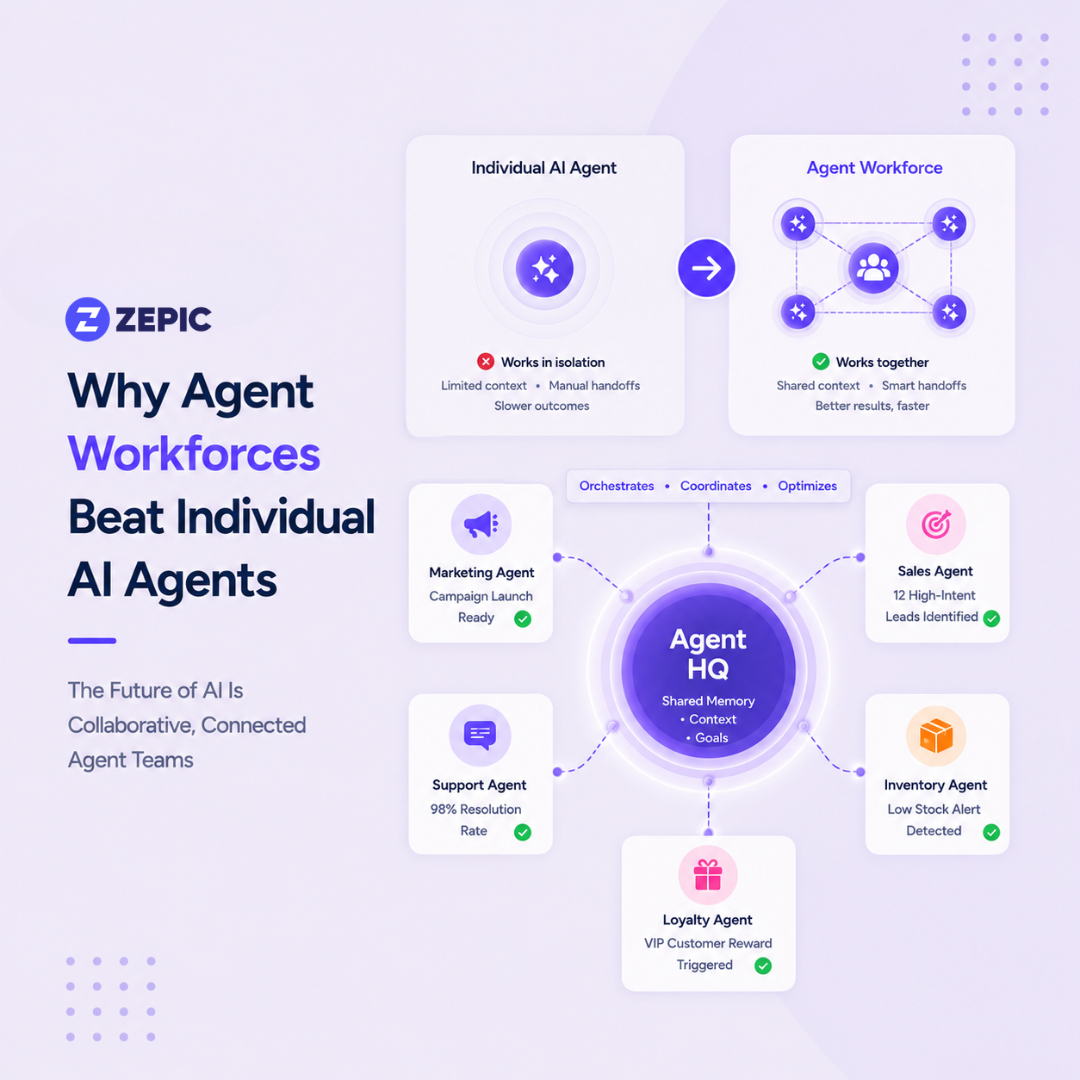
By the end of 2026, experts project that nearly 40% of enterprise applications will feature task-specific AI agents. The agent workforce model doesn't try to squeeze all intelligence into one container. Instead, it distributes responsibility across a coordinated team of purpose-built agents, each operating as a deep expert in its domain.
In a Multi-Agent System (MAS), you deploy an Orchestrator Agent that acts as the manager. When a complex query comes in, the Orchestrator doesn't try to solve it. Instead, it breaks the problem down into micro-tasks and delegates them to a network of specialized worker agents.
Let’s say a VIP customer emails your e-commerce brand to complain about a defective smartwatch and attaches a photo of a shattered screen. Here is how a digital workforce handles it:
The Support Agent takes all this localized data and drafts a highly personalized apology, offering an immediate, free replacement. This entire symphony of delegation, analysis, and resolution happens in about three seconds.
An agent workforce fundamentally changes the architecture of your automation.
Why is an interconnected team of specialized bots superior? The benefits compound rapidly as your business scales, addressing the exact pain points that make solo agents fail.
Because each agent in a workforce operates independently, multiple tasks can run simultaneously. While the Support Agent is drafting a response, the Vision Agent is analyzing the photo, the Inventory Agent is checking stock levels, and the Finance Agent is reviewing customer LTV. None of them are waiting on each other. The result is resolution at a speed that a sequential system simply cannot match, no matter how powerful the underlying model is.
For businesses operating at scale, this matters enormously. Think about what happens on a high-traffic sales day. Thousands of customer interactions, return requests, inventory checks, and campaign triggers are firing at the same time. A single agent queues all of that up and works through it linearly. An agent workforce handles it all in parallel
Statistics show that specialized AI models achieve up to 90% in accuracy for domain-specific tasks. An agent trained exclusively on logistics routing will always beat a generalist language model at calculating the fastest delivery path. A workforce model lets you deploy best-in-class expertise for every single function of your business, rather than settling for "good enough."
One of the most fascinating capabilities of a multi-agent workforce is internal collaboration and oversight. You can program one agent to be the "Creator" and another to be the "Critic."
Before a promotional SMS is sent to your VIP list, the Creator agent drafts it. The Critic agent will be strictly prompted to look for legal compliance, brand voice consistency, and hallucinated discount codes and review the draft. If the agent finds an error, it kicks it back to the Creator for a rewrite. This rigorous, microsecond internal dialogue ensures the final output is flawlessly accurate. You cure artificial incompetence with artificial collaboration.
If your single AI agent crashes or gets confused by a software update, your entire automated operation grinds to a halt. In an agent workforce, the system is modular.
If your Marketing Agent needs to be taken offline for retuning, your Support Agent keeps humming along perfectly. Furthermore, if you want to expand your business into a new territory, you don't need to rebuild your entire AI architecture; you simply hire a new "Translation Agent" and plug it into the network. It’s an infinitely scalable, highly resilient digital infrastructure.
“You can define agentic AI with one word: proactiveness.” – Enver Cetin, AI expert at Ciklum
Here's the part of the agent workforce conversation that tends to get buried under the excitement of the technology itself: governance.
Deploying multiple agents across business-critical functions means multiple agents making decisions that affect your customers, your finances, and your brand. That level of autonomy demands oversight; not as a constraint on what AI can do, but as the framework that makes scaling it safely possible.
Effective agent governance means defining clear boundaries for autonomous decision-making versus human escalation. It means audit trails that can show, in plain terms, what each agent did, why they did it, and what data informed that decision. It means monitoring systems that can catch drift before it compounds into a customer-facing problem.
The businesses that stumble with agent workforces are almost always the ones that treated governance as a Phase 2 consideration. By the time they circle back to it, the system has already developed habits, inconsistencies, and hidden failure modes that are expensive to unwind. Build the guardrails before you open the highway.
The shift from individual agents to agent workforces is, at its core, a shift in how businesses think about AI. The question stops being "how do we build a smarter bot?" and starts being "how do we build a smarter system?"
The most forward-thinking enterprises have already made this shift. They're not asking their AI to be the best all-rounder in the room. They're building coordinated, specialized teams with clear roles, shared context, and distributed accountability. The single-agent era is over. The agent workforce era is here. The only question left is how quickly your business is going to make the transition.
At ZEPIC, we've been thinking about this problem, and the answer we've built is Neura HQ. Neura HQ is a connected AI agent workforce platform designed to close the gaps that individual agents can't bridge on their own. Instead of deploying isolated bots and hoping they figure it out, Neura HQ gives your agents a shared brain. It combines unified data, coordinated decision-making, and the orchestration layer that turns a collection of tools into a genuine workforce.
If you're ready to move beyond the single-agent ceiling and see what a truly connected agent workforce looks like in practice, book a demo with the ZEPIC team, and let's build it together.

%201.png)


.png)