Meet

Neura HQ,
Your connected AI Agent Workforce Know more



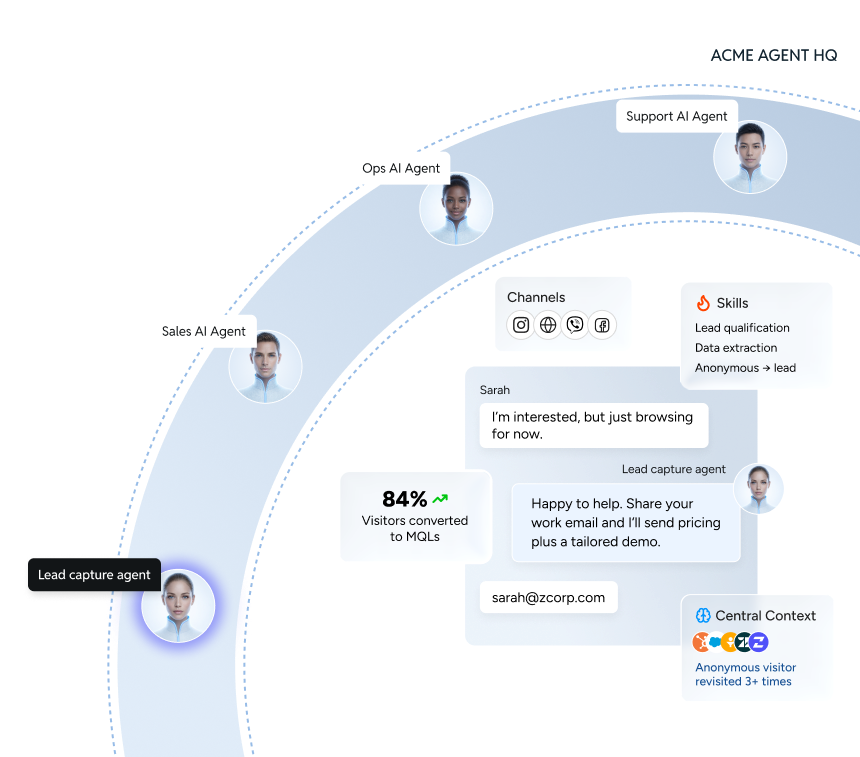
Every enterprise is sitting on more context than it knows what to do with.
Think about everything that happens in a single day across your business. A customer calls support with a billing question. A sales rep closes a renewal with a different contact at the same account. A product signal fires indicating a key user hasn't logged in for three weeks. A partner sends a message asking about a co-sell opportunity. An employee submits a request that touches three different teams before it gets resolved.
Each one of these interactions generates context, history, some kind of a signal. A data point that, if connected to everything else happening in your business, would tell you exactly what to do next.
But here is the uncomfortable truth. Most of that context never makes it to the moment it matters most. Not because your teams don't care. Not because your systems aren't capturing it. But because the gap between knowing and doing, between having the context and acting on it at the right time, in the right conversation, with the right outcome in mind is wider than any team can bridge on their own.
This is the problem ZEPIC was built to solve.
When we started ZEPIC, we had one foundational belief: that the most valuable thing you could give any business team was a complete, real-time picture of everything happening around them. Not a dashboard. Not a report. A living, always-current context layer. One that connected every signal, every touchpoint, every customer interaction, and every system into a single, coherent view of the business.
We built ZEPIC as a platform, not a point solution. That was a deliberate choice. We didn't want to solve the context problem for marketing and leave sales behind, or fix it for customer success while ops remained blind. We built it to serve any team, any function, any workflow, customisable by design, so every part of the business could run on the same foundation of shared, real-time intelligence.
And it worked.
Customers began connecting their systems, capturing signals they had never been able to act on before, and building an understanding of their business that changed how their teams operated. Revenue signals that used to disappear into the noise became visible. Customer moments that used to pass unnoticed became opportunities. The context layer became the most valuable asset in the business.
But the more it worked, the more clearly something else came into focus.
There is a ceiling to what context alone can do.
Knowing that a customer's renewal is in 30 days, that they raised a support ticket last week, that their product usage has climbed every month for the past quarter, and that a competitor recently approached their procurement team — all of that is enormously valuable. But value doesn't compound until someone, or something, acts on it.
The opportunity that ZEPIC revealed was not a gap in our platform. It was an opportunity in the market. Every enterprise we worked with had unlocked more context than their teams could act on at the speed and scale the data demanded. Real-time signals were surfacing faster than any human team could respond to. Opportunities were sitting on the table not because nobody cared, but because the bandwidth to pursue every one of them simultaneously simply did not exist.
Context, at that scale, deserves more than a team acting on it. It deserves an intelligence layer built on top of it — one that operates at the speed of the data, across every function, every conversation, and every outcome that matters.
That is the opportunity we decided to build toward. And that is what Neura is.
Before we talk about what Neura does, it is worth being honest about why the existing AI agent landscape falls short for enterprises.
The promise of AI agents is simple and compelling: deploy intelligent software that can take actions, make decisions, and drive outcomes without constant human oversight. For enterprises, this is particularly attractive. The volume of work, the complexity of operations, and the number of touchpoints across customers, partners, and employees creates an almost unlimited surface area for automation and intelligent action.
But the reality of how most AI agents are deployed today creates a new set of problems as fast as it solves old ones.
Most AI agents are built in isolation. A support agent handles tickets. A sales agent surfaces leads. A marketing agent personalises campaigns. Each one is trained, configured, and deployed to do a specific job — and each one does that job without any meaningful awareness of what every other agent, or every other team, knows.
The support agent that closes a ticket has no idea the renewal is in two weeks. The sales agent that reaches out to a prospect doesn't know that the same prospect complained to customer success six days ago. The marketing agent that sends a re-engagement campaign doesn't know that the account has already been flagged as at-risk by the success team.
Agents multiply, and so do the silos.
This is not a problem of model capability. The underlying AI is, in many cases, genuinely impressive. The problem is architectural. When agents don't share context, don't carry memory across interactions, and don't operate as a connected team with a unified view of the business, they replicate the same fragmentation problem that every enterprise has been trying to solve for decades — just faster, and at greater scale.
Adding more isolated agents does not solve context collapse. It accelerates it.
Neura is the answer to a question that the enterprise AI market hasn't properly asked yet: what would it look like if every AI agent in your organisation operated with the full context of your business behind it, worked as part of a connected team, and was deployed in a way that gave your organisation complete control over where your data lives and which models it runs on?
Neura is the first Agent HQ built to close AI gaps in enterprises. It is not a single agent. It is not a chatbot. It is not a thin wrapper around a large language model. And it is not an agent studio that you figure out alone.
Neura is a system. We architect it, deploy it, and operate it inside your infrastructure — tuned to your data, grounded in your context, built around your outcomes. The difference between a studio and a system is simple. A studio gives you tools. A system gives you results.
Here is what that means in practice.
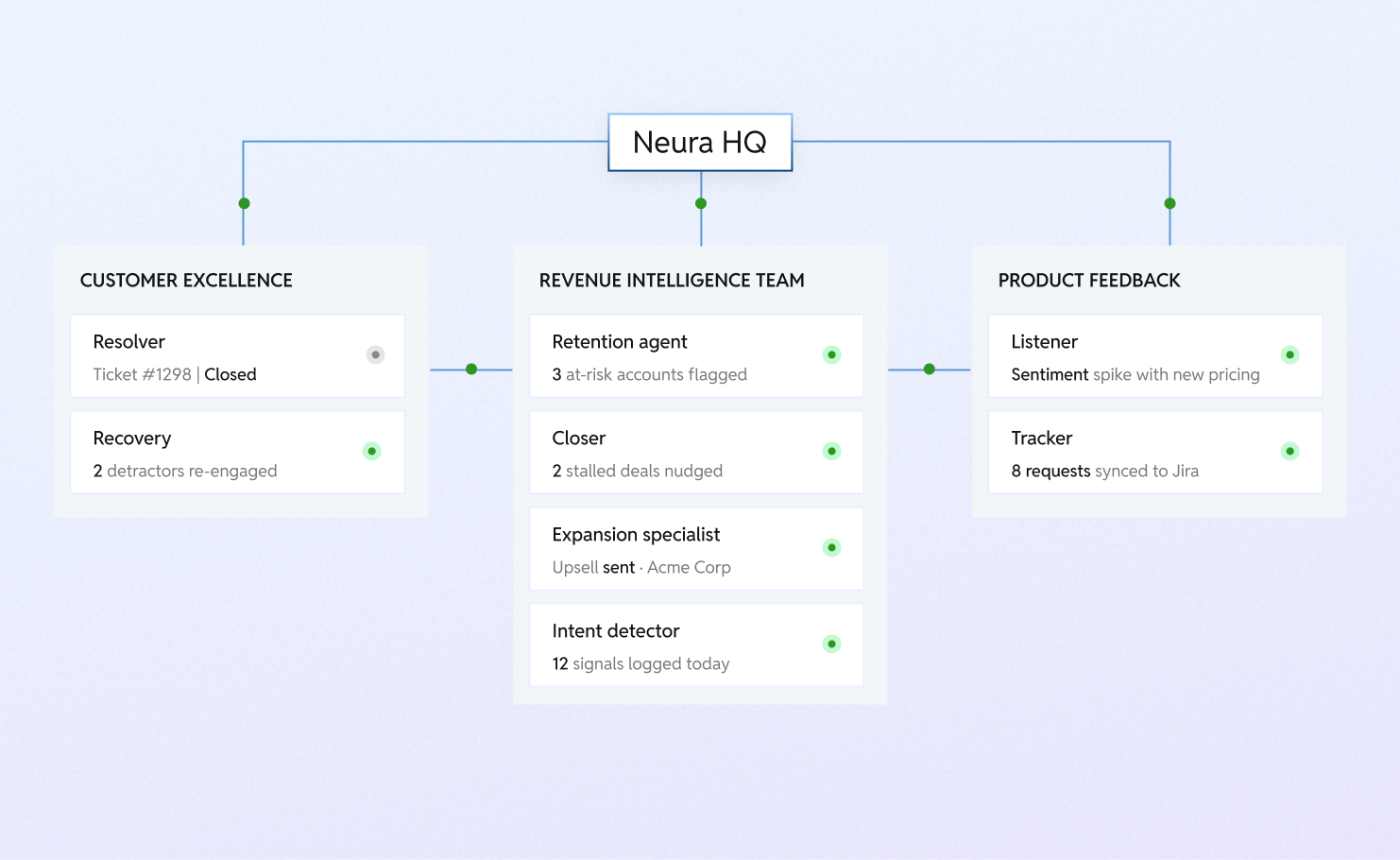
The fundamental unit of Neura is not the individual agent. It is the team.
Inside Neura HQ, you build your agent workforce the same way you would build any high-performing team inside your business. You define the functions you need to cover — customer success, sales support, partner coordination, internal ops, employee experience, whatever the shape of your enterprise demands. You assemble agents around those functions. And those agents operate not as isolated tools executing discrete tasks, but as a connected workforce that shares memory, passes context seamlessly between interactions, and drives outcomes collectively.
When one agent interacts with a customer, every subsequent agent that touches that account starts from a complete picture. When a handoff happens from one agent to another, from an agent to a human, or from a human back to an agent, nothing is lost. The thread is never dropped. The context compounds across every interaction rather than fragmenting with each new touchpoint.
This is what inbuilt orchestration means in practice. Not a routing layer that decides which tool handles which query. A genuine coordination architecture that lets your agent organisation function like your best team — aware of everything, connected to everyone, and always moving toward the outcome.
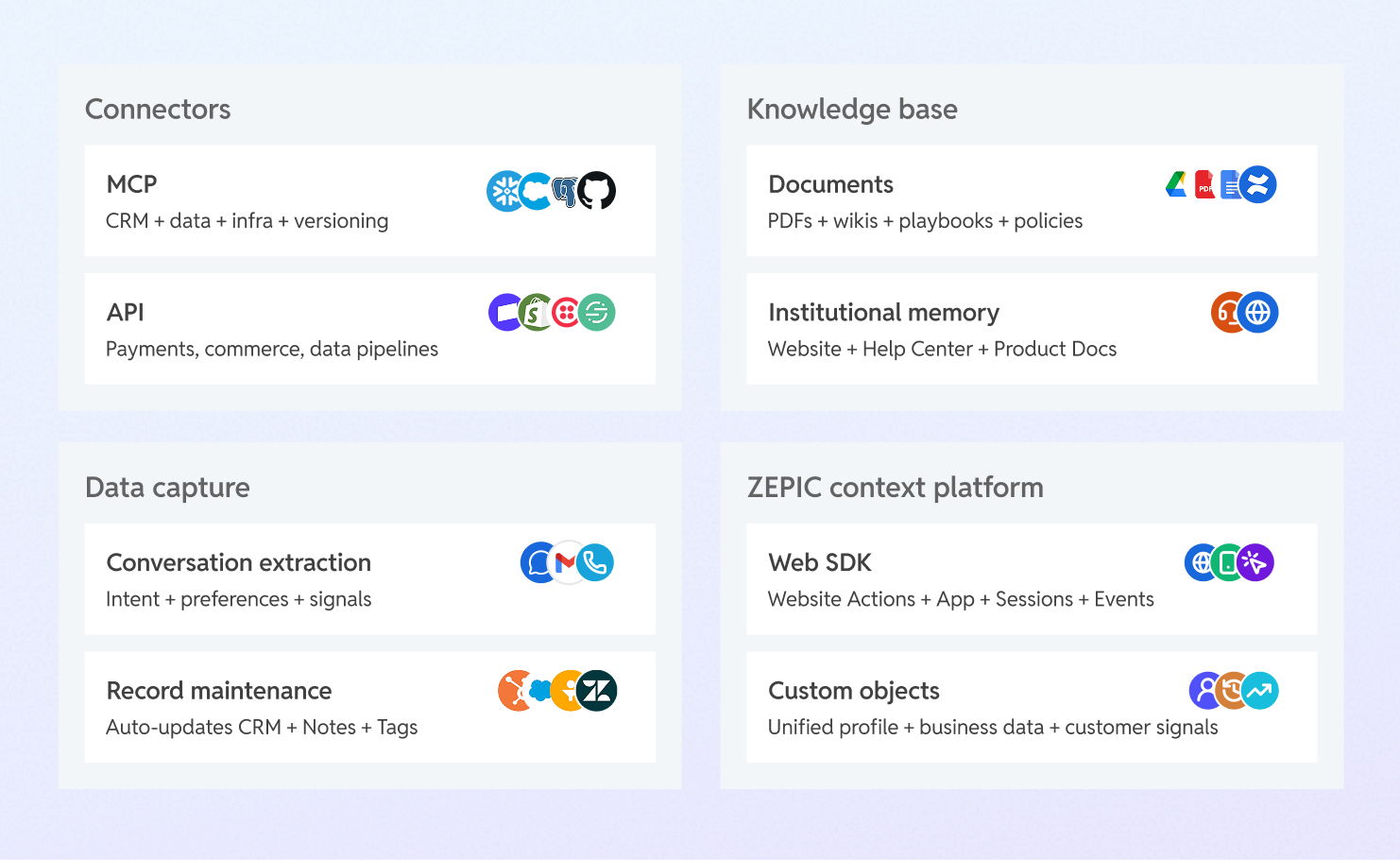
Every agent in Neura runs on ZEPIC's living context layer.
This is not a static data connection or a nightly sync from your CRM. It is a real-time, always-current picture of your entire business — every customer signal, every touchpoint, every interaction, every milestone across every system you have connected to ZEPIC.
What this means for your agents is that every conversation, every decision, and every action they take is informed by the most complete and current view of your business available. An agent handling a support interaction knows the renewal timeline, the product usage trend, the last five touchpoints across every channel, and the sentiment signal from the most recent conversation — before it says a single word.
Context this rich, delivered in real time, changes what agents can do. It shifts the bar from task completion to genuine outcome ownership. An agent that knows your business the way your best people do can do what your best people do — connect dots, anticipate needs, close risks, and open opportunities in a single interaction.
One of the most important things we decided when building Neura was that it could not impose a fixed architecture on the enterprises that use it. Every enterprise has a different starting point, a different level of AI maturity, different security requirements, and a different vision for what they want their agent organisation to eventually look like.
Neura is built to meet you exactly where you are — and scale with you from there.
If you want to start with a single agent augmenting one specific team, you can do that. If you want to build a fully autonomous agent workforce that operates end-to-end without human involvement, you can do that too. If you want humans in the loop at certain decision points like approving actions, reviewing outputs, handling escalations, Neura supports that natively. If you want some teams to be fully automated while others remain hybrid, that is possible within the same HQ.
The same flexibility applies to your infrastructure and model choices. Neura deploys inside your environment — your cloud, your servers, your Virtual Private Cloud. Your data does not leave your infrastructure. You choose which large language models power which agents, based on capability, cost, or compliance requirements. GPT, Claude, Gemini, open-source models — the choice is yours, and it can be different for different agents or different use cases within the same deployment.
Security is not a feature we added on top. It is the architecture.
Neura is built for enterprises that are serious about AI — not as a pilot, not as a proof of concept, but as a genuine operational layer that changes how the business runs.
It is for organisations that have already recognised that isolated AI tools are not delivering on the promise of enterprise AI, and that the problem is not the quality of the models but the absence of a connected, context-aware architecture underneath them.
It is for CIOs, CTOs, CXOs, AI officers, and operations leaders who need AI that works inside their infrastructure rather than around it, who cannot afford to hand their enterprise data to a third-party cloud, and who need deployment certainty rather than deployment complexity.
It is for customer-facing teams like marketing, sales, support, and onboarding that are watching revenue signals and customer moments pass through the gaps between their tools and their teams.
And it is for internal teams that are spending too much time on coordination, handoffs, and context-sharing that an intelligent agent organisation could handle automatically.
If your enterprise has ambitions for AI that your current setup cannot match, Neura is built for you.
The measure of an agent platform is not how many agents it can spin up. It is what those agents can actually do inside a real enterprise and whether they get better over time.
Neura agents are purpose-built for outcomes, not tasks. The distinction matters. A task-oriented agent executes an instruction and stops. An outcome-oriented agent understands the goal, takes the steps needed to reach it, adapts when circumstances change, and owns the result. Neura agents reason, decide, and act autonomously, without constant human oversight, while knowing exactly when to loop a human in and when to proceed on their own.
They are not general-purpose tools you configure once and forget. They are continuously learning from every interaction, every signal, and every piece of context that flows through the business. The longer they run, the more capable they become — compounding intelligence across every conversation rather than starting from scratch each time.
And they do all of this as a team. Not as isolated tools that happen to share a platform, but as a genuinely connected workforce, handing off seamlessly, sharing memory, coordinating across functions, and driving toward shared outcomes with the full context of your business behind every decision.
Inside Neura HQ, every agent organisation is built on six foundations
Brain: The context layer that powers everything. Connected to ZEPIC's real-time intelligence, the Brain gives every agent a living, always-current picture of your business — every customer, every signal, every interaction. This is what separates Neura from every other agent platform. Intelligence without context doesn't scale. The Brain is how Neura scales.
Knowledge Base :Every agent learns from what your business knows. Product documentation, process guides, historical interactions, domain expertise — the Knowledge Base is where your institutional intelligence lives, and what your agents draw on to make decisions that reflect your business, not just a generic model.
Skills: The capabilities your agents bring to every interaction. Skills define what an agent can do — how it communicates, how it reasons, how it handles specific scenarios. Purpose-built for your workflows, not borrowed from a generic library.
Forms: Structured data extraction, built into the agent workflow. When agents need to capture specific information — from customers, partners, or internal processes — Forms handle it cleanly, turning unstructured conversations into structured, actionable data.
Teams: The organisational layer of Neura HQ. You build your agent organisation the same way you build your human one — by function, by outcome, by business unit. Teams give your agents structure, shared context, and coordinated purpose. Different teams for different parts of your business, all operating inside the same HQ.
Actions: The tools your agents use to drive outcomes. Integrations with the systems your business runs on, so agents don't just know what to do — they can do it. From updating records to triggering workflows to communicating across channels, Actions are how intent becomes outcome.
We made a deliberate decision about how Neura goes to market, and it is worth being explicit about it.
Neura is not a self-serve product you configure yourself and figure out as you go, yet. We architect and deploy your complete agent organisation with you. That means we work alongside your team to understand your business, your context, your systems, and your goals and we build the agent HQ that matches your ambition, inside your infrastructure, on your terms.
The enterprises that come in now are not just customers. They are going to build with us, shaping what enterprise AI looks like in practice, informing what the platform becomes, and gaining a structural advantage in their markets that compounds as their agent organisation grows.
It is worth being clear about how ZEPIC and Neura relate to each other, because the relationship is not incidental. It is the reason Neura works where other agent platforms fall short.
ZEPIC is the context OS. It is the layer that connects your systems, captures your signals, and maintains the real-time picture of your business that every agent needs to operate at full capability. Without ZEPIC, agents are working blind. With ZEPIC, they are working with the most complete business intelligence available.
Neura is the agent HQ. It is where your agent organisation lives, operates, learns, and scales. It is where you build your teams, define your workflows, set your guardrails, and drive your outcomes.
Neura is powerful enough to stand on its own. Enterprises that are not on ZEPIC can deploy Neura independently, connecting their existing systems, closing their AI gaps, and building a connected agent workforce on top of whatever context infrastructure they already have. But for enterprises running on ZEPIC, the two platforms form a complete architecture — one where the intelligence layer and the action layer are built as a single system, not bolted together as an afterthought.
Neura amplifies ZEPIC. ZEPIC powers Neura.
We are at the beginning of a genuinely significant shift in how enterprises operate. The question is no longer whether AI will be part of enterprise operations, it is whether the AI architecture enterprises deploy will compound their advantage or compound their complexity.
Neura is our answer to that question.
One HQ. Unified AI workforce. Infinite outcomes.
If you are ready to transform your AI ambitions into a connected Agent Workforce, we would like to build it with you.

%201.png)


.png)