TLDR
- Enterprises are shifting from chat-based AI tools to autonomous AI agent platforms that can execute multi-step workflows independently.
- Choosing the wrong AI agent platform in 2026 can lead to multimillion-dollar project failures and long-term scalability issues.
- AI agents differ from assistants and copilots because they can plan, reason, integrate with systems, and take actions autonomously.
- Modern AI agent platforms require orchestration layers, memory systems, integrations, guardrails, and multi-agent coordination capabilities.
- Regulation, production-ready AI models, and economic pressure are accelerating enterprise AI agent adoption in 2026.
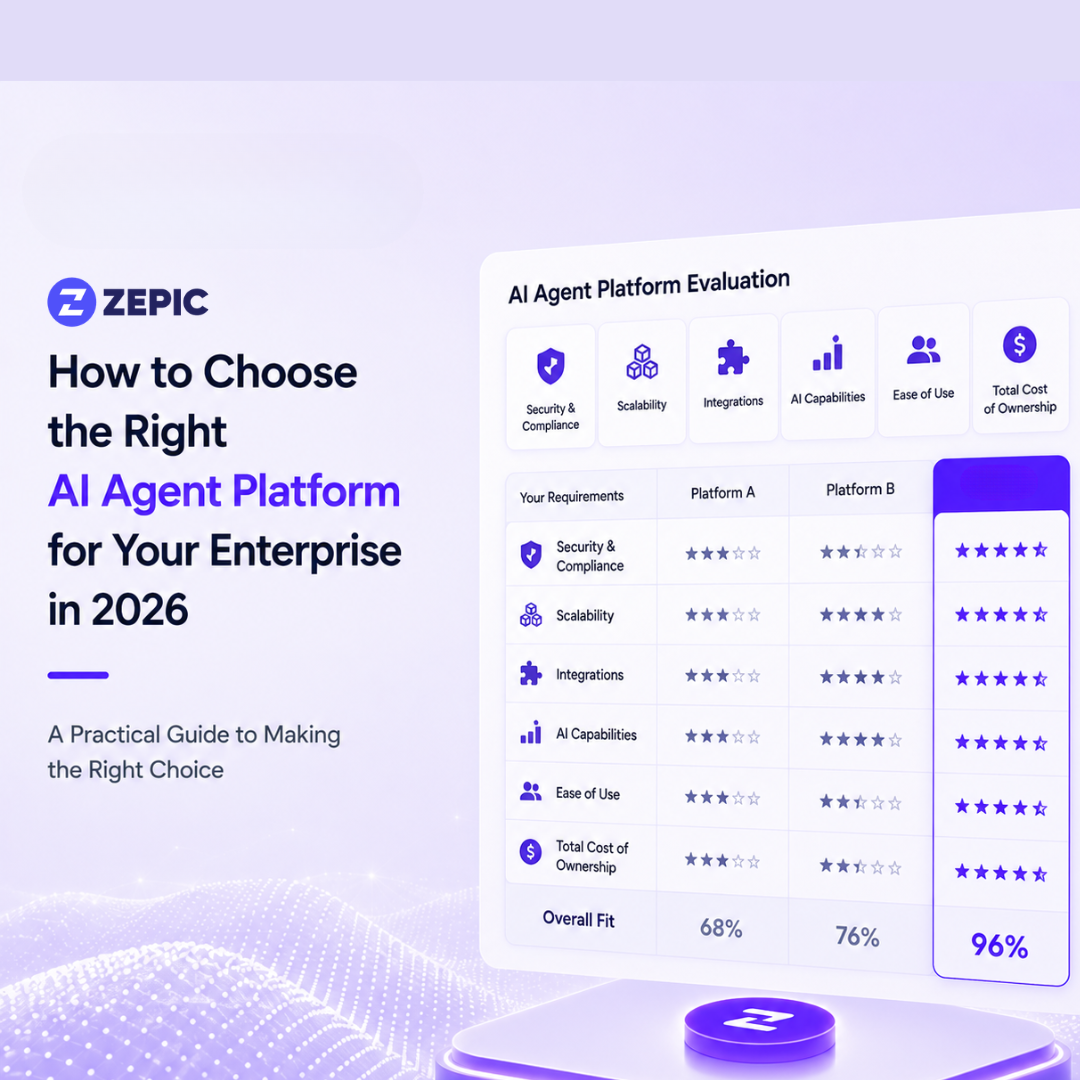
- Key evaluation criteria include model flexibility, multi-agent orchestration, memory architecture, security, scalability, observability, governance, and cost-per-task.
- The Model Context Protocol (MCP) has become the standard for connecting AI agents to enterprise systems and tools dynamically.
- Security and compliance are major priorities, especially for industries like finance and healthcare that require audit trails, data residency, and strict governance.
- Companies often fail by focusing too heavily on model quality instead of orchestration, integrations, governance, and long-term platform flexibility.
The enterprise landscape has shifted rapidly over the last twelve months. In early 2025, many organizations were still experimenting with chat-based assistants that helped employees write emails or summarize meetings. By 2026, the priority has moved toward autonomy. We are now in the era of the AI Agentic Workflow, where software does more than suggest actions; it executes them.
Choosing the wrong platform today carries a heavy price. According to 2026 industry data, failed projects cost an average $4.2M-$8.4M, depending on failure mode. Even more damaging is the organizational trust deficit that occurs when a platform cannot scale, forcing teams to restart from scratch.
This guide provides a roadmap for CIOs, IT leaders, and digital transformation teams to evaluate and select an AI agent platform that will serve as a long-term competitive moat.
What is an AI Agent Platform? (And what it is not)
To choose the right AI agent platform, you must first define what you are actually buying. In 2026, the market distinguishes clearly between three types of AI:
- AI Assistants: Basic chatbots that answer questions based on a fixed knowledge base.
- AI Copilots: Tools that live inside an application (like a word processor or CRM) to help a human perform a task faster.
- AI Agents: Autonomous systems that can plan, use tools, and execute multi-step workflows with minimal human intervention.
An AI Agent Platform is the underlying infrastructure that allows you to build, deploy, and manage these agents at scale. It is more than a simple API connection to a Large Language Model (LLM). A true enterprise platform includes:
- The Orchestration Layer: The brain that breaks a high-level goal (e.g., "Onboard this new vendor") into twenty smaller tasks.
- Memory Systems: Both short-term (session context) and long-term (historical data) storage, so agents remember past interactions.
- Tool Integration: The ability for the agent to handshake with your ERP, CRM, and internal databases.
- Guardrails: Hardcoded safety layers that prevent the agent from taking unauthorized actions or leaking data.
The Multi-Agent Shift
In 2026, we have seen a move away from single, do-it-all agents. Leading platforms now support multi-agent systems where specialized agents (such as a compliance agent, a data agent, and a writer agent) work together under a central coordinator.
Why 2026 is the Defining Year for AI Agent Adoption
The window for experimental AI has closed. Recent reports from Gartner indicate that by late 2026, over 70% of enterprises will have deployed at least one agentic workflow in production, a massive jump from less than 5% in early 2025.
Market Maturity and Regulation
Several factors make this year the turning point:
- The EU AI Act: As of August 2, 2026, full compliance for high-risk AI systems is mandatory. Platforms must now provide native audit trails and risk management modules to stay legal in European markets.
- Production Readiness: We have moved beyond "Proof of Concept" (POC) purgatory. The models of 2026, such as Gemini 2.0 and GPT-5, are stable enough to handle complex logic without the frequent hallucinations seen in 2024.
- Economic Pressure: With labor costs rising, enterprises are using agents to handle high-volume, low-complexity tasks in finance and IT operations to maintain margins.
10 Critical Criteria to Evaluate an AI Agent Platform in 2026
Evaluating an AI agent platform in 2026 requires looking beyond basic chat capabilities. You are no longer just buying a box for an LLM; you are investing in an orchestration ecosystem that must manage a digital workforce. The following ten criteria provide a technical and operational framework for making a future-proof choice.
1. LLM Flexibility and Model Routing
The best model changes every quarter. A platform that locks you into a single provider like OpenAI or Google creates massive long-term risk. In 2026, top-tier platforms provide Dynamic Model Routing, which automatically selects the most efficient model for a specific task.
- Small Language Model (SLM) Support: Can the platform run smaller, faster models for simple tasks like data formatting to save costs?
- Model Switching: Can you swap a reasoning-heavy model (like GPT-5) for a context-heavy model within a single multi-step workflow?
- Vendor Agnostic Infrastructure: Ensure the platform supports open-source models alongside proprietary ones.
2. Advanced Multi-Agent Orchestration
The industry has moved from single agents to agentic clusters. Your platform must act as a conductor for multiple specialized agents. Look for platforms that support Hierarchical Orchestration, where a manager agent assigns tasks to Worker Agents.
Conflict Resolution: How does the platform handle two agents providing contradictory information?
- State Management: Can the platform pause a complex workflow for three days while waiting for human approval without losing the progress of the sub-tasks?
- Human-on-the-Loop (HOTL): This is a 2026 standard where humans oversee the process rather than participating in every step.
3. Memory Architectures: Episodic and Semantic
Basic chatbots are stateless, meaning they forget everything once a session ends. Enterprise agents require persistent memory. An elite platform distinguishes between two types of storage.
- Episodic Memory: This records the specific "events" of a conversation (e.g., "The user complained about their last invoice on Tuesday"). It is vital for customer service.
- Semantic Memory: This stores "facts" and "learned preferences" (e.g., "This specific vendor always requires a PDF attachment").
- Memory Pruning: As agents accumulate data, storage costs rise. Look for platforms that "prune" or summarize old memories to keep the context window clean and affordable.
4. Tool Integration via Model Context Protocol (MCP)
In 2026, manual API coding is a bottleneck. The Model Context Protocol (MCP) has become the industry standard for connecting agents to data. A platform should allow your agents to "discover" tools dynamically.
- Pre-built Connectors: Does it have native bridges for SAP, Salesforce, and Microsoft 365?
- Dynamic Tool Use: The agent should be able to look at an API documentation file and "figure out" how to use a custom internal tool without a developer writing new code.
- Sandbox Execution: Secure platforms run agent-triggered code in "containers" to prevent an agent from accidentally deleting a database.
5. Identity and Security (Agent-Centric IAM)
Agents now have their own identities. You cannot simply give an agent a human's password. In 2026, you must evaluate how the platform handles Agent Identity and Access Management (IAM).
- Cryptographic Verification: Every action taken by an agent should be signed and verifiable to prevent agent spoofing.
- PII Redaction: The platform must automatically scrub sensitive data (like Social Security numbers) before it is sent to a third-party model provider.
- Regional Data Residency: For global firms, the platform must ensure that data processed in Germany stays on German servers to comply with local laws.
6. Scalability: From 10 to 10,000 Agents
Scaling an agentic workforce is different from scaling a website. You need to manage token throughput and rate limits across thousands of concurrent tasks.
- Agent Clusters: Does the platform allow you to group agents into clusters that share resources?
- Auto-scaling Logic: If a marketing campaign triggers 5,000 agents at once, does the platform automatically provision more computing power?
- Latency Budgets: Look for platforms that provide "latency guarantees" for real-time customer interactions.
7. Observability and "Thought-Chain" Tracing
When a traditional app fails, you look at code logs. When an AI agent fails, you need to look at its Chain of Thought (CoT). In 2026, observability means seeing the logic behind the decision.
- Traceability: You should be able to click on an agent's final answer and see every search it performed and every tool it called.
- Cost Attribution: The platform must show you exactly how many dollars were spent on a specific Successful Outcome rather than just showing total token counts.
- Drift Detection: Does the platform alert you if an agent's performance begins to degrade over time?
8. Developer and Business User Experience
The Citizen Developer movement is in full swing by 2026. A platform must cater to both deep-stack engineers and non-technical managers.
- Low-Code Flow Builders: Can a department head drag and drop logic blocks to create a simple agent?
- Robust SDKs: Do your engineers have access to Python or TypeScript libraries for complex customization?
- Simulation Environments: Can you dry run an agent in a safe environment before it starts talking to real customers?
9. Governance and Mandatory Kill Switches
With the EU AI Act fully active in 2026, governance is a legal requirement. You need a platform that enforces corporate policy at the infrastructure level.
- Hard Guardrails: These are "unbreakable rules" (e.g., "This agent can never offer a discount higher than 15%").
- The Kill Switch: Every autonomous agent must have a centralized "Stop" command that an admin can trigger if the agent begins behaving unpredictably.
- Audit Trails: The platform should generate immutable logs for SOC 2 Type II and HIPAA compliance.
10. Total Cost of Ownership: Cost-per-Task
By 2026, pricing has shifted from tokens to success-based pricing. You should evaluate a platform based on the total cost to complete a business task, not just the monthly subscription fee.
- Inference Optimization: Does the platform use "caching" to prevent paying for the same model response twice?
- License Sprawl: Ensure you are not paying for "seat licenses" for agents; you should only pay for the work they actually perform.
- Hidden Ops Costs: Factor in the cost of the human team needed to monitor and maintain the agents.
Comparison Example: High-Stakes vs. Low-Stakes Platforms
| Feature |
Financial Audit Agent (High Stakes) |
Content Idea Agent (Low Stakes) |
| Model Choice |
High-Reasoning (GPT-5/Claude 4) |
Lightweight (Llama 3/Gemini Flash) |
| Memory |
Long-Term Semantic (7 Years) |
Short-Term Episodic (1 Session) |
| Security |
VPC / Air-Gapped |
Standard Cloud encryption |
| Governance |
100% Human Approval Required |
Fully Autonomous |
When choosing your platform, prioritize the criteria that match your most valuable use cases. For most enterprises in 2026, security (#5) and orchestration (#2) are the primary differentiators between a "toy" and a tool.
Industry-Specific Considerations
The right AI agent platform often depends on the specific regulations of your sector.
Financial Services
Focus on auditability. You need a platform that saves every single thought the agent had for at least seven years to satisfy regulators. Look for platforms that offer Explainable AI modules to show why a loan was denied or a trade was flagged.
Healthcare
Compliance with HIPAA and the EU AI Act’s high-risk clauses is the priority. The platform must offer air-gapped or VPC (Virtual Private Cloud) deployment options where your patient data never leaves your secure environment to train the provider's models.
Retail and E-commerce
Focus on personalization at scale. Your platform must be able to pull data from a customer's loyalty history, previous returns, and real-time browsing behavior to offer an agentic shopping experience that feels human.
Common Mistakes to Avoid When Choosing an AI Agent Platform
Many enterprises fail because they focus on the wrong metrics during the evaluation phase.
- Overweighting Model Quality: It is a mistake to choose a platform just because it uses the best model today. Models change every six months. Choose the platform with the best orchestration and security, as these are harder to replace than the model itself.
- Skipping the Compliance Audit: Do not wait until after the POC to involve your legal team. In 2026, the regulatory requirements for AI are so strict that a late-stage compliance check can kill a project entirely.
- Ignoring "Shadow AI": If your chosen platform is too difficult to use, employees will build their own agents using unsanctioned consumer tools. Ease of use is a security feature.
- Failing to Plan for Multi-Agent Complexity: A platform that works well for one agent might crash when you have 50 agents trying to talk to each other. Ensure your choice supports "Agent Communication Protocols."
The 5-Phase Decision Framework
Follow this step-by-step process to ensure a successful selection.
Phase 1: Define Use Case and Complexity
Identify whether you need a Reactive Agent (responds to triggers) or an Autonomous Agent (seeks out work). Most enterprises start with IT Helpdesk or Invoice Processing as these have high ROI and clear success metrics.
Phase 2: Map Security and Compliance
Create a checklist of your must-have certifications. If you operate in the EU, look for AI Act Ready stickers on vendor documentation. Ensure the vendor offers a Data Processing Agreement (DPA) that protects your intellectual property.
Phase 3: Build a Shortlist
Use the 10-criteria matrix in Section 3 to narrow your choices to three vendors. In 2026, most companies pick one hyperscaler and one specialist for comparison.
Phase 4: Run a Structured POC
A successful POC should last 4 to 6 weeks. Measure three specific things:
- Accuracy: How often does the agent complete the task correctly without human help?
- Integration Speed: How hard was it to connect the agent to your internal data?
- Cost Predictability: Did the token usage match your initial estimates?
Phase 5: Build the Business Case
Present the ROI to leadership not just as time saved, but as risk reduced and revenue enabled. In 2026, the most successful business cases highlight how AI agents allow the current staff to focus on high-value strategy rather than manual data movement.
Choose with Intent
The choice of an AI agent platform is one of the most significant architectural decisions your company will make this decade. It is a decision that dictates how your data flows, how your employees work, and how fast you can respond to market changes.
The focus of your evaluation should be on orchestration, governance, and integration. While the models themselves will continue to improve, the platform that manages them provides the stability your enterprise needs.
Choosing with intent today ensures that your AI agents are a source of growth tomorrow.
If you want to close the gap between AI strategy and actual results, it is time to look at a connected workforce. Visit Neura HQ to see how a dedicated Agent HQ can orchestrate your autonomous future.
Frequently Asked Questions
How do AI agents differ from traditional RPA tools?
Traditional RPA tools follow predefined, rule-based scripts and often break when environments change, such as UI updates. AI agents, by contrast, use reasoning and context awareness to adapt dynamically. They can handle unstructured inputs like emails, interpret intent, and solve tasks even when conditions deviate from expected patterns.
What security features should an enterprise AI agent platform have?
Key security features include SOC 2 Type II compliance, HIPAA readiness where applicable, end-to-end encryption, PII redaction, and human-in-the-loop approval workflows. The platform should also ensure that your data is isolated and never used to train shared models, maintaining strict data privacy and compliance.
What is the difference between an AI agent platform and an LLM framework?
An LLM framework provides the building blocks for developers to create AI agents, including libraries and orchestration tools. However, it requires teams to build infrastructure such as security, hosting, and interfaces from scratch. An enterprise AI agent platform offers a complete solution with built-in compliance, scalability, and user-friendly dashboards, allowing teams to deploy and manage agents without extensive custom development.
Can AI agents be deployed on-premise for highly regulated industries?
Yes. Many organizations in regulated industries such as finance and healthcare deploy AI agents within private environments like Virtual Private Clouds or on-premise infrastructure. This ensures full data sovereignty, keeps sensitive information within organizational boundaries, and supports compliance with strict regulatory requirements.
How long does it take to deploy AI agents across an enterprise?
A typical pilot deployment for a focused use case takes between 8 and 16 weeks. Platforms with pre-built integrations can deliver initial value within 60 to 90 days. Building custom solutions from scratch using frameworks often takes significantly longer, sometimes extending to a year or more due to the need for infrastructure, security, and orchestration development.





%201.png)


.png)