Meet

Neura HQ,
Your connected AI Agent Workforce Know more



TLDR
A risk officer at a major global bank recently asked a seemingly simple question during a board meeting: "Where exactly does our data go when a junior analyst queries GPT-4 for a market summary?"
The room went silent. The answer is that the data leaves the bank's secure perimeter, travels across the public internet, and resides on a third-party server. For industries governed by strict privacy laws and fiduciary duties, this reality is more than a technical detail. It is a fundamental liability.
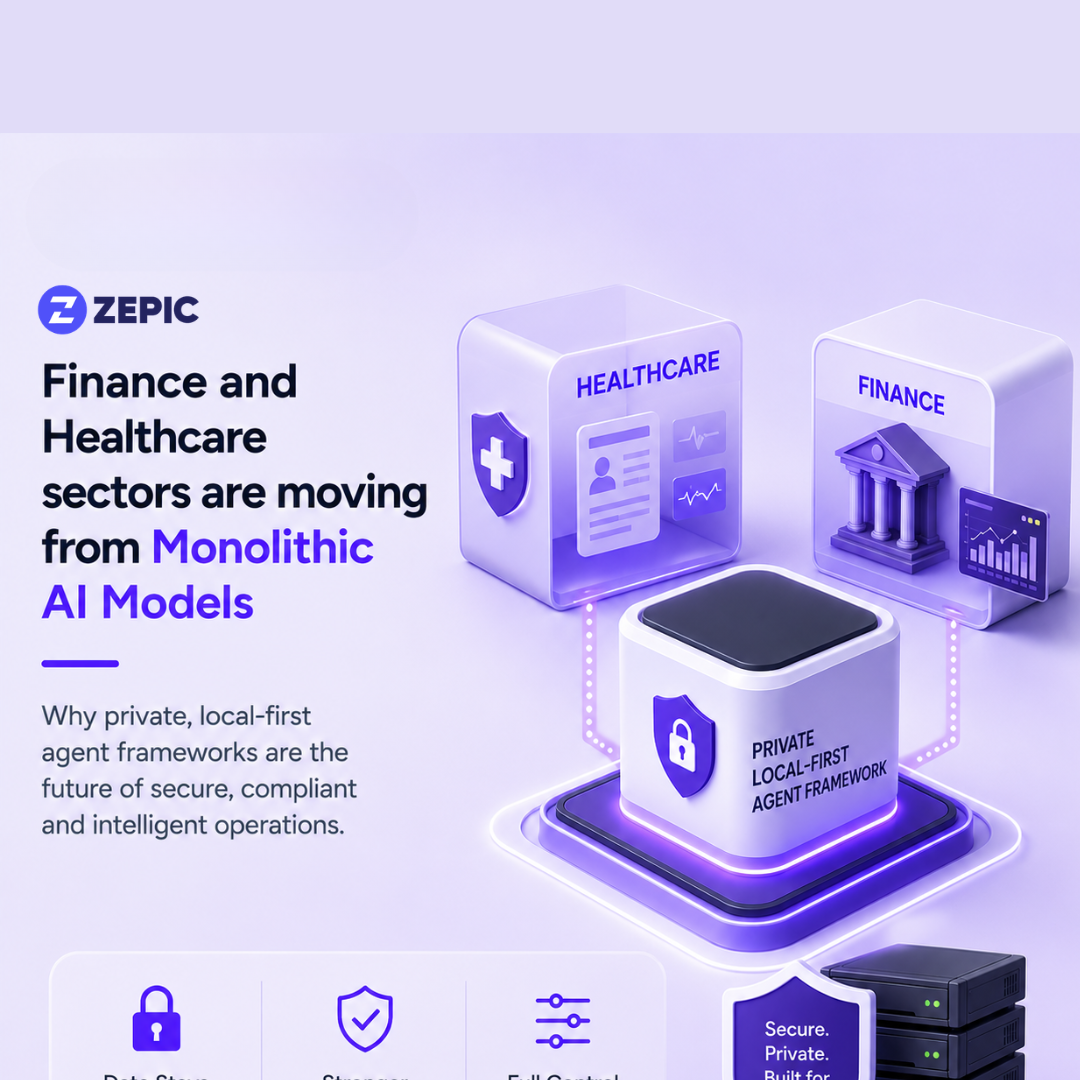
This question is driving one of the most consequential shifts in enterprise AI adoption today. While the initial wave of generative AI was defined by a rush toward massive, cloud-hosted monolithic models, the tide is turning. Finance and healthcare institutions are moving away from these black-box systems in favor of private, local-first agent frameworks.
The move is driven by a need for private AI that respects data sovereignty and meets the rigid compliance standards of regulated industries. These organizations are demanding a fundamentally different architecture that prioritizes control without sacrificing the intelligence required to stay competitive.
To understand why a shift is happening, we must define the monolithic model approach. In the context of AI, monolithic refers to centralized systems where inference, data processing, and model control are handled by a single external vendor.
When a firm uses a cloud-based AI, they are sending their most sensitive proprietary information to a black box. The vendor controls the model weights, the training data, and the hardware. For a hospital or a hedge fund, this creates a significant visibility gap. They cannot audit the model’s internal decision-making process or guarantee that the vendor will not change the model’s behavior overnight.
Every API call to a cloud provider is a potential data egress event. In healthcare, patient data (PHI) is protected by HIPAA. In finance, client data is guarded by the SEC and FINRA. Sending this data to a cloud server often violates data residency requirements, especially in regions like the European Union, where the GDPR and the upcoming EU AI Act mandate that certain data remain within specific borders.
OpenAI and Google frequently update their models. While an update from GPT-4 to GPT-4o might seem like an improvement, it can disrupt enterprise workflows that rely on consistent, predictable outputs. Regulated industries require auditable model versioning. If a regulator asks why a specific loan was denied six months ago, the bank must be able to recreate that exact inference environment. Cloud providers rarely offer this level of granular, long-term version control.
A monolithic model is a single, large program that tries to do everything in one go. An agent framework is a modular system where a smaller brain (the LLM) coordinates several specialized tools and workers to complete complex tasks step by step.
Financial and healthcare organizations do not need the smartest model in the world for every task. They need the most compliant and controllable model.
In the United States, the SEC and FINRA have made it clear that AI usage does not absolve a firm of its fiduciary duties. SEC Regulation S-P, which was updated for 2026, requires smaller investment advisers to perform rigorous due diligence on every AI vendor that touches client data. Under these rules:
Healthcare providers operate under the minimum necessary standard. This means they should only use the specific data points required for a task. Massive cloud models often ingest more context than is necessary, creating a larger attack surface. Organizations must comply with HIPAA in the US and the NHS Information Governance (IG) Toolkit in the UK.
Both sectors share a common requirement: they must be able to explain what the model did and why. If a clinical decision support tool suggests a specific treatment, the doctor needs to see the reasoning and the specific data sources used. Local-first frameworks allow for chain-of-thought logging where every step of the AI's logic is saved in a private database that never touches the public web.
A local-first agent framework is a system where the AI intelligence (the LLM) and the orchestration layer (the "agent") run entirely on an organization’s own hardware or within their private, virtual cloud.
In this model, the inference happens behind the company firewall. No data is sent to OpenAI, Anthropic, or Google. By using open-weight models like Llama 3.1, Mistral, or Qwen, companies can host the brain of the AI themselves.
A model by itself is just a calculator for words. An agent framework adds the following capabilities:
Instead of one giant model trying to be a doctor, a lawyer, and an accountant, firms are building swarms of small, specialized agents. One agent might be an expert at reading ISDA schedules (financial contracts), while another is an expert at checking those schedules against current SEC regulations. These agents talk to each other over a local network, ensuring that sensitive data never takes a trip to a third-party server.
The move to private AI is not just a theoretical preference. It is happening because specific high-value tasks cannot be done safely in the cloud.
Banks process millions of transactions per second. When a potential fraud alert is triggered, an analyst must review the history of that customer. Sending a full transaction history to a cloud AI for reasoning is a massive privacy risk. Instead, banks use local agents to:
Analyzing 10-Ks, ISDA schedules, and private equity offering memoranda involves handling non-public information. Local-first agents can summarize these documents while keeping the knowledge of those documents inside a private vector database. This prevents the information from being leaked or used to train a competitor's model.
At the point of care, a doctor might use an AI to help with a differential diagnosis. This involves inputting symptoms, lab results, and medical history. By using a local framework, the hospital ensures this Protected Health Information (PHI) stays within the hospital’s electronic health record (EHR) system. The AI provides suggestions based on the latest medical journals without that patient's specific history ever leaving the room.
One of the biggest administrative burdens in healthcare is "prior auth"—getting an insurance company to approve a procedure. This requires extracting data from payer guidelines and matching it against clinical notes. Private agents can automate this extraction process safely, reducing the time patients wait for surgery from weeks to hours.
Building a private agent stack is more complex than calling an API, but it provides a moat of security and proprietary value.
As of 2026, several open-source and open-weights models have reached frontier levels of performance.
This is the manager that directs the models. It handles the routing of questions. For example, if a question is about a medical code, the orchestrator sends it to a model fine-tuned on ICD-10 codes. If it is a general question, it goes to a larger model.
Retrieval-Augmented Generation (RAG) is the process of giving the AI open-book access to your company’s files. In a local-first setup, the index of these files is stored in a private vector database hosted on-premises.
Every single thought the agent has must be logged. This layer tracks:
This level of detail is exactly what regulators like the SEC or the UK’s NHS AI Lab look for during an inspection.
It would be dishonest to suggest that local-first AI is better in every single way. Organizations must weigh the benefits against some very real challenges.
Frontier models like GPT-4o or Gemini Ultra still hold a slight edge in extreme reasoning or multi-modal tasks (like looking at an image and a spreadsheet simultaneously). While models like Llama 3.1 have significantly narrowed this gap, the very latest cloud models usually have a six-month lead on open-source alternatives.
When you use a cloud API, the vendor handles the hardware, the cooling, the security, and the uptime. When you go local-first, you own the infrastructure. This means you need:
The gap between closed and open models is closing faster than most experts predicted in 2024. For 95% of enterprise tasks—summarization, data extraction, and logical routing—open models are now indistinguishable from their cloud counterparts. In fact, many firms find that a smaller local model fine-tuned on their specific financial or medical data actually outperforms a general giant model like GPT-4.
The legal landscape is the final push moving companies toward local-first AI.
Entering its full implementation phase in 2026, the EU AI Act classifies most AI used in healthcare and essential financial services as high-risk. High-risk systems have a legal obligation to provide transparency and provision of information to users. It is much easier to prove transparency when you own the model and the data logs than when you are renting them from a third party in a different country.
The US government has released the NIST AI Risk Management Framework. While not law in the same way as the EU Act, it has become the gold standard for insurance companies. If a bank wants to be "insurable" against AI-related errors, it must follow NIST guidelines, which emphasize data governance and robustness—both of which are easier to achieve in a local-first environment.
The NHS has shifted its strategy toward shared data layers. They are moving away from isolated pilots and toward a unified architecture where AI resolves issues (like updating records) rather than just answering questions. This agentic approach requires the AI to be deeply integrated into the hospital's private network.
If your organization is considering moving away from The Big Three cloud providers and toward a private stack, use this practical checklist to evaluate your options:
The question for 2026 is no longer "Which AI is the smartest?" The real question is "Which AI can we trust with our most sensitive assets?"
For finance and healthcare, the answer is increasingly clear. The monolithic, cloud-only model is a relic of the "experimental" phase of AI. As these technologies move into core operations—processing trades, diagnosing patients, and managing billions of dollars in assets—the need for accountability outweighs the convenience of a simple API key.
The move to local-first is not a step backward in capability. It is a step forward in maturity. By adopting private agent frameworks, regulated industries are building a future where AI is powerful, private, and, most importantly, under their control.
If you are ready to explore how a private, agentic architecture can secure your firm’s future, visit NeuraHQ to learn more about our local-first deployment solutions.

%201.png)


.png)