Every customer conversation carries a signal. A question about a product is a sales opportunity. A complaint about a delayed order is an operations issue. A loyalty query is a retention moment. The problem isn't identifying these signals, it's doing something about them, fast, without dropping the ball.
That's exactly what Agent Assignment in ZEPIC is built for.
From WhatsApp and Instagram, to the Right Person—Automatically
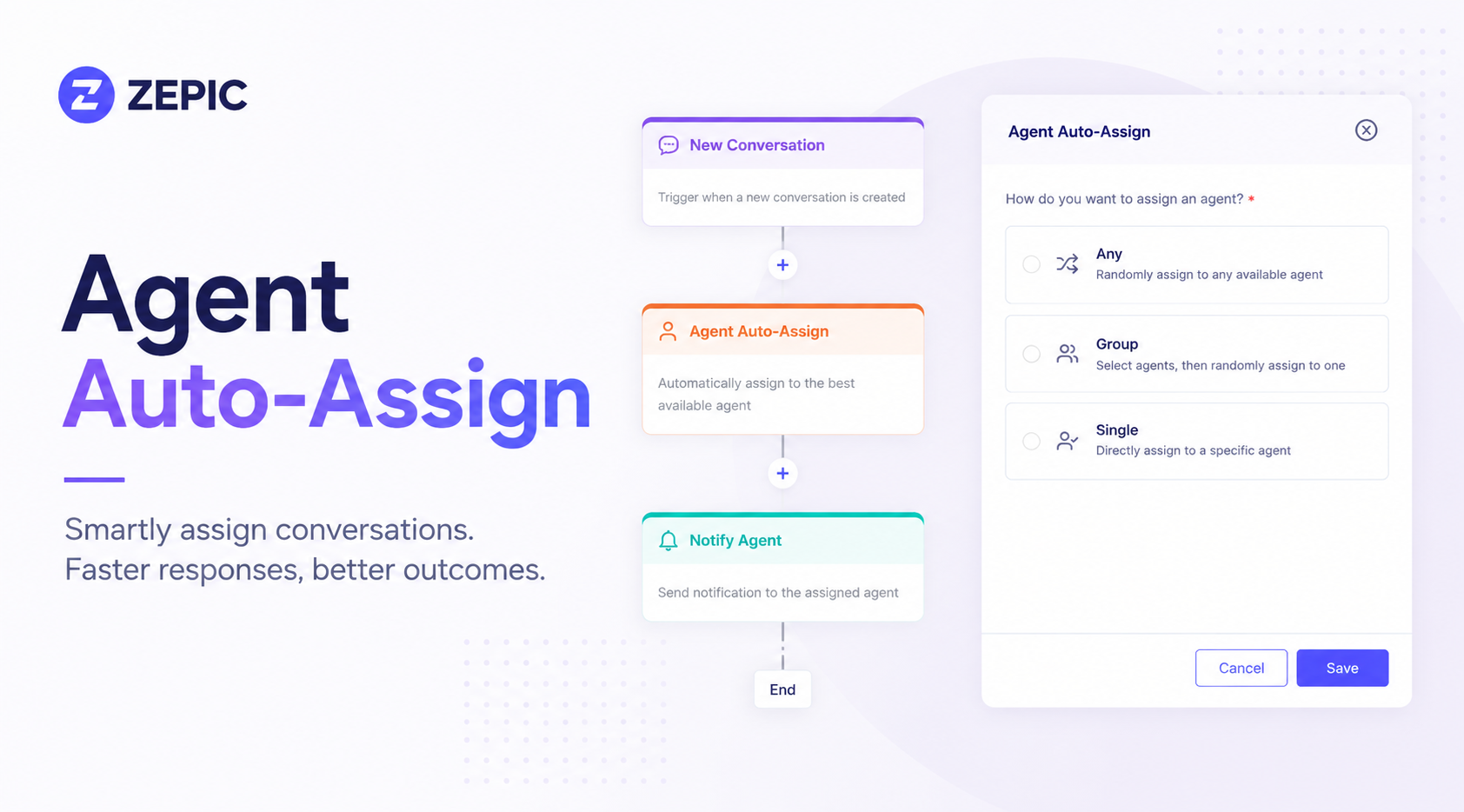
Agent Assignment is a block inside ZEPIC's chatbot flows for WhatsApp and Instagram. The moment a customer sends a message on WhatsApp or Instagram, ZEPIC reads the intent and routes the conversation to the right person or team, automatically.
No manual triage. No copy-pasting into another tool. No falling through the cracks.
Three ways to assign:
Any — distribute to any available agent
Group—route to a team, and let ZEPIC pick who picks it up
Single — directly assign to a specific agent
Every Response Is an Action Waiting to Happen
The real power isn't just routing; it's what you route to.
A customer messages, "my order was late" on WhatsApp; that's not just a support ticket, it's operational feedback. Assign it to your e-commerce or operations team to log, act on, and close the loop. A prospect DMs you on Instagram showing interest in a product; route them straight to sales before the intent fades. A loyalty member asks about their points; assign it to your CRM team to personally follow up.
Agent Assignment works across every use case your customer-facing teams deal with:
Sales: catch high-intent signals and get them to the right rep instantly
Support: route issues to the right team based on the nature of the complaint
Marketing: flag responses as feedback and loop in the right person
CRM: trigger personal follow-ups at exactly the right moment
Operations: turn complaints and signals into action items for the right team
Beyond Agent Assignment. Make everything actionable
ZEPIC doesn't just keep it all in one place; it can push to the tools your teams already live in.
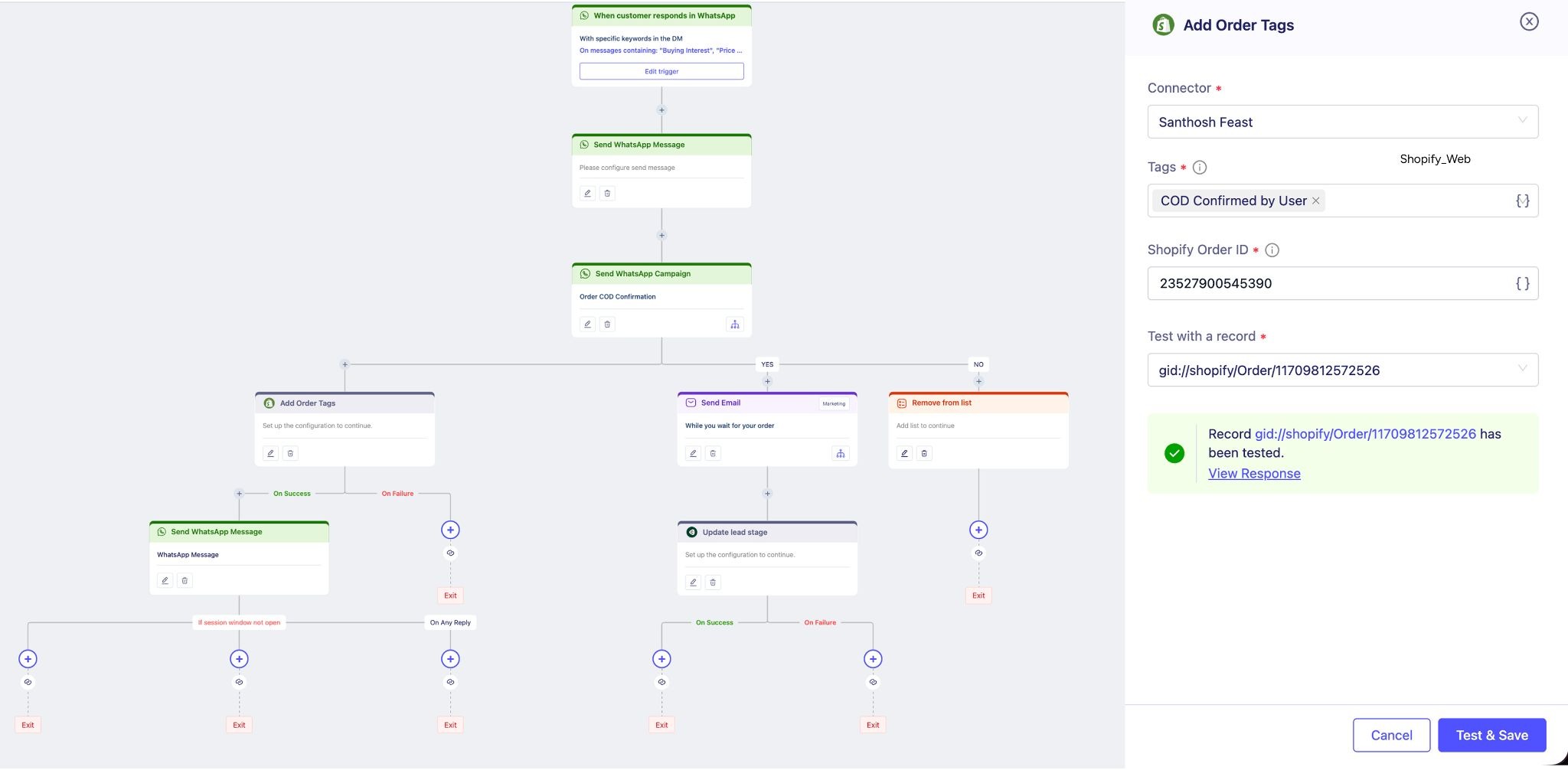
Assign the conversation to an agent inside ZEPIC, and simultaneously update your CRM. Create a support ticket in your helpdesk. Log the interaction in your operations tool. From the same flow, trigger follow-up actions on other channels: email or WhatsApp, based on how the customer responded.
For teams already running multiple tools, ZEPIC becomes the connective tissue. The place where the customer signal is caught, interpreted, and distributed, without anyone manually bridging the gap.
The Complete Customer Picture, Even After Marketing
One of the most underrated benefits of Agent Assignment is what it does to the customer profile.
When a conversation gets assigned and acted on, that context feeds back into ZEPIC. The sales rep who took the call, the support issue that was resolved, and the feedback that was logged; it all lives in the same place as the marketing data, the campaign history, and the behavioral signals. The customer profile gets richer with every interaction, not just the ones marketing owns.
That's the shift. Customer-facing teams have always worked in parallel. Agent Assignment helps them work together—from one platform, with one shared view of the customer.
Getting Started
Add the Assign Agent block to any WhatsApp or Instagram chatbot flow. Choose your assignment mode: any, group, or single. Set your conditions based on keyword or customer intent. Done.
From a product inquiry on Instagram to a late delivery complaint on WhatsApp, every conversation finds its owner automatically.
Desperate times call for desperate Google/Chat GPT searches, right? "Best Shopify apps for sales." "How to increase online sales fast." "AI tools for ecommerce growth."
Been there. Done that. Installed way too many apps. But here's what nobody tells you while you're doom-scrolling through Shopify app reviews at 2 AM—that magical online sales-boosting app you're searching for? It doesn't exist. Because if it did, Jeff Bezos would've bought (or built!) it yesterday, and we (fellow eCommerce store owners) would all be retired in Bali by now. Growing a Shopify store and increasing online sales isn’t easy—we get it. While everyone’s out chasing the next “revolutionary” tool/trend (looking at you, DeepSeek), the real revenue drivers are probably hiding in plain sight—right there inside your customer data. After working with Shopify stores like yours (shoutout to Cybele, who recovered almost 25% of their abandoned carts with WhatsApp automation), we’ve cracked the code on what actually moves the needle. Ready to stop app-hopping and start actually growing your sales by using what you already have? Here are four fixes that will get you there!
The Painful Truth: You're probably losing about 70% of your potential sales to cart abandonment. That's not just a statistic—it's real money walking out of your digital door. And looking for yet another Shopify app for abandoned cart recovery isn't going to fix it if you're not getting the fundamentals right.
The Quick Fix: Everyone knows you need multi-channel recovery that hits the sweet spot between "Hey, did you forget something?" and "PLEASE COME BACK!" But here's the reality—most recovery apps are a one-trick pony. They either do email OR WhatsApp, not both. And don't even get us started on personalizing offers based on cart value—that usually means toggling between three different dashboards while praying your apps talk to each other.
Enter ZEPIC: This is where we come in. With ZEPIC's automated Flows, you can: Launch WhatsApp recovery messages (with 95% open rates!) Set up perfectly timed email sequences (or vice versa) Create personalized recovery offers not just on cart value but based on your customer’s behavior/preferences Track and optimize everything from one dashboard
Fix #2: Reactivate past customers today
The Painful Truth: You're probably losing about 70% of your potential sales to cart abandonment. That's not just a statistic—it's real money walking out of your digital door. And looking for yet another Shopify app for abandoned cart recovery isn't going to fix it if you're not getting the fundamentals right.
The Quick Fix: Everyone knows you need multi-channel recovery that hits the sweet spot between "Hey, did you forget something?" and "PLEASE COME BACK!" But here's the reality—most recovery apps are a one-trick pony. They either do email OR WhatsApp, not both. And don't even get us started on personalizing offers based on cart value—that usually means toggling between three different dashboards while praying your apps talk to each other.
Enter ZEPIC: This is where we come in. With ZEPIC's automated Flows, you can: Launch WhatsApp recovery messages (with 95% open rates!) Set up perfectly timed email sequences (or vice versa) Create personalized recovery offers not just on cart value but based on your customer’s behavior/preferences Track and optimize everything from one dashboard
Offering light at the end of the tunnel is Google’s Privacy Sandbox which seeks to ‘create a thriving web ecosystem that is respectful of users and private by default’. Like the name suggests, your Chrome browser will take the role of a ‘privacy sandbox’ that holds all your data (visits, interests, actions etc) disclosing these to other websites and platforms only with your explicit permission. If not yet, we recommend testing your websites, audience relevance and advertising attribution with Chrome’s trial of the Privacy Sandbox.
Top 3 impacts of the third-party cookie phase-out
Who’s impacted
How
What next
Digital advertising and acquisition teams
Lack of cookie data results in drastic fall in website traffic and conversion rate
Review all cookie-based audience acquisition. Sign up for Chrome’s trial of the Privacy Sandbox
Digital Customer Experience
Customers are not served relevant, personalised experiences: on the web, over social channels and communication media
Multiply efforts to collect first-party customer data. Implement a Customer Data Platform
Security, Privacy and Compliance teams
Increased scrutiny from regulators and questions from customers about data storage and usage
Review current cookie and communication consent management, ensure to align with latest privacy regulations