Meet

Neura HQ,
Your connected AI Agent Workforce Know more



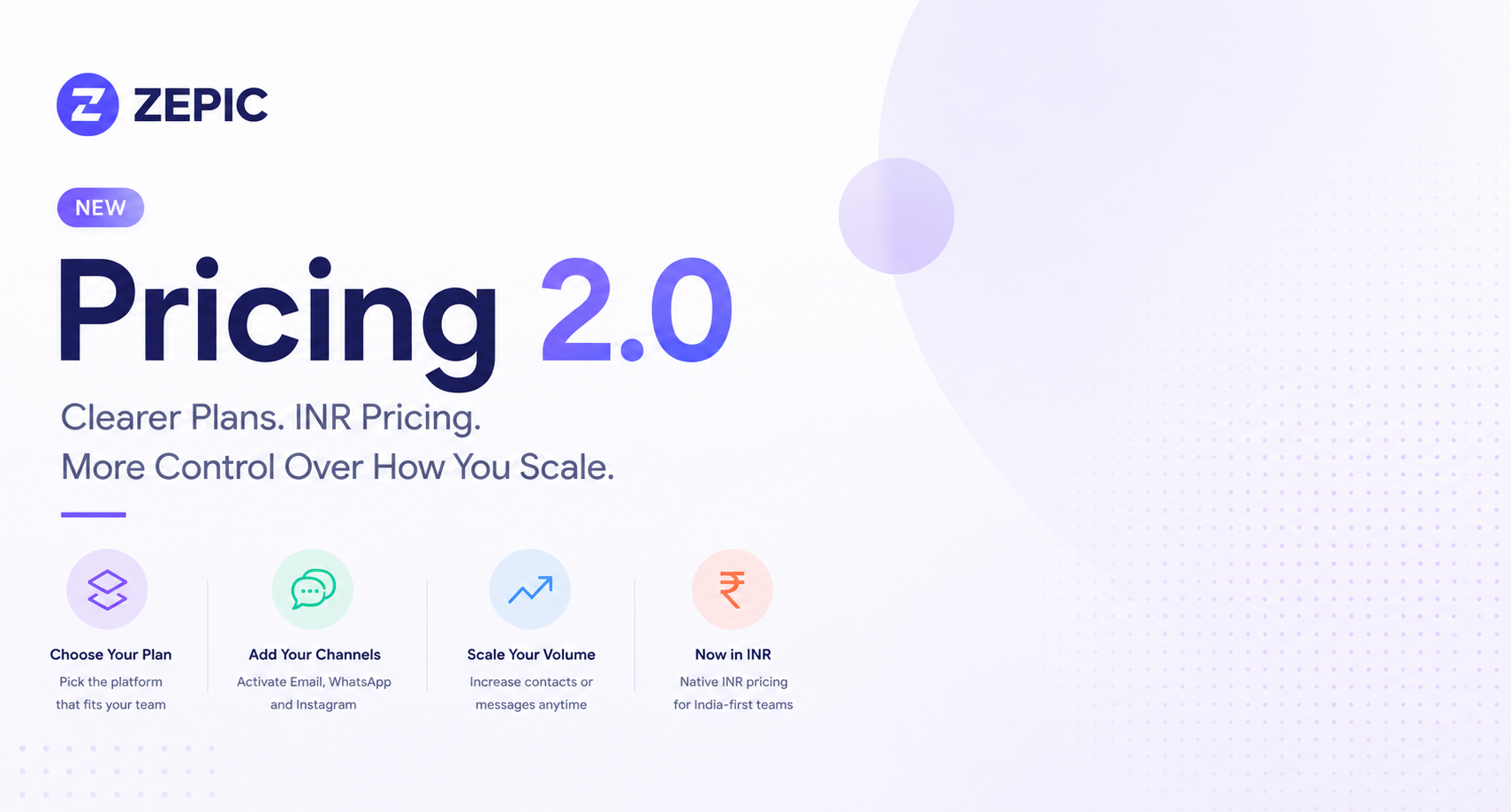
We've redesigned how ZEPIC is priced. Here's what changed, why, and what it means for your business.
When we launched ZEPIC, we built a credit-based model designed to give you flexibility. One wallet. Every channel. Pay for what you use. For many customers, that worked well. But as more brands started evaluating and using the platform, a pattern of feedback emerged: credits are flexible, but they're also hard to forecast. How do you budget when you're not sure how many credits an automation run consumes? What does a month of WhatsApp + email actually cost?
Good feedback. We listened.
ZEPIC Pricing 2.0 is our answer: a cleaner, more predictable model that replaces the unified credit wallet with purpose-built plans, channel add-ons, and usage top-ups. Everything is right-sized for how real teams actually buy: choose your platform, activate your channels, scale your volume. And, the entire pricing stack is now available in Indian Rupees (INR) as well.
The core ZEPIC platform including CDP, segmentation, journeys, automation, AI is exactly the same product it's always been. What's changed is how you pay for it.
Before: A single credit wallet covered all usage: emails, WhatsApp messages, AI features, automations. Flexible, but opaque. Budgeting required either guesswork or the calculator.
Now: Three clean layers.
The result: you know exactly what you're committing to, and you only pay more when you actually need more.
Pick Starter if your goal right now is getting one channel working well. You get the full ZEPIC CDP including customer profiles, segmentation, web tracking, and campaign reporting, plus one activated channel of your choice: Email, WhatsApp, or Instagram.
Three active flows, three seats, and all the compliance (SOC 2, ISO 27701, GDPR) you'd expect from day one.
This is the right starting point for lean teams who want to run focused campaigns without overbuilding infrastructure they don't need yet.
Not a fit if: you need to run flows across more than one channel, connect external data sources, or give your team a shared inbox to manage conversations.
Growth is for brands that are ready to connect the dots between channels and want to bring in data from external systems like Shopify or CRM or support tools. The key unlocks: all three channels active simultaneously, data connectors, and the Team Inbox so your customer-facing team can manage WhatsApp conversations alongside automated journeys, from one place.
A few meaningful additions over Starter: pre-built ecommerce workflows (abandoned cart, post-purchase, and more), advanced event-based segmentation, transactional emails, Zenie AI for Instagram intent matching, and role-based access control. This is where ZEPIC starts to feel like a full marketing engine rather than a campaign tool and where most growing D2C brands land.
Not a fit if: your data needs go deeper than standard integrations — think custom data models, multiple sources that need transformation before they sync, or building a unified customer view that pulls from proprietary systems. That's Pro territory.
Pro is where the platform opens up for brands with more complex data and automation needs and where ZEPIC's WhatsApp chatbot capability comes in, which is what most brands upgrading to Pro are here for.
The chatbot isn't a standalone widget. It lives inside your flows so the same journey that sends a post-purchase email and a WhatsApp follow-up can also trigger a chatbot conversation, collect customer inputs, match intent with AI, and route to a human agent when needed. All connected, all in one flow. Pair that with full REST API and webhook access, and you can build automation that responds to signals from anywhere in your stack.
Other meaningful unlocks at Pro: 10 custom objects to model your own data (orders, loyalty tiers, store locations), auto lead capture from Instagram, identity resolution, destination connectors for pushing enriched data back out to other tools, and custom reporting add-ons.
This is the right tier for brands running multi-location operations, building conversational commerce on WhatsApp, or integrating ZEPIC into an existing data stack.
Not a fit if: you need custom role-based permissions, audit logging, dedicated account management, or RFM-level reporting — those are Enterprise.
Enterprise is built for large B2C operations where scale, governance, and team complexity are the real constraints. On top of everything in Pro: workflows and campaigns triggered off any custom object, scheduled and RFM reports, custom role-based permissions, audit logging and data governance, and a dedicated Customer Success Manager.
This is the tier for brands managing multiple regions or business units, running complex loyalty or membership data models, or operating teams where access controls and data governance are non-negotiable.
For the first time, every ZEPIC plan, add-on, and volume pack is priced natively in Indian Rupees — fixed INR prices designed for INR billing, not a live conversion of USD rates. If you've been evaluating ZEPIC in dollars and doing the math yourself, that's no longer necessary.
The channel model is straightforward. Each channel — Email, WhatsApp, Instagram — is an optional add-on. Activate one, or activate all three for omnichannel engagement.
Each activated channel includes a base messaging allocation.
On Starter, you can only activate one channel. Growth and above support all three simultaneously — which is where the real omnichannel value of ZEPIC comes through.
Beyond your base allocation, volume scales cleanly through two mechanisms.
Recurring add-ons are monthly subscriptions for additional message volume or contacts. Buy in blocks: 10,000 emails, 20,000 Instagram DMs, 5,000 contacts. Commit annually and save up to 23–29%. Volume tiers kick in automatically as you scale at 100K emails/month, your per-10K price drops by 3%; at 700K, by 10%.
One-time top-ups are there for campaigns that push past your recurring limit without requiring a permanent subscription increase. You buy a block of sends, they sit in your account, and you use them when needed. They remain valid as long as your account is active. No monthly expiry.
This separation matters: you're not forced to upgrade your subscription to handle a seasonal spike. Buy a top-up for Black Friday. Your base cost stays the same in January.
Committing annually unlocks meaningful savings, roughly equivalent to getting one quarter free. Platform fees drop by up to 29–30% on annual vs. monthly billing. Contact packs save up to 28.57% annually. Email and Instagram volume packs save up to 23%.
If you're a growing brand that knows ZEPIC is in your stack for the year, annual billing is the obvious choice.
Credits were a bold bet on maximum flexibility. For many customers, they delivered exactly that. But we heard the same feedback across enough conversations: predictability and forecastability matter more than theoretical flexibility, especially for finance teams approving annual SaaS budgets.
The new model doesn't sacrifice flexibility, you can still scale volume up or down, add channels, buy top-ups, or upgrade plans at any time. What changes is the baseline clarity. You know your monthly platform cost before any variable usage. You know what each channel add-on costs. You know your contact bill for the quarter.
That's a better starting point for most teams.
If you're evaluating ZEPIC for the first time:
If you're an existing customer: nothing about the product has changed. Your capabilities, your data, your workflows are all intact. The new pricing model gives you a cleaner way to understand and forecast your cost going forward. Our team will reach out to walk you through what the transition looks like for your account.
Ready to explore the new plans? See pricing → or book a call with the team.

%201.png)


.png)