Meet

Neura HQ,
Your connected AI Agent Workforce Know more



TLDR:
Online skincare shopping has always struggled to replicate the in-store experience. In a physical setting, a trained advisor listens to the shopper’s concerns and recommends a routine tailored to their needs. Online, that experience is often reduced to a quiz or a product grid that leaves too much room for guesswork.
This gap shows up clearly in performance. High-intent shoppers visit a site and then drop off because they are not confident in their choices. A few static questions cannot capture the complexity of real skin concerns, and they cannot evolve as the conversation unfolds.
As expectations rise, this limitation becomes more visible. Shoppers are used to personalized experiences in other categories and expect the same level of guidance when it comes to skincare. When that expectation is not met, they look elsewhere.
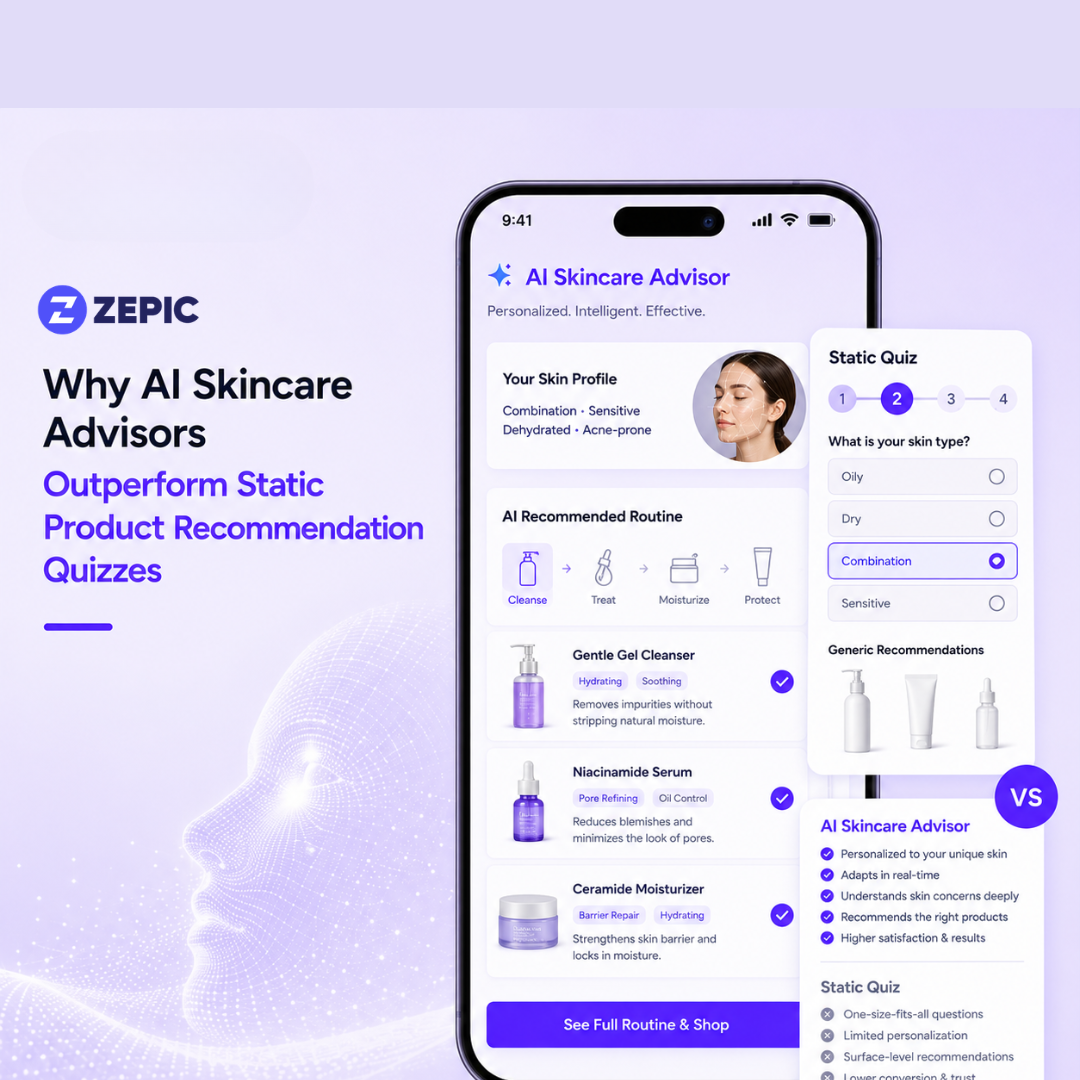
AI skincare advisors close this gap by delivering a guided, adaptive experience that mirrors expert consultation. They interpret context and build trust in a way static tools cannot.
Product recommendation quizzes became popular because they gave brands a structured way to collect zero-party data. They also helped guide shoppers toward relevant products and created a slightly more personalized experience than a bare product grid.
But they have fundamental limitations that become more obvious as consumer expectations for personalization change.
They are rigid by design: A quiz follows a fixed logic tree. If a shopper's situation does not fit neatly into one of the pre-built paths, the recommendations are inaccurate. Someone with combination skin, hormonal breakouts, a sensitivity to fragrance, and a budget under $60 is not well-served by a quiz that asks five binary questions.
They cannot follow up: A quiz ends when the questions end. It cannot ask a clarifying question. It cannot respond to a message saying, "Actually, my skin gets really dry in winter but oily in summer." It cannot build on a previous answer to probe deeper.
They go stale: A quiz built in 2023 reflects your catalog and your understanding of your customers in 2023. Updating the logic requires developer time. In practice, most quizzes sit untouched for months or years while shoppers, products, and skin science all move on.
They collect data once and stop: The quiz captures a moment but does not learn from what the shopper does next, what they click, what they add to cart, what they return, or what they repurchase.
They do not build routines: Most skincare quizzes recommend one or two products. A skincare routine is three to five steps. An advisor who thinks about the shopper's entire regimen and recommends complementary products across cleansers, actives, and SPF is doing a fundamentally different job.
An AI skincare advisor is a conversational, reasoning system trained on skincare science, your product catalog, and customer behavior data. It engages in a dynamic dialogue with the shopper rather than walking them through a fixed script.
Here is what the skincare agent does differently:
It asks adaptive questions: If a shopper mentions acne, the advisor asks follow-up questions:
The questions branch based on what the shopper says, producing a much richer picture of their needs.
It builds complete routines: Rather than surfacing one product, the advisor recommends a morning and evening routine, explains why each step matters, and flags ingredient conflicts between products the shopper might already be using.
It uses selfie-based skin analysis: Advanced implementations use computer vision to analyze the shopper's actual skin from a selfie, detecting concerns across 20 or more skin metrics with measurable accuracy.
It remembers context: Within a session, and in many cases across sessions, the advisor holds the conversation history. A returning customer does not start from scratch. The advisor knows what they bought, how they rated it, and what their skin concerns were last time.
It explains its reasoning: Instead of returning a product list with no context, the advisor explains why it is recommending each product: "Because you mentioned sensitivity to fragrance and your skin analysis shows mild redness, I'm suggesting this barrier repair serum over the retinol toner." That explanation builds purchase confidence.
It captures first-party data continuously: Every interaction generates high-quality zero-party data: skin type, concerns, sensitivities, budget, and routine preferences. Unlike quiz data, this feeds back into your CRM in real time and powers downstream segmentation, lifecycle emails, and targeted campaigns.
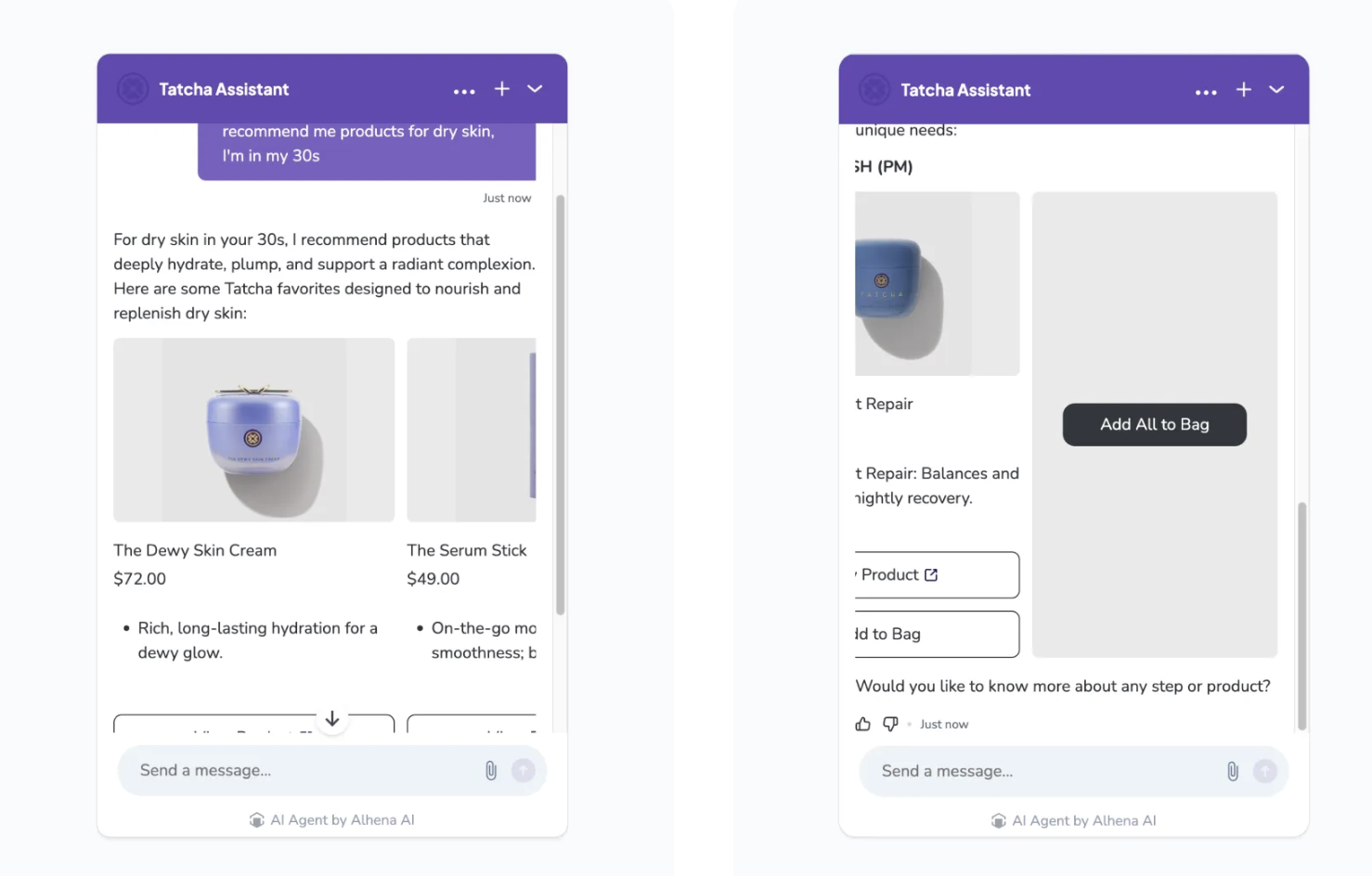
Tatcha's in-store advisors build multi-step skincare rituals tailored to each customer's skin type, concerns, and goals. Replicating that experience online was the challenge: 70% of beauty shoppers want personalized skincare advice when buying online, but most brands offer little beyond a static product page.
Tatcha deployed an AI shopping concierge that runs a conversational skin consultation, adapts in real time based on shopper responses, recommends complete rituals, surfaces rich product cards inside the chat, and handles agentic checkout. The setup took under 48 hours with no developer resources required. The results were clear: a 3x conversion rate, 38% higher AOV, and 11.4% of total site revenue flowing through the advisor channel.
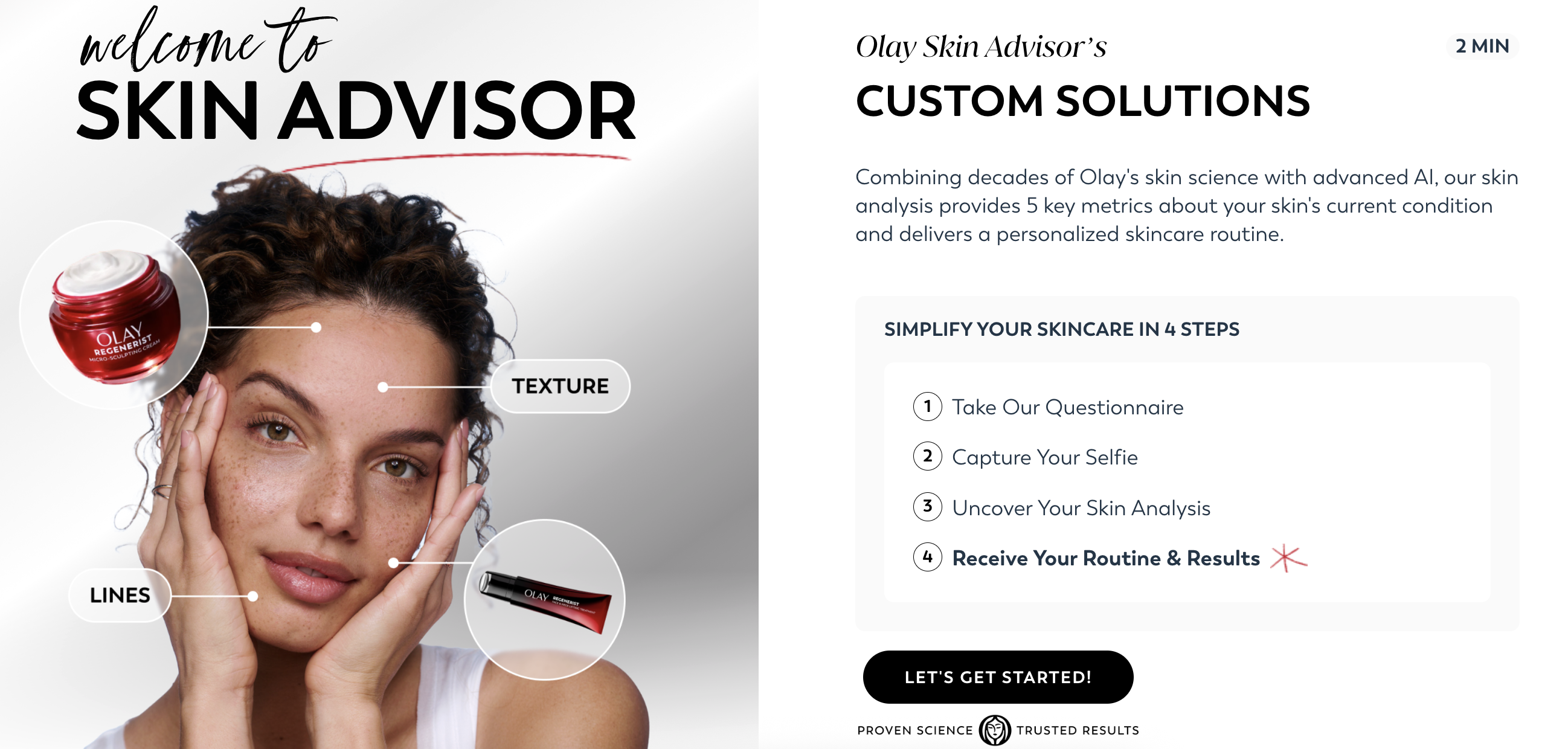
Olay's Skin Advisor uses deep learning and computer vision to analyze a user's skin from a selfie, identifying aging zones across the forehead, cheeks, mouth, crow's feet, and under-eye areas. The advisor then layers in a short questionnaire about the shopper's current regimen and concerns before generating a personalized product recommendation.
Olay's Skin Advisor estimates a user's skin age with around 90% accuracy. The tool hit nearly one million visits in its early rollout and has driven measurable conversion lifts at scale, demonstrating that AI skin analysis can work across a mainstream consumer base, not just premium skincare shoppers.
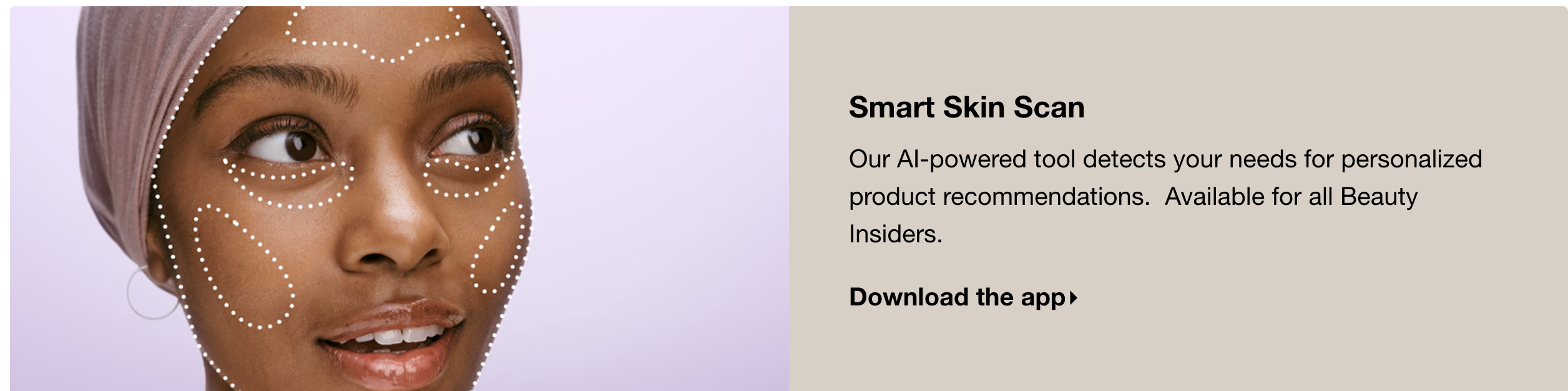
Sephora developed an advanced AI Skin Diagnostic Tool using computer vision, dermatological data, and deep learning, allowing users to upload selfies through the Sephora app or web platform for a data-driven skin analysis tied directly to personalized product recommendations.
Sephora also uses AI to power workforce training, equipping in-store beauty advisors with NLP-powered search that lets them ask questions like "best moisturizer for rosacea-prone skin" and receive curated answers backed by Sephora's full product database. This means the AI advisor experience is consistent whether a shopper is online or standing at a counter.
There is a data story inside the AI advisor that most skincare brands undervalue.
With third-party cookies increasingly unreliable and browser tracking becoming harder to rely on, first-party opt-in data becomes a competitive asset: whoever can capture it wins. There is no better generator of high-quality first-party data than how shoppers interact with AI chat and beauty tools.
A shopper who completes an AI skin consultation shares many details, such as their
Deploying an AI skincare advisor does not require a six-month platform overhaul. Most implementations follow a staged approach:
Phase 1: Define one clear entry point. The most common starting point is a skincare consultation widget on your homepage, high-traffic PDPs, or a standalone "Find My Routine" page. Pick the entry point where you see the most browsing-without-converting behavior.
Phase 2: Connect your product catalog with rich attributes. The advisor needs to reason across your products. That means complete ingredient lists, clear skin type and concern tags, sensitivities flagged, and routine step labeling (cleanser, toner, treatment, moisturizer, SPF). This is the same catalog hygiene that benefits your SEO and your email merchandising.
Phase 3: Add skin analysis if your brand supports it. For brands with a clear skin science positioning, selfie-based AI skin analysis is a strong differentiator. It produces a more objective starting point than self-reported quiz answers and gives shoppers a memorable, shareable experience.
Phase 4: Push advisor data to your CRM. Skin type, concerns, and sensitivities captured in the advisor should flow into your customer profiles in real time. This data powers post-purchase coaching sequences, reorder reminders timed to product usage cycles, and targeted campaigns for new launches.
Phase 5: Measure the right metrics. Track conversion rate for advisor sessions versus non-advisor sessions, AOV uplift, routine adoption rate (how many shoppers purchase three or more products in one session), email opt-in rate, and 90-day repeat purchase rate. These five metrics tell the full ROI story.
The in-store experience that sells a $95 moisturizer relies on a trained advisor who reads your skin, builds a skincare routine, and walks you to checkout. Most beauty brands default to static quizzes or generic chatbots that feel nothing like the counter experience.
That gap between what shoppers experience at the counter and what they get online has always been real. What is different in 2026 is that the technology to close it is accessible, proven, and deployable within days, not months.
Static quizzes were the best tool available when they were built. AI skincare advisors are what is available now. The brands treating the two as equivalent are leaving measurable revenue, loyalty, and first-party data on the table with every session that ends without a sale.
The counter experience is no longer exclusive to stores. It belongs on your website too.
ZEPIC helps beauty and skincare brands build AI-powered customer experiences that turn browsers into buyers and first-time purchasers into loyal customers. Talk to our team about building your AI advisor agent.

%201.png)


.png)