Meet

Neura HQ,
Your connected AI Agent Workforce Know more



TL/DR:
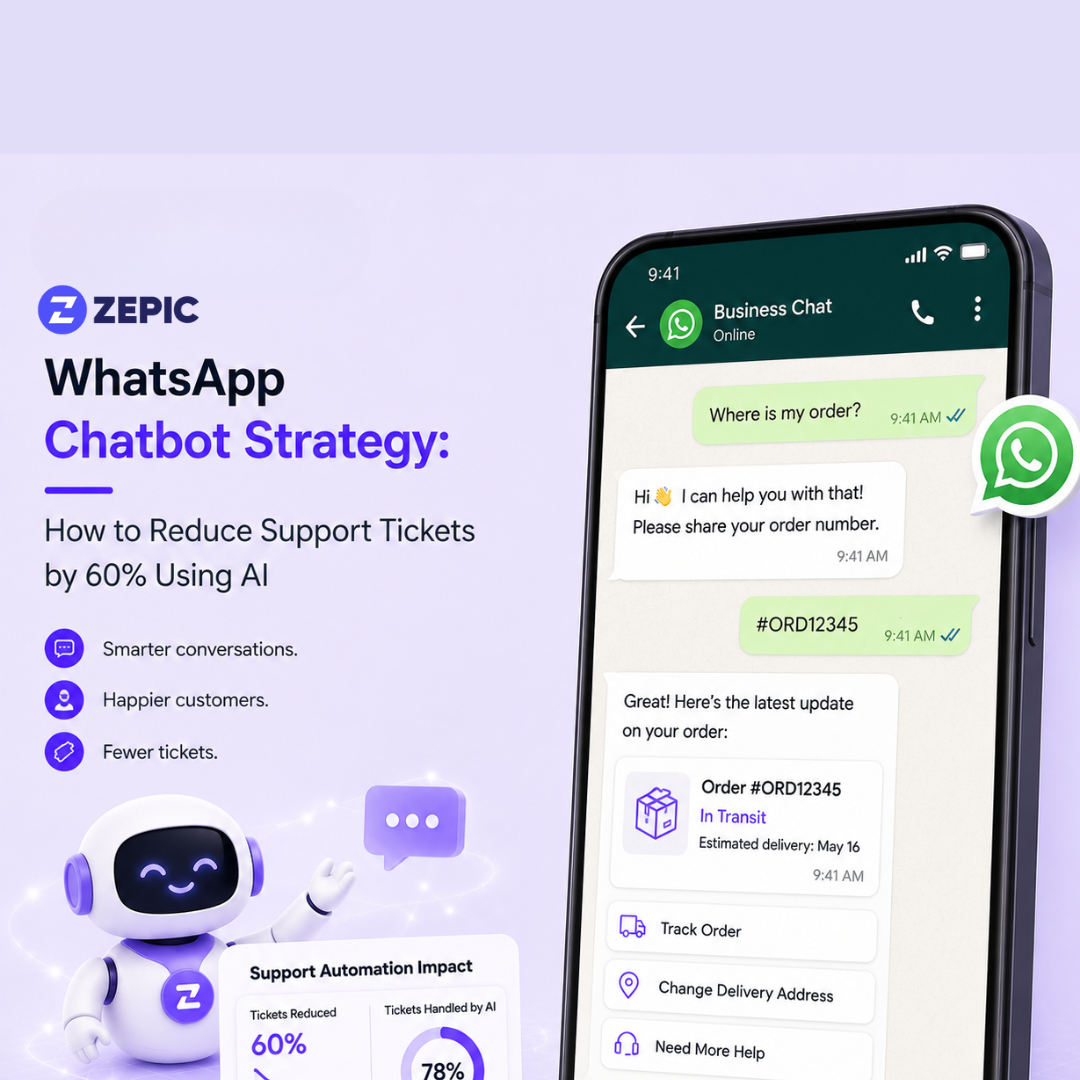
Success in e-commerce is a double-edged sword. As your brand scales and your sales go up, so does the mountain of customer inquiries. One day, you're celebrating a sales spike; the next, your support team is buried under "where's my order?" avalanches. Smart brands fight back with WhatsApp chatbots, slicing ticket volumes by 60% while keeping customers happy.
Here is how you can do the same without losing the human touch.
Did you know that over 50% of business leaders expect customer enquiries to increase by one-fifth in the next two years?
Growth fuels chaos. When you have 100 customers, you can manage support via a shared Gmail inbox. When you have 100,000, that inbox becomes a black hole.
Most e-commerce support volume isn't actually difficult, but it's repetitive. Customer inquiries in retail generally are about the same five topics. As brands scale, these repetitive queries create a bottleneck that prevents support agents from handling high-stakes issues like fraud or major logistics failures. This leads to burnout, high churn in support staff, and a Customer Satisfaction (CSAT) score that starts to look like a temperature in the Arctic.
I think chatbots are the future of engagement between a fan and a brand or celebrity.
— Christina Milan
A WhatsApp chatbot is an automated software program integrated with the WhatsApp Business API. Unlike the bots of 2018 that could only understand a few keywords, today’s AI-powered bots use Natural Language Processing (NLP) to understand context, intent, and even sarcasm.
It works like a bridge between your backend systems (your Shopify store, your ERP, or your shipping partner) and the customer’s phone. When a customer asks, "Where is my stuff?" the bot doesn't just guess. It fetches the real-time tracking ID from your database and serves it up instantly. It’s like having an employee who has memorized your entire database and never sleeps.
For most e-commerce brands, the results are humbling. The vast majority of volume concentrates around a short list of predictable questions—and that predictability is exactly what makes automation so effective.
"Has my order shipped?" "What's my tracking number?" "Why does the tracker say it's still in the warehouse?" This single category accounts for 35 to 40% of support contacts for most online retailers. A WhatsApp chatbot connected to your order management system can pull live tracking data and respond in under five seconds—no agent login required, no copy-pasting carrier links, no queue.
Reactive support is costly. Proactive messaging is cheap. A chatbot that automatically notifies customers when their order is dispatched, out for delivery, or delayed eliminates a huge portion of inbound queries before they're ever sent. When customers already know their package is arriving today, they don't reach out to ask.
Customers return around 17% of the online orders they place. Nobody loves processing returns, least of all an agent doing it manually for the fortieth time in a shift. A chatbot can walk a customer through your return policy, collect the required details, initiate the request, and send a confirmation, in a single conversation. For refund status checks, live integration with your payments system means accurate answers instead of "please allow 5–7 business days" guesswork.
Sizing charts. Material composition. Compatibility questions. Payment options. Cancellation windows. These queries feel minor in isolation, but at scale, they represent thousands of human-hours per year. A well-maintained chatbot knowledge base handles all of them instantly, and updating it when policies change takes minutes, not a retraining session.
The 60% reduction in tickets isn't just hype. Bots handle the 70% repetitive load, leaving reps for the 30% that needs heart. Here's the breakdown:
Response time is one of the most underrated deflection tools in support. When a customer sends a message and hears nothing for two hours, they send another one. Then an email. Then a comment on your Instagram post. Each escalation is a new ticket that could have been prevented by a response that arrived in 30 seconds.
Chatbots break that spiral by design. Research shows that 62% of consumers would prefer a chatbot over waiting for a human agent. This is not because they love talking to bots, but because they love waiting even less. Speed, in support, is a form of service.
Your customers don't observe business hours. A customer in Singapore placing an order at 2 AM local time has the same expectation of responsiveness as one shopping during a London lunch break. A WhatsApp chatbot doesn't clock out. It handles the same query at 3 AM with the same accuracy as it would at 3 PM. This matters significantly for any brand with cross-border sales or late-night shopping traffic.
The 80/20 rule hits support harder than almost any other function. Roughly 80% of ticket volume comes from 20% of query types. Identify that 20%, build solid automated responses for each, and you've structurally deflected the bulk of your inbound volume. Brands that execute this well consistently report deflection rates within the first quarter of deployment.
A chatbot that traps customers in an endless loop of irrelevant responses is worse than no chatbot at all. A smart one knows exactly when to step aside.
Escalation triggers should be deliberate: two failed resolution attempts, explicit customer frustration signals, specific query types like payment disputes or complaints, or a direct request to speak with a person. When those triggers fire, the handoff happens with the full conversation history already in the agent's view. No customer should repeat themselves. That continuity is what separates a good chatbot deployment from a frustrating one.
To the user, chatbots seem to be “intelligent” due to their informative skills. However, chatbots are only as intelligent as the underlying database.
- Peter Gentsch
Deploying a chatbot isn't a one-time setup. The brands that see the biggest ticket reductions treat it as an ongoing product. Here's what that approach looks like:
If you don't measure it, you can't improve it. These are the numbers that tell you whether your WhatsApp chatbot is actually working:
One metric worth adding to this list that rarely gets tracked: repeat contact rate. If customers who received a chatbot resolution are messaging again about the same issue, the resolution wasn't real. A declining repeat contact rate is the clearest signal your automation is closing loops, not just closing conversations.
A poorly built chatbot can damage trust faster than a slow support team ever could. Customers who hit a dead end, receive an incorrect answer, or feel stonewalled by automation will be more frustrated than if they'd simply waited. A few patterns that consistently derail chatbot deployments:
Most WhatsApp chatbots share a structural flaw: they live in isolation. The bot sits in one system, the human inbox in another, the customer data somewhere else entirely. The result is a fragmented experience where customers repeat themselves at every transition and agents start every escalation without context.
ZEPIC's WhatsApp chatbot is built inside the same platform as your marketing automation, customer profiles, and team inbox. The bot has access to who it's talking to, their order history, their segment, and their previous interactions before the first message is sent. When a conversation escalates to a human, it lands in a shared inbox with everything already visible. The customer doesn't notice a seam because, structurally, there isn't one.
As we move further into 2026, the line between a chatbot and an AI Agent is blurring. We are moving away from buttons and menus toward natural, fluid conversations where the bot doesn't just provide information, it performs actions.
Whether it's re-routing a package that's headed to an old address or applying a discount code a customer forgot to use, the next generation of WhatsApp support is about autonomy. Your strategy today should be built with that level of sophistication in mind.
Don't wait until your support queue is 500 tickets deep to start thinking about automation. Start with your top three FAQs. Master the "Order Status" flow. Once you see that initial 20-30% drop in volume, you’ll have the breathing room (and the data) to automate the rest.
At ZEPIC, we’ve seen firsthand how a unified approach to data can turn a clunky chatbot into a brand-defining asset. When your bot knows your customer as well as you do, support stops being a cost center and starts being a competitive advantage.
Let’s talk about launching your AI-powered WhatsApp strategy with us today.

%201.png)


.png)