Meet

Neura HQ,
Your connected AI Agent Workforce Know more




TLDR
The word “personalization” gets thrown around a lot in the e-commerce space. You hear it everywhere—in marketing tools, agency pitches, and competitor case studies. But when you look closely at what most brands are doing, the personalization often stops at the bare minimum: "Hi [Customer Name]" or "Here’s a product you bought before."
Is that truly personalized? Not really.
This approach fails to recognize the nuances of your customer's unique preferences or the granular details of the specific products they purchased. This lack of depth is why so many campaigns feel irrelevant and potential sales is lost.
To bridge the personalization gap, brands must move beyond surface-level data and capture the details that actually influence buying decisions. Shopify Metafields give you the flexibility to do just that.
Metafields are custom data fields you can add to products, customers, orders, or variants when Shopify’s default fields aren’t enough. They help you store deeper, more contextual information that powers richer segmentation and personalization.
For example: If you’re a skincare brand, your product might need attributes like skin type, skin concern, or active ingredients, details that Shopify doesn’t store by default. You need to create meta fields to save this data.
However, the real challenge is that you can’t bring that data from Shopify into most marketing automation platforms.
So even though your product data is detailed and well-structured inside Shopify, your marketing still operates only on:
Which means the most valuable, conversion-driving details are left out of your marketing process.
This is where ZEPIC changes the game. You can easily import Shopify Metafields into our platform and use the data to hyperpersonalize your campaigns.
While most platforms ignore Shopify Metafields or force you to work around them, ZEPIC is built to fully embrace your structured product data.
Define and Map Custom Fields: To bring your Metafield data into ZEPIC, you first customize a ZEPIC object (like a Product record) to include the same custom data properties (e.g., fit_type, care_instructions) as your Shopify store.

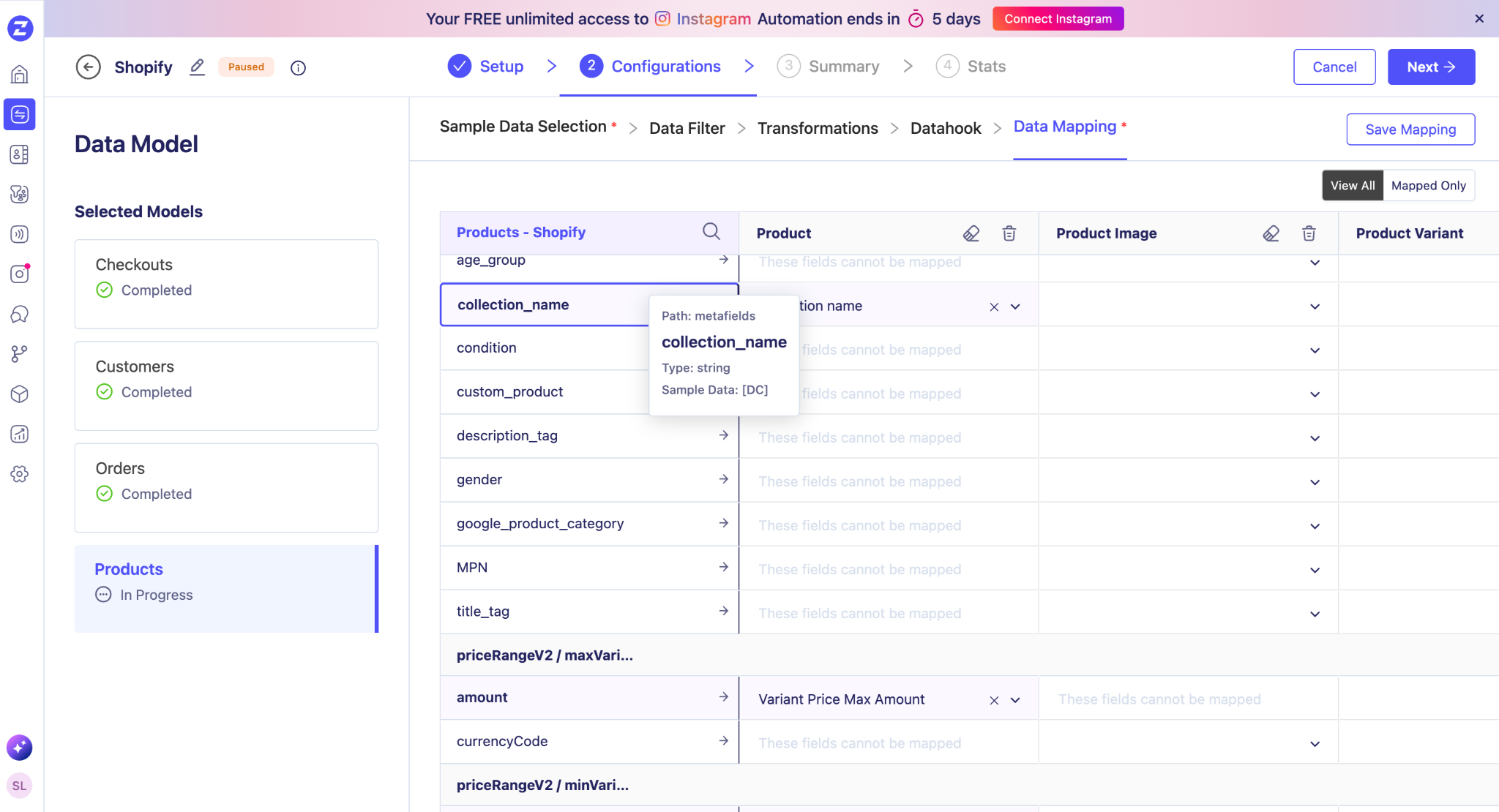
Automatic Synchronization: Once your Shopify store is connected and the fields are mapped, ZEPIC automatically pulls in all corresponding Metafield data. Any change you make inside Shopify is updated instantly inside ZEPIC without any manual uploads or patchwork solutions.
ZEPIC then treats this rich Metafield data just like any standard field, allowing it to be used for dynamic content, ultra-specific audience segmentation, and sophisticated automation triggers across all your campaigns.
Now that you have the data in the system, here’s what you can do with it:
Customers are often loyal to a specific style, component, or sub-category detail of your products. Generic announcements dilute this loyalty and waste budget. Metafields allow you to segment and target customers based on the granular attributes of their past purchases, isolating your most receptive buyers for specific new arrivals.

Imagine you’re an apparel brand launching a new collection of DC superhero T-shirts.
Most marketers would send a broad “New Collection Dropped!” email to everyone who has ever bought a T-shirt. But with Shopify Metafields imported in ZEPIC, you can go far deeper.
Say in your Shopify store, each product already has metafields like:
Because ZEPIC imports these metafields automatically, you can create hyper-specific segments, such as:
Instead of one generic announcement, you send:
Each group receives a message that aligns with their exact preferences, not just “new T-shirt”, but new T-shirt in the theme, character, material, and style they love.
This level of relevance drastically increases:
Returns often happen not because customers dislike a product, but because they didn’t understand how to use it, care for it, or wear it correctly. Metafields give you the ability to deliver proactive, product-specific guidance that prevents disappointment, before it happens.

Let’s say you run a jewelry brand that sells delicate gold-plated pieces. In Shopify, your products already have metafields such as:
After your Shopify Metafields sync into ZEPIC, you can use that data to trigger post-purchase automations for the exact product a customer bought.
For example:
By proactively educating customers:
Replenishment is one of the most reliable ways to boost repeat purchases and increase LTV—but only when it’s timed right. Sending a generic “Running low?” message doesn’t work if you don’t know when a customer is actually likely to run out.
Shopify Metafields give you the ability to store product-specific details like:
With this data synced into ZEPIC, you can build precision-timed replenishment flows that fire exactly when each customer is likely to need a refill.

Say a skincare brand sells a vitamin C serum with these metafields:
You can use these metafields to create a replenishment flow that sends a reminder right before the customer is likely to run out.
For example:
The serum usually lasts around 28 days and it takes about 5 days to deliver. So you set ZEPIC to send the reminder a few days before the bottle is expected to run out.
For high-value or sensitive products like supplements, electronics, home appliances, or premium textiles, transparency builds trust. Customers feel more confident when you proactively share compliance details, certifications, and warranty information instead of making them hunt for it.
Shopify Metafields let you store these important details, such as:
With these you can create automated messages that increase confidence, reduce uncertainty, and minimize support tickets.

Imagine you sell premium headphones that come with:
After these metafields sync into ZEPIC, you can create a post-purchase flow that sends customers:
All tailored to the exact product they purchased.
Generic “You may also like” suggestions rarely convert. Customers don’t want random recommendations—they want products that are compatible, complementary, or stylistically aligned with what they just bought.
Shopify Metafields let you store the deeper product data that makes this possible, such as:
You can leverage this to recommend complementary products.

Imagine a home décor brand selling lamps with metafields like:
When a customer buys a lamp:
Shopify Metafields unlock a level of customer understanding that generic product fields simply can’t match. And when this rich, structured data flows directly into ZEPIC, your marketing stops being broad, repetitive, and guess-based.
With metafields powering customer journeys, your brand finally operates with the personalization depth customers expect.
But the impact goes beyond today’s campaigns.
Structured data is also what fuels the next era of commerce: conversational shopping and AI agents that can filter, recommend, compare, and guide customers automatically.
LLM-powered agents can only be as smart as the data they’re given. When you organize your product information through metafields and syncing it into ZEPIC, you’re preparing your brand for the coming shift to agentic commerce.
In short:
Better data → smarter automations → deeper personalization → higher revenue—now and in the future.
Ready to turn your Shopify product data into a personalization engine?
Connect your store to ZEPIC and unlock the full power of metafields today.

%201.png)


.png)