The Hotel Guest Messaging Stack: WhatsApp, SMS, or Email: When to Use Which
Anandhi Moorthy
Senior Content Marketer
August 14, 2026
TL;DR
During pre-stay, use email 7–14 days before arrival for detailed guides and offers, then WhatsApp or SMS around 48 hours before arrival for check-in and logistics.
Pre-arrival messaging can drive ancillary revenue through room upgrades, airport transfers, early check-in, and in-room add-ons.
During the stay, WhatsApp should be the primary concierge channel, while SMS works well for urgent operational updates.
Timely in-stay messages can monetize unused capacity by promoting spa slots, dining experiences, and late check-out options.
Post-stay messaging should capture feedback quickly and use email to deliver receipts, request reviews, and encourage loyalty.
Hotels can turn one-time guests into repeat direct bookers with personalized offers, loyalty incentives, and seasonal reactivation campaigns.
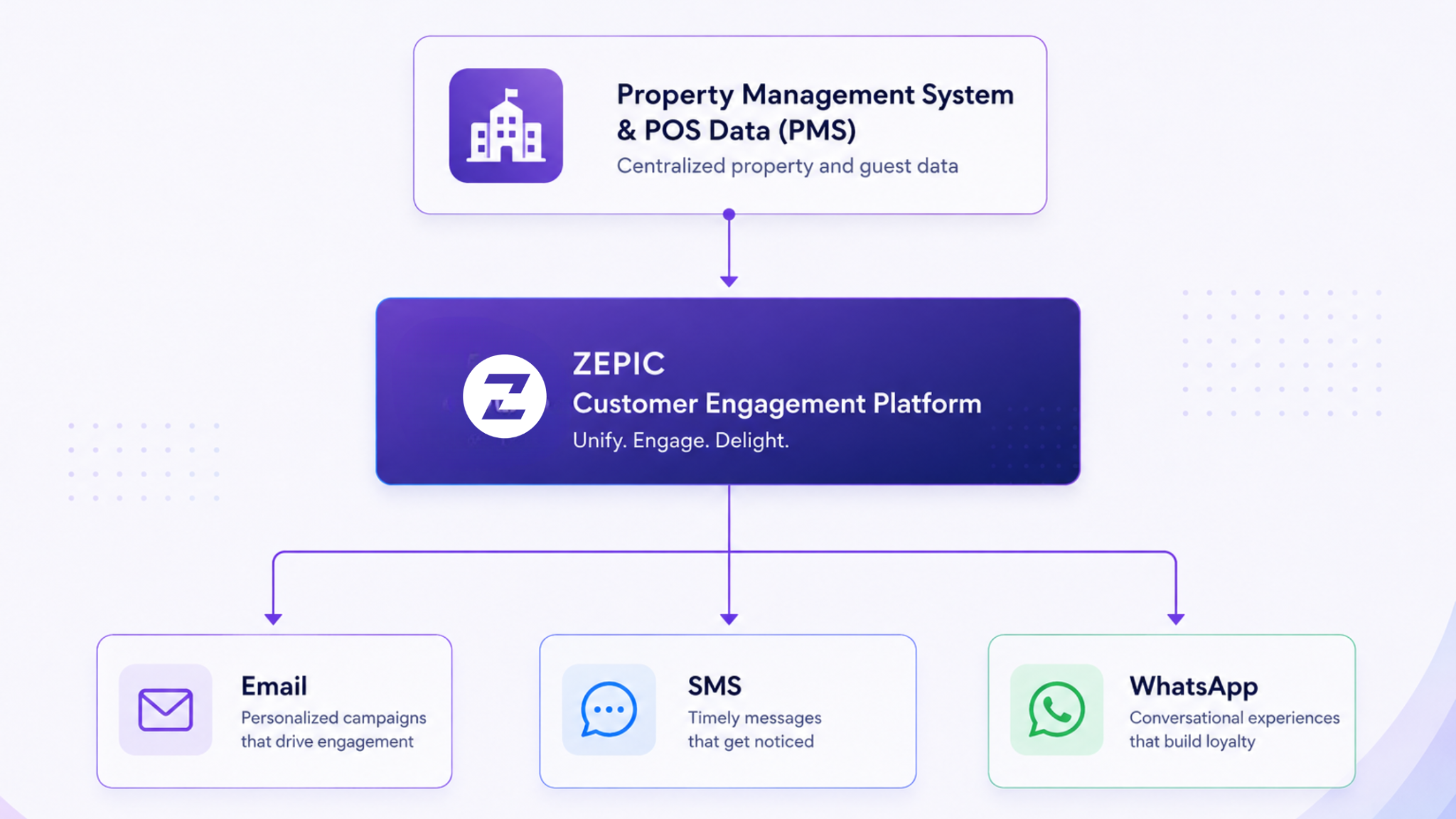
A unified customer engagement platform prevents fragmented communication by connecting PMS, POS, guest profiles, and messaging channels into automated journeys.
The travel industry has seen a drastic boom in the last two years. According to UN Tourism, about 307 million tourists traveled internationally in the first quarter of 2026, about 6 million more than the same period of 2025. This growth has created huge opportunities for hoteliers, but it has also increased the need for a seamless guest messaging strategy.
Say John and his family landed at your hotel after an eight-hour flight. They’d have to walk into a crowded lobby and wait 20 minutes to get to their room, only to realize they forgot to request a late check-out or ask about spa availability. On the hotel’s end, the front desk team is overwhelmed with repetitive calls about Wi-Fi passwords, while the spa is 40% empty because nobody knew there were open slots.
This friction is a direct symptom of a broken communication system. Traditional hotel touchpoints rely heavily on in-person front desk interactions or emails the guests rarely open while traveling.
Imagine if John received a text asking if we’d be interested in ancillary services. He would’ve easily booked the spa, and the hotel would’ve made more money.
To create such friction-free guest experiences, your hotel needs a multi-channel guest messaging strategy.
You need to place the right message on the right channel at the right moment to get the most out of your communication strategy. Email, SMS, and WhatsApp each play a distinct role across the pre-stay, in-stay, and post-stay phases.
If you apply it strategically, this multi-channel framework can improve operational efficiency, elevates guest satisfaction scores, and unlocks substantial ancillary revenue through automated upselling.
Let’s look at how you can improve your guest messaging at each stage of their journey.
Email is the foundational communication anchor. It can handle high-volume information, rich image layouts, legal terms, and formal documentation without character limits.
Strengths: High content capacity, rich formatting, universally adopted, zero per-message send costs.
Limitations: Lower open rates (~20%) and delayed response times.
WhatsApp is a dynamic, two-way communication channel supporting rich media, quick-reply buttons, interactive catalogs, and automated chatbot integration.
Strengths: Supports high media engagement, interactive buttons, two-way conversations, and low friction for international travelers.
Limitations: Requires phone number opt-ins and adherence to Meta message template pricing and window rules.
Primary Role: Real-time concierge requests, interactive pre-arrival check-ins, targeted in-stay upselling, and direct guest resolution.
What Mesages to Send During the Pre-Stay Phase
The pre-stay phase is the window between booking confirmation and arrival. Guests usually show high engagement levels during this period as they actively plan their trip logistics.
Pre-Arrival Communication Strategy
7 to 14 Days Before Arrival (Email): Send a comprehensive destination guide, resort policy details, and curated stay packages. Email allows guests to review options at their own pace.
48 Hours Before Arrival (WhatsApp or SMS): Send a direct message offering pre-arrival registration and immediate logistics confirmation.
Guests are receptive to pre-arrival upselling when offers directly address travel convenience and comfort.
Room Category Upgrades: Offer unsold premium inventory (e.g., Ocean View Suites or Executive Floors) at an exclusive pre-arrival rate.
Arrival Logistics: Offer private airport transfers, prepaid parking passes, or guaranteed early check-in.
In-Room Add-Ons: Promote pre-stocked minibars, chilled champagne on arrival, or welcome fruit platters.
Example (WhatsApp - 48 Hours Pre-Arrival):
"Hi [Guest Name], we look forward to welcoming you to [Hotel Name] this Thursday! Skip the front desk line by completing your quick digital check-in here: [Link]. Would you like us to arrange a private airport transfer for your arrival at [Flight Arrival Time]? Reply 1 for Sedan ($45) or 2 for SUV ($65)."
What Messages to Send During their Stay at Your Property
The in-stay phase should be all about frictionless service delivery and real-time monetization of property amenities.
In-Stay Channel Optimization
WhatsApp (Primary Channel): Enables seamless two-way interactions. Guests can send text messages or photos to request extra towels, order room service, or inquire about pool hours without calling the front desk.
SMS (Secondary/Fallback): Used for immediate operational messaging, such as notifications that a room is ready or emergency property alerts.
Maximizing In-Stay Ancillary Revenue
In-stay monetization relies on timely, context-aware offers that fill real-time operational capacity.
Spa & Wellness Slot Filling: Broadcast limited-time promotional rates to guests during off-peak morning or early afternoon hours.
On-Property Dining & Bar Engagement: Send interactive dinner menus or chef's tasting menu invitations around 4:30 PM to influence evening dining decisions.
Late Check-Out Extensions: Send an automated message the evening prior to departure offering extended stay options for a fixed fee.
Example (WhatsApp - In-Stay Spa Promotion):
"Good morning [Guest Name]! Looking to unwind today? We have 2 open slots at The Serenity Spa this afternoon with an exclusive 20% credit for current guests. Tap below to reserve your slot directly." [Book 2:00 PM Slot] [Book 4:30 PM Slot] [View Spa Menu]
What to Send in the Post-Stay Phase
The post-stay phase should be about getting guest feedback and building long-term brand loyalty.
Post-Stay Channel Execution
1–2 Hours Post Check-Out (WhatsApp or SMS): Send a short, single-question satisfaction rating while the stay experience remains top-of-mind.
24–48 Hours Post Check-Out (Email): Send a formal thank-you email containing the itemized guest folio, direct links to review platforms (Google, TripAdvisor), and loyalty program registration.
Driving Lifetime Value (LTV) & Direct Revenue
Convert one-time visitors into repeat direct bookers by providing targeted incentives through email marketing workflows.
Direct Booking Incentives: Offer returning guests exclusive rates or complimentary perks (e.g., free breakfast, room upgrade) on future stays booked directly.
Seasonal Reactivation: Send personalized booking reminders timed around the anniversary of their previous stay or during seasonal holiday periods.
Example (Email - 24 Hours Post-Departure):
Subject: Thank you for staying with us, [Guest Name]! Here is your receipt.
"Dear [Guest Name],
Thank you for choosing [Hotel Name] for your recent stay. Your final itemized folio is attached to this email.
If you enjoyed your time with us, would you mind taking 60 seconds to share your experience on Google? Your feedback helps our team tremendously.
[ Leave a Google Review ]
Planning your next getaway? Use promo code on our website to receive 15% off your next stay plus complimentary breakfast."
Why Your Hotel Needs a Customer Engagement Platform
Managing three distinct channels manually or across disconnected software tools quickly leads to fragmented guest experiences and missed revenue opportunities. A guest might receive an email offering an early check-in pass after they have already booked one over WhatsApp, or receive a room upgrade text after they check in.
ZEPIC acts as the central orchestration engine that connects your Property Management System (PMS), point-of-sale systems, and messaging channels into a single operational brain.
1. Unified Guest Profiles
ZEPIC consolidates data across every guest touchpoint—booking history, preferred amenities, past room service orders, and message interactions—into one dynamic profile. Your team always knows who the guest is, whether they prefer WhatsApp or email, and what services they have already purchased.
2. Automated Lifecycle Orchestration
Instead of sending generic messages, you can use ZEPIC to create messaging flows based on real-time event data. When a guest books a stay, ZEPIC automatically initiates the pre-arrival sequence via email, transitions to WhatsApp 48 hours prior to check-in, and pauses promotional texts the moment the guest checks in.
3. Smart Channel Routing
If a critical operational message fails to deliver over WhatsApp due to connection issues, you can automatically set up a fallback to SMS to ensure 100% delivery for urgent alerts.
4. Maximized Ancillary Revenue
When you sync PMS reservation status with ZEPIC's automated journey builder, your hotels can serve targeted upselling campaigns based on guest behavior. This ensures guests are offered spa packages, room upgrades, or late check-outs at the exact moment they are most likely to convert.
The Hotel Guest Messaging Channel Matrix
Use this framework to map operational touchpoints to their optimal channel and timing:
Lifecycle Phase
Guest Touchpoint
Primary Channel
Secondary Channel
Key Objective
Pre-Stay
Booking Confirmation
Email
SMS
Provide detailed reservation documentation.
Pre-Stay
Destination & Amenities Guide
Email
-
Educate guest on property offerings
Pre-Stay
Digital Check-in & Upgrade Offer
WhatsApp
SMS
Capture pre-arrival upsells and arrival times
In-Stay
Room Ready Notification
SMS
WhatsApp
Provide instant notification upon check-in readiness
In-Stay
Concierge Requests & Room Service
WhatsApp
-
Streamline guest requests and internal operations
In-Stay
Off-Peak Amenity Promotions
WhatsApp
-
Fill unsold spa, cabana, or dining slots
In-Stay
Late Check-Out Offer
WhatsApp
SMS
Monetize departure flexibility
Post-Stay
Immediate Micro-Feedback
WhatsApp
SMS
Intercept negative feedback before public reviews
Post-Stay
Itemized Folio & Review Request
Email
WhatsApp
Collect public reviews and provide official receipt
Post-Stay
Win-Back & Direct Loyalty Offers
Email
WhatsApp & SMS
Secure repeat direct bookings
Transform Your Guest Experience with Modern Messaging
An effective guest messaging stack is a core driver of guest satisfaction and ancillary revenue. If you match the right channel to each phase of the guest journey, you create a frictionless experience from the moment a room is booked to long after checkout.
Email sets expectations with rich detail, SMS delivers critical alerts with speed, and WhatsApp drives real-time engagement and upselling opportunities during the stay.
However, technology is only a part of the equation. To deliver truly personalized journeys without overwhelming your operational team, your messaging channels must speak to each other in real time.
Ready to elevate your hotel guest messaging stack?
With ZEPIC, you can connect your PMS data, unify guest profiles across touchpoints, and build automated multi-channel journeys that turn everyday messages into meaningful revenue.
WhatsApp is the leading messaging app for international and leisure hotel guests due to its global adoption, support for rich media, and interactive messaging features. For domestic travelers or quick alerts, SMS serves as a reliable secondary channel.
How far in advance should hotels send pre-arrival messages?
Hotels should send detailed pre-arrival emails 7 to 14 days before arrival for trip planning. Direct messaging via WhatsApp or SMS should be sent 48 hours before check-in to offer digital check-in and confirm arrival logistics.
What is the difference between SMS and WhatsApp for hotel guest messaging?
SMS relies on cellular networks, making it ideal for short, critical text alerts without requiring internet access. WhatsApp operates over internet data, enabling media-rich media, quick-reply buttons, interactive catalogs, and dynamic messaging workflows.
How do hotels avoid overwhelming guests with too many messages?
Hotels should implement strict messaging frequency limits and segment audiences by guest behavior using a customer engagement platform like ZEPIC. Send transactional messages (confirmations, check-in links) as needed, but limit promotional upselling messages to 1–2 per stay segment across the guest journey.
What is the average open rate for hotel SMS versus hotel email?
Hotel SMS messages achieve average open rates between 82% and 98%, with most messages opened within three minutes of delivery. Hotel promotional emails average open rates between 20% and 25%.
How can hoteliers measure ROI from automated guest messaging?
Track conversion rates across pre-arrival room upgrades, on-property amenity bookings, and late check-out purchases generated directly through messaging links. Additionally, monitor labor savings from reduced front-desk call volume and improvements in overall review scores.




.jpg)

%201.png)


.png)