Meet

Neura HQ,
Your connected AI Agent Workforce Know more



.png)
TL;DR
It’s the year 2040.
Your fridge orders your groceries. Your digital assistant schedules your salon appointment and picks the best stylist based on your calendar, budget, and how frizzy your hair’s been lately.
You’re on the couch, telling your grandkids,
“Back in my day, we’d scroll through endless options, add things to our cart, and—get this—manually check out!”
They gasp in horror. Someone whispers, “That sounds exhausting.”

If you’re thinking 2040 is too soon for this level of change, you might need to think again because Agentic Commerce is already here.
With Shopify, Amazon, Google, and OpenAI rolling out intelligent agents that are redefining ecommerce, this future might become a reality very soon. As one of our co-founders, Bharathi Kannan puts it:
"Just as the iPhone changed phones forever, AI agents are transforming how we live. They automate your daily tasks, freeing you to focus on what only humans can do. Imagine telling your shopping agent: 'Find eco-friendly yoga pants in navy blue, size M, under $50, and have them here by Friday.' While you sip your morning coffee, it searches every store, compares reviews, and places the order. That's tomorrow's convenience... today."
Let’s explore what’s unfolding in the Agentic Commerce space in 2026 and what it means for consumers and D2C brands trying to stay ahead of the curve.
If 2025 was about individual AI agents, 2026 is all about interoperability. Until now, AI agents lived in walled gardens; a ChatGPT agent couldn't easily talk to a Google checkout, and a Shopify store didn't necessarily "speak" the same language as an Amazon assistant. In 2026, those walls have come down, replaced by a shared infrastructure that makes commerce truly headless and agent-first.
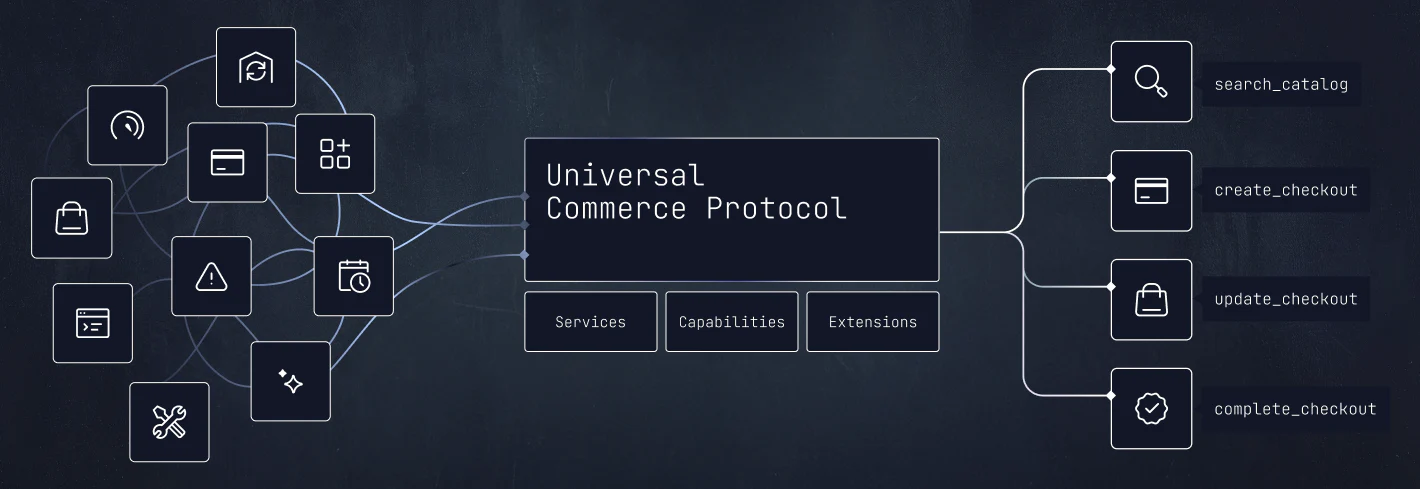
Shopify announced one of the biggest breakthroughs of the year on January 11, 2026, at NRF. Co-developed by Shopify and Google, the Universal Commerce Protocol (UCP) provides a standardized way for any AI agent—regardless of who built it—to understand a brand’s inventory, pricing, and shipping rules in real-time.
Shopify also announced that native shopping on Google surfaces is rolling out soon, which means Shopify merchants can sell directly in AI Mode in Google Search and the Gemini app. The brand is also releasing an update to its Microsoft Copilot integration with a new embedded checkout experience
Let’s look at an example of how this will change the shopping experience,
1. The Prompt: While driving to work, John realizes he forgot to buy a gift for a housewarming party tonight. He tells his car’s AI assistant: "Find me a high-end scented candle under $60 that can be delivered to my office by 3:00 PM today."
2. The Protocol Negotiation: Using the Universal Commerce Protocol, the AI agent doesn't just "Google" candles. It pings the UCP endpoints of local D2C brands. It instantly compares a Shopify-powered boutique and a local artisan brand.
3. The Proactive Offer: The AI agent sees that John has a 10% discount code for Brand A from a previous purchase (stored in his digital wallet). It communicates this through the UCP, and Brand A’s system confirms: "If he buys now, we can prioritize a courier for 2:30 PM delivery."
4. The Frictionless Sale: The AI tells John, "I found a luxury Sandalwood candle from Brand A. With your discount, it's $49.50 and will arrive at your office by 2:30 PM. Should I buy it?" John says, "Yes." The agent completes the Native Checkout using John's saved Shop Pay credentials via the UCP.
John never looked at a screen, and the brand won a high-margin sale purely because their UCP-ready data proved they could meet the customer's specific, real-time constraints.
In a bold move, Shopify opened its product catalog infrastructure to brands not on Shopify. This allows any brand to feed their products into the "Shopify Catalog" so they can be discovered by AI agents across the web.
To help brands make the most of agentic AI, Google is introducing Gemini Enterprise for Customer Experience (CX), a single platform that combines shopping and customer support. It comes with ready-made AI agents that can be set up quickly and handle the full customer journey, from helping someone find the right product to resolving issues after purchase. These agents go beyond answering questions. They can think through the next steps and take action, while keeping humans in control.
One example is Google’s Shopping agent, which acts like a personal shopping assistant. It understands text, voice, and images, builds carts automatically, and completes approved actions, turning conversations into purchases.
On August 6th, Shopify launched three tools to make it easier for developers to embed the eCommerce functionality into the apps, chatbots, or whatever they’re building.
This move aims to bring shopping directly into AI conversations. Through the new developer toolkit, Shopify enables intelligent agents to seamlessly search, select, and purchase products across its entire merchant ecosystem.
Imagine an AI helper that can instantly search through millions of products and find exactly what you want, with prices and availability updated in real time. Shopify’s Catalog does just that.
Shopify has introduced a universal product ID system that combines identical products to eliminate duplicate results.
The catalog also has easy-to-use web components that developers can customize to fit their apps. These components handle things like subscriptions, product bundles, and different product options, while letting the AI agent guide the entire shopping experience smoothly.
Say you like a dress from Store A and a pair of shoes from Store B. Normally, you’d have to visit both websites, add items to separate carts, and go through two different checkout processes. Shopify’s Universal Cart is designed to simplify this process.
It consolidates items from multiple merchants into a single cart within the AI agent’s interface. This eliminates the friction of managing separate carts or checkouts.
Shopify’s Checkout Kit delivers a merchant’s branded, fully customized checkout experience inside the AI conversation or app. It supports Shop Pay and meets stringent compliance requirements, including GDPR, CCPA, and PCI DSS v4, so merchants can trust the security and regulatory adherence of the checkout process. These updates are just the beginning.
“Agents will become a common way people shop... We’re making that as easy as possible for the AI age.”
-Tobias Lütke, CEO of Shopify
While Shopify is powering the backend of agentic commerce, Google is busy reshaping the frontend experience.

In May 2025, Google launched AI Mode, a conversational shopping experience. This feature is powered by Gemini and the colossal Shopping Graph, which includes over 50 billion product listings updated in real time.
For instance, if you want to buy a travel bag, all you have to do is ask the AI. The more information you give, the better suggestions you get. If you want to narrow your options down to bags suitable for a trip to Portland, Oregon, in May, the AI factors in the season, local weather, and travel context to present you with water-resistant, durable bags perfect for the rain.

Agentic checkout is another innovation that was introduced by Google earlier this year. Let’s say you’ve found the travel bag you like, but it’s out of your price range. You can click on the “Track Price” option and set the desired price range; the AI will send a push notification when the price drops. If you want the AI to buy the product for you, all you have to do is click on “Buy for me.” Yes, it’s that effortless.
Google’s innovative Virtual Try-On tool lets you upload a full-length photo of yourself and virtually try on clothes right from search results. This AI-powered feature, now broadly available across the U.S., uses advanced image generation technology to realistically show how an outfit looks on.
You can save your favorite looks, revisit past try-ons, and share them with friends to get their opinion. Beyond clothing, the tool also supports makeup try-ons with real-time AR overlays for lipstick, foundation, and full makeup styles.

In April 2025, Amazon introduced a beta version of its “Buy for Me” option. So how does this feature work?
Imagine you’re looking for Nike running shoes on Amazon; unfortunately, they’re not available on the platform. You would have to go to Nike’s website, right? No, that’s where you’re wrong. You’ll see a new option: “Shop brand sites directly.” When you tap on it, you will be taken to a product detail page within the Amazon app.
If you decide to buy, simply tap the “Buy for Me” button. Amazon then securely uses agentic AI to complete the whole purchase on the third-party retailer’s site. It safely transmits your encrypted payment, shipping, and contact information to finalize the checkout.
The transaction stays within Amazon’s familiar interface, where you can review and confirm order details such as delivery address, taxes, and shipping fees.
After purchase, you receive order confirmation and shipment tracking directly through Amazon, while the third-party brand handles delivery, customer service, returns, and exchanges.
We can’t talk about agentic commerce without mentioning OpenAI.
OpenAI complements this ecosystem with its cutting-edge AI assistants that make agentic commerce more intelligent and accessible across platforms.
ChatGPT Agents bring autonomous capabilities to shoppers and businesses alike. These AI-powered agents can browse, compare, and shop for products across multiple websites while interacting naturally with users. They utilize a built-in virtual browser to navigate e-commerce sites, fill forms, and complete purchases with user approval.
OpenAI works closely with e-commerce platforms like Shopify, enabling developers to embed ChatGPT-powered experiences into their apps and websites. This integration allows merchants to offer AI-driven product discovery, personalized recommendations, and automated cart and checkout management.
Beyond buying, OpenAI’s language models power chatbots and virtual assistants that provide customer support and assist with product questions.
Yes, all these innovations are impressive. They make shopping faster, more contextual, and incredibly convenient for consumers.
But here’s the million-dollar question: If AI agents are doing the shopping, where does that leave your brand?

An AI agent’s journey (yes, we might have to start thinking about AI journeys, too) is different from a customer’s journey. It doesn’t land on your home page; it scans structured data. IF you want to surface in agentic conversations, you’ll need clean, enriched product catalogs with real-time inventory, clear pricing, relevant tags, and detailed descriptions.
When human shoppers browse your site or click on ads, you can tweak experiences in real time. But with AI agents shopping on their behalf, personalization has to happen before the interaction begins.
So how do you personalize for AI? By giving it the best, clearest possible data to work with.
Zero- and first-party data play a crucial role here. First-party data helps you tag and organize your catalog in a way that makes sense to AI agents. For instance, if a customer regularly buys minimalist gold jewelry, your product feed should reflect those patterns with detailed attributes.
Zero-party data can be used to label products more accurately (e.g., “fragrance-free,” “cruelty-free,” or “suitable for oily skin”). The clearer and more structured your product metadata is, the better the AI can match the right products to the right customers without ever needing a human to click around your website.
Will traditional websites and targeted ads become obsolete? Not entirely, but their roles will transform significantly.
Websites become storytelling hubs: Instead of being the primary place customers discover your products, your website becomes the space where they connect with your brand. It’s where they learn your story, explore detailed product info, and see your values in action, often after an AI agent has already introduced them to your product.
Targeted Ads Evolve: Traditional targeting won’t cut it when AI agents are the ones doing the browsing. Instead of chasing eyeballs, the focus shifts to feeding high-quality, enriched product data into the system. That means well-labeled, up-to-date, and context-rich listings that AI can understand and use to recommend your products to customers.
One of the most exciting aspects of agentic commerce is how it levels the playing field for smaller and emerging D2C brands without massive advertising budgets.
AI agents prioritize product relevancy, quality, and suitability over brand size or ad spend. They show the best matches based purely on shopper needs. This organic discovery opportunity might help lesser-known brands to reach new audiences that might have been inaccessible before.
The shift to agentic commerce is already unfolding fast.
We’re entering a world where shopping journeys are no longer driven by search bars and banner ads but by conversations between AI agents and intelligent systems.
Data-driven e-commerce brands have a head start, but it’s not too late to catch up.
Focus on how well your product data is structured, tagged, and ready for machine interpretation. That means prioritizing product metadata, using real-time customer feedback loops, and building systems to collect zero- and first-party data at every touchpoint.
Because ultimately, the better your data, the more likely it is that AI agents will choose—and champion—your products.
ZEPIC can help you.
Our marketing intelligence platform helps make sure your data foundation is solid, structured, and ready to feed the next generation of AI-driven shopping experiences. Book a demo now!

%201.png)


.png)