Meet

Neura HQ,
Your connected AI Agent Workforce Know more



TLDR:
Imagine two e-commerce brands with identical products and email marketing setups.
Brand A sends campaigns to the same 10,000 subscribers every month and slowly optimizes its way to a 3% improvement in open rates. While brand B spends the same time building a pipeline that adds 500 genuinely new subscribers every month from Instagram.
After a year, Brand A has a slightly better-performing list of 10,000 people. Brand B, on the other hand, has 16,000 people on their list, including new subscribers who had never heard of them twelve months ago.
What did Brand B do differently? They used Instagram effectively to grow their email list.
Email's average ROI sits at $36 for every $1 spent. That return means nothing if the list isn't growing. And here's the part most brands miss: your email and SMS audiences are largely the same opted-in contacts. You're reinforcing an existing relationship instead of building a new one.
That's where Instagram changes the equation.
Used together, Instagram and email become a full-funnel engine rather than two separate efforts running in parallel. Instagram does the job, email can't: it shows your brand to people who have never visited your store. Once they follow you, you have a warm lead. How you nurture this lead can make all the difference.
If you get their email through DM automation or Story Reply automation, you can successfully convert them from a curious follower to a loyal customer. The best part is that you don’t have to do this manually; you can set up workflows that run automatically in the background.
Let's look at how to make Instagram and email work together as one growth engine.
Before you can solve the problem, you need to see it clearly.
When a customer visits your store and signs up via a pop-up, they typically enter their email address. When they check out, they often opt into SMS too. You've now got the same person on two lists. That's not a bad thing on its own. Reaching a buyer across multiple touchpoints reinforces your brand and can improve conversion.
The problem is that most e-commerce brands stop there and treat SMS plus email as an audience-expansion strategy when it's actually an audience-reinforcement strategy.
Industry research consistently shows that the majority of SMS marketing programs are used primarily for retention, not acquisition. They keep existing customers engaged, recover abandoned carts, and announce sales to people who already know the brand. All of these are valuable, but none of it grows your audience.
When you rely entirely on email and SMS, you eventually hit what might be called an audience ceiling. Open rates plateau. Revenue per send flatlines. List growth slows because the only way new people enter your funnel is through your own website, which means they already found you somehow.
That "somehow" is the gap. Instagram fills it.
Instagram currently has over 2 billion monthly active users. A large portion of these users are actively looking for new products and following brands they have never purchased from before. This is the primary difference between Instagram and your internal lists. Email and SMS require the customer to already have a relationship with you. Instagram allows you to reach people who do not
The platform offers specific advantages for e-commerce brands looking to grow:
The necessary mental shift is to view Instagram as a lead generation pipeline rather than just an engagement platform. Every follower who has not joined your email list represents a missed opportunity for conversion
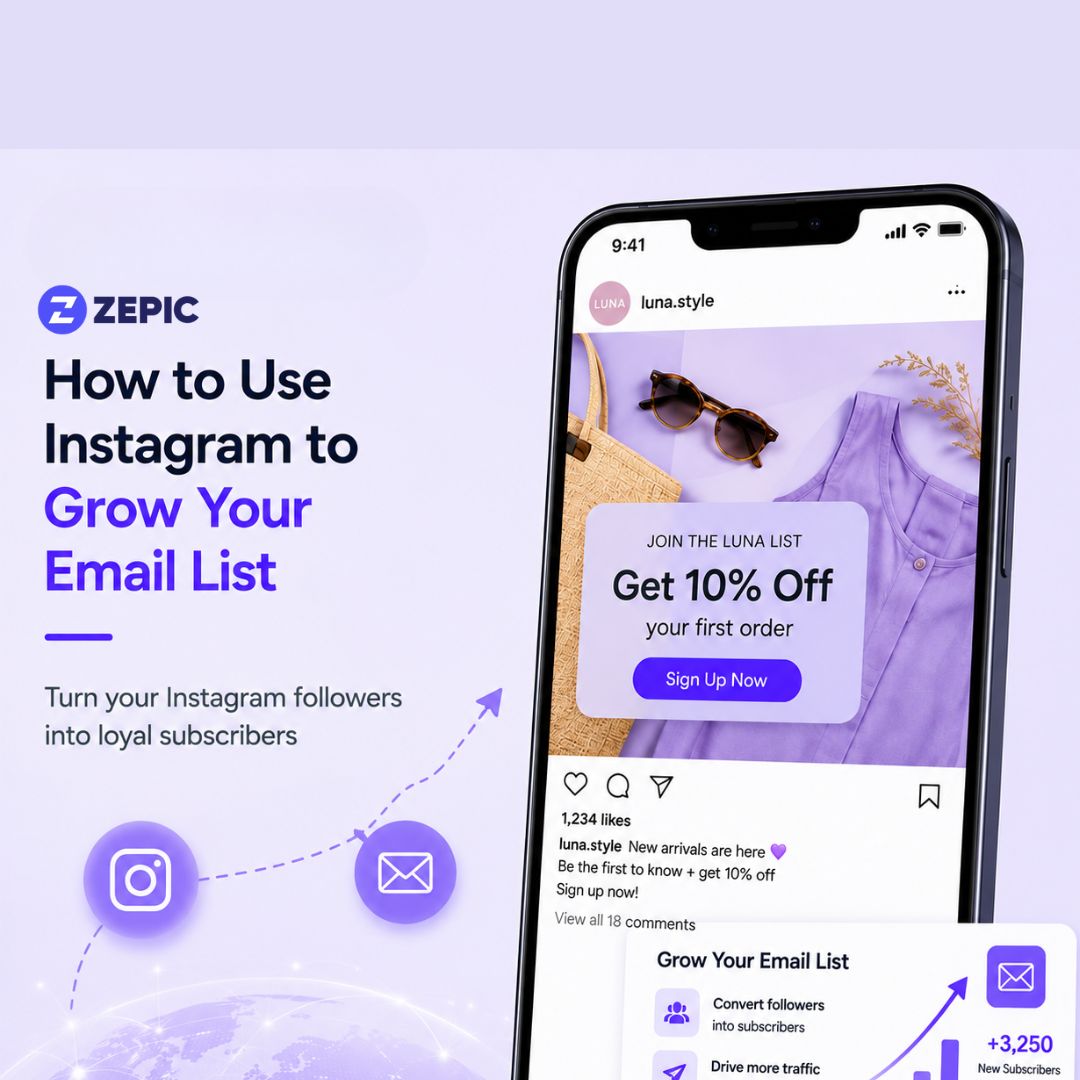
You can build a good email list from Instagram by using specific tactics designed to move followers into your marketing funnel.
Your Instagram bio is the only permanent, clickable real estate on your profile. You should use it to point to a dedicated landing page that offers something valuable in exchange for an email address. A generic invitation to join a newsletter is rarely effective. Instead, use a lead magnet that solves a real problem for your buyer.
For example, a home decor brand might offer a "Small Space Styling Guide" as a PDF download.
A skincare brand could offer a first-purchase discount code of 15% off.
Also, provide early access to a new collection before it goes live to create a sense of exclusivity.
Stories sit at the top of the feed and get consistent views from your followers. They're also the easiest low-friction path to initiate a conversation. You can use a simple three-slide Story arc to capture leads:
You can set up a Story Reply automation that collects their email to send the guide and add them to your email list.
Comment-to-DM flows are highly effective for email list building. You can post a Reel or a carousel and ask your followers to comment with a specific keyword like "STYLE" or "DEALS".
When a user comments, an automation tool instantly sends them a DM with the promised resource.
Within that DM flow, you ask for their email address to deliver the full content.
For instance, a clothing brand could post a Reel of a new Spring collection and tell users to comment "LOOKBOOK". The automated DM then collects their email before sending the digital catalog.
This method works well because the user stays within the Instagram app, avoiding the friction of external links or slow-loading landing pages.
Giveaways are a staple of Instagram marketing, but they are often handled in a way that provides no long-term value to the brand. Many brands ask users to "tag three friends" and "follow this account." While this increases your follower count, it does not give you a way to reach those people via email or SMS.
Imagine a coffee roastery running a "Morning Ritual Bundle" giveaway. The bundle includes a bag of beans, a French press, and a branded mug.
This approach is far more effective than a landing page because it keeps the user inside the app and uses actions they are already comfortable taking, like commenting and replying to stories.
If you have a budget to scale quickly, Instagram lead gen ads are powerful. Meta's native lead forms let users submit their email addresses without leaving the app. The form is often prefilled with their Instagram information, reducing drop-off.
The real power of these ads comes from targeting look-alike audiences built from your existing email list. Meta finds people on Instagram who share characteristics with your best customers. This is a scalable way to find net-new contacts who match your buyer profile. This directly addresses the gap left by the closed-loop problem of SMS and email.
Once you have moved a follower from Instagram to your email list, your job is only half done. A subscriber who came from an Instagram giveaway is in a very different mindset than someone who just bought a hundred dollars' worth of product. If you treat them the same, you will likely see a high unsubscribe rate.
The most important step is to tag every new subscriber with their source. In most Instagram automation platforms, you can automatically tag someone as "Instagram-Giveaway" or "Instagram-Bio-Lead." This allows you to see exactly which tactics are driving the most valuable subscribers over time.
Subscribers from Instagram often need more education about your brand. While your standard welcome flow might focus on a discount, an Instagram-specific flow should focus on your brand story and product benefits.
If someone signed up via a "Skincare Routine Guide," your first three emails should provide additional tips for healthy skin. You are building authority and trust. Once they have engaged with these value-focused emails, you can then introduce your products as the tools they need to achieve the results you have been discussing.
A common mistake is to drop new Instagram leads directly into your weekly promotional blast. These people are still warming up to your brand. Instead, keep them in a separate nurture sequence for the first week or two. Only after they have opened a few emails or clicked a link should they "graduate" to your main promotional list.
This protects your sender reputation and ensures you are only sending sales-heavy content to people who are ready to see it.
Email and SMS are powerful retention and conversion tools. They deserve the investment you're putting into them. But if those are the only channels feeding your marketing, you're working with a closed loop.
Instagram opens the loop. It gives you access to buyers who match your customer profile but have never found your brand. Through consistent content, DM automation, and Stories, you can build a pipeline that turns cold discovery into warm email subscribers and, eventually, paying customers.
The brands getting the most out of email marketing in 2026 are the ones that treat Instagram as the top of the funnel, feeding it. They're not blasting the same list harder. They're building a better list systematically.
ZEPIC brings all of this together in one platform. From Instagram DM automation to email campaigns, you can convert an Instagram follower to a loyal customer without switching between tools.
If you want to see how it works for your store, get a demo today!
SMS and email serve different roles in a marketing strategy. SMS is designed for speed and urgency, making it ideal for time-sensitive promotions, order confirmations, and shipping alerts. Email, on the other hand, supports deeper storytelling with visuals, longer explanations, and brand narratives. Because both channels usually rely on the same opted-in audience, brands often use external sources like Instagram to consistently grow their subscriber base.
The most effective approach for modern ecommerce brands combines DM automation with compelling lead magnets. By encouraging users to comment a keyword to receive a guide, offer, or discount, you remove the friction of leaving Instagram. This approach typically generates significantly higher conversion rates than asking users to click a link in a bio.
A landing page can work, but comment-to-DM and Story reply automation often produce better results. These tools allow participants to enter the giveaway and submit their email address without leaving Instagram. This reduces friction, improves the user experience, and typically increases both participation and data capture.
A lead magnet is a free offer provided in exchange for a customer’s contact information. In ecommerce this might include a discount code, a digital lookbook, a styling guide, a tutorial video, or early access to a product launch. The offer needs to feel valuable enough that customers see it as a fair exchange for sharing their email address.
When a subscriber first joins, focus on quality rather than frequency. Begin with a welcome sequence of three to five emails spread across the first two weeks. Once the subscriber demonstrates engagement through opens or clicks, they can transition into your regular sending schedule, which for many ecommerce brands falls between two and four emails per week.

%201.png)


.png)