How to Prepare for Black Friday/Cyber Monday 2026: A 3-Month Playbook for Retail and E-Com Brands
Anandhi Moorthy
Senior Content Marketer
August 24, 2026
TLDR:
Start early: BFCM success is built over the 13 weeks leading up to Black Friday, not just during the holiday weekend.
Get your data ready: Clean customer data and build actionable segments based on purchase history, engagement, loyalty, intent, and channel preferences.
Build for both digital and physical retail: E-commerce brands should optimize for AI and social commerce, while retailers should connect online journeys with BOPIS, local inventory, and in-store experiences.
Match channels to intent: Use email for storytelling and early access, SMS for urgency, and WhatsApp for conversational engagement, recovery, and real-time updates.
Automate the moments that matter: Set up cart and browse recovery, Instagram DM flows, post-purchase messaging, and other automated journeys before peak season hits.
Keep optimizing after BFCM: Monitor inventory and campaigns in real time, then shift into win-back, cross-sell, and loyalty campaigns once the shopping rush ends.
Black Friday/Cyber Monday (BFCM) is one of the biggest shopping weekends of the year. Despite inflation and macro headwinds, the buying intent of customers is remarkably resilient. A record 202.9 million U.S. consumers shopped over the five-day Thanksgiving-to-Cyber-Monday window in 2025, per NRF (134.9 million online (up 9% year-over-year) and 129.5 million in-store (up 3%)).
The numbers could be bigger this year.
With Black Friday/Cyber Monday three months away, brands have to buckle up and start preparing to capitalize on this opportunity.
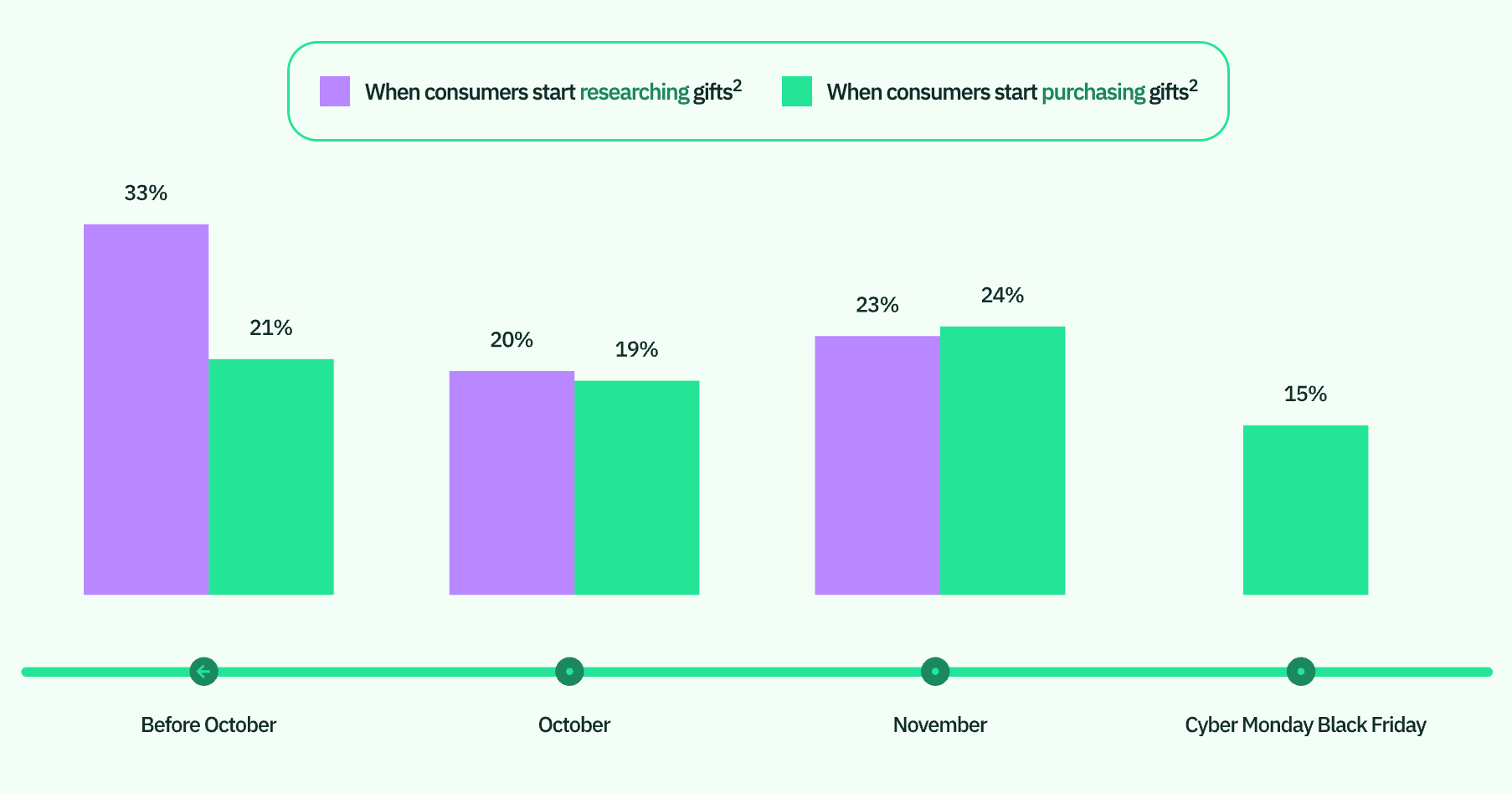
If you’re thinking there’s still a lot of time, you’d be surprised to find out that customers are already researching what to buy and where to buy it.
tvScientific's report found that a fair share of Millennials start purchasing gifts in October, and Gen X and Baby Boomers typically start in November. Gen Z is more likely to hold out specifically for Black Friday Cyber Monday deals.
65% of marketers are bound to start their holiday campaigns earlier because there’s more pressure to prove ROAS or revenue impact.
Let’s look at what e-commerce and retail brands can do to make the most of Black Friday 2026.
Black Friday/Cyber Monday 2026 Tactics for e-commerce brands
Discovery and conversion are the two main problems e-commerce-only and DTC brands are tackling this year. The traditional website or marketplace route to discovery has become a tad complicated as AI shopping assistants and social apps influence purchase decisions.
Studies show that 65% of shoppers will use AI assistants for shopping this BFCM. We’ve put together a detailed plan on what your e-commerce can do in these three months.
Weeks 12–9 (now through mid-September): Strengthen Your Foundations
Audit site and app speed, checkout flow, and mobile experience. Mobile will bring in roughly three-quarters of online holiday traffic, so make sure there’s no friction there.
Clean and unify customer data (purchase history, browsing behavior, email/SMS engagement, and loyalty status) into segments you'll use for the rest of the quarter.
Optimize your product feed and structured data for shopping AI agents and marketplaces.
Set up or refresh cart- and browse-abandonment flows across email, SMS, and WhatsApp.
Weeks 8–5 (mid-September through mid-October): Build Your Strategies
Set up native checkout in Instagram/TikTok Shop if you haven't. Social commerce is growing far faster than traditional channels, and sales are closed without a site visit at all.
Build your promotional calendar around real shopper timing rather than a single BFCM weekend: plan an October campaign for early shoppers, a November campaign for the BFCM crowd, and a separate cadence for last-minute December buyers.
Launch or expand an on-site recommendation engine. The conversion boost from clicked recommendations is a lower-effort win for your brand.
Create a separate plan for your VIP/early-access program for top-spending customers.
Weeks 4–1 (November): Activate your campaigns
Launch teaser and countdown content across email, SMS, WhatsApp, and Instagram.
Stress-test every automation (cart recovery, DM triggers, post-purchase flows) end to end.
Tighten your returns policy messaging because clear returns terms reduce purchase hesitation.
Black Friday week and beyond
Monitor inventory and messaging in real time; be ready to swap out sold-out products in ads, emails, and automated DMs.
Shift immediately into win-back and post-purchase upsell sequences once the peak shopping window passes.
How to optimize your store for AI shopping assistants
AI shopping assistants are becoming another layer between shoppers and your store. Instead of browsing dozens of product pages, customers can ask an AI assistant to find the best gift under $100, compare two products, or recommend something based on their preferences.
For BFCM, that means your products need to be easy for AI systems to understand and recommend.
Let's breakdown what your e-commerce brands should do before the holiday rush:
Keep product data complete and consistent: Make sure product titles, descriptions, prices, availability, sizes, colors, images, and shipping information are accurate across your website and product feeds. AI assistants need structured, reliable information to make useful recommendations.
Use descriptive product language: Don't rely on clever copy alone. Clearly explain what the product is, who it's for, key features, dimensions, materials, compatibility, and use cases. Think about the questions a shopper might ask an AI assistant.
Strengthen your product schema: Use structured data such as Product, Offer, AggregateRating, Review, and availability information where relevant. This gives search engines and shopping systems machine-readable context about your products.
Make reviews and FAQs discoverable: Reviews, sizing information, shipping details, returns policies, and FAQs can help answer the questions shoppers ask before buying. Keep this information accessible and clearly associated with the relevant products.
Keep inventory and pricing feeds fresh: An AI recommendation is only useful if the product is actually available at the stated price. Sync inventory, promotions, and product feeds regularly—especially during BFCM when stock and prices can change quickly.
Create comparison-friendly content: Build gift guides, "X vs. Y" comparisons, buying guides, and product collections around common shopping needs. These give AI systems more contextual information to work with while helping shoppers make decisions.
Optimize for conversational queries: Think beyond keywords like "Black Friday deals." Build content around questions such as "What's the best laptop for a college student under $800?" or "Which skincare set would make a good gift for someone with dry skin?"
Don't neglect your website experience: Getting recommended is only half the job. Make sure the landing page, checkout, mobile experience, shipping information, and returns process are ready to convert shoppers arriving from AI-assisted discovery.
The BFCM rule of thumb: If an AI shopping assistant can't quickly figure out what your product is, who it's for, how much it costs, whether it's available, and why someone should buy it, you're making it harder for that product to get recommended.
Black Friday/Cyber Monday 2026 Tactics for Retail Brands
Even though there are many avenues to shop online, customers still enjoy the in-store shopping experience during the holiday season.
However, the latest holiday shopping studies show that the offline shopping experience is not in isolation anymore. It is part of a larger omnichannel model.
42% of consumers visit the store to buy something they already researched online; 79% are actively on their phones while walking the aisles. They’re checking competitor prices (24%), browsing social for style inspiration (15%), hunting discount codes (14%), and checking loyalty apps (9%).
Weeks 12–9: Lay the Foundations
Forecast inventory and finalize seasonal staffing. NRF's data shows shopping weekend foot traffic is still growing year-over-year.
Check Buy-Online-Pickup-In-Store (BOPIS) and curbside logistics thoroughly. Free shipping and low-friction fulfillment are the one factor shoppers agree on regardless of income level, and BOPIS is your budget-friendly means to meet that expectation.
Audit and clean your local customer data: past in-store purchases, loyalty membership, store-visit frequency, and preferred location.
Weeks 8–5: Build your strategy
Launch or refresh local inventory ads and Google Business Profile listings so nearby "in stock near me" searches route to your store.
Equip store associates with mobile clienteling tools that show the same customer and product context shoppers had access to online. The in-store visit is increasingly the final step of a digital journey, not a separate one.
Plan in-person moments that give people a reason to show up beyond the discount: exclusive early drops, in-store workshops or lounges, or nostalgic early-morning Black Friday events. Different generations respond to different versions of this—younger shoppers respond to exclusivity and energy, older shoppers to comfort and community.
Weeks 4–1: Activate
Finalize holiday hours and communicate them across every channel, including SMS and Google.
Set up geofenced or location-based SMS/WhatsApp alerts for shoppers near a store location.
Train staff on BOPIS handoff, gift-wrapping, and returns policy so peak-day service doesn't buckle.
Black Friday week and beyond
Run in-store-exclusive offers alongside digital ones to reward foot traffic without cannibalizing online sales.
Offer buy-online-return-in-store to reduce fulfillment costs on returns.
Re-engage in-store shoppers post-holiday via loyalty program messaging to convert one-time holiday visitors into repeat customers.
How to use your data and create segments for Black Friday/Cyber Monday
Both playbooks above lean on the same foundation: usable customer data. Before you jump into campaign creation, take a step back and look at the data that’s already in your arsenal. Pull together purchase history, site/app browsing behavior, email/SMS/WhatsApp engagement, and loyalty tier. If you’re a retail brand, check store visit and BOPIS history.
Then build segments you can actually message differently.
Segment
Why It Matters
What to Send Them
VIP / high-LTV customers
Small group, outsized revenue; least price-sensitive
Early access, exclusive bundles, premium perks rather than blanket discounts
With roughly a third of shoppers trading down this year, this segment is larger than usual
Lead with value and free shipping, not just percentage-off
Lapsed / at-risk customers
Cheaper to reactivate than to acquire new customers
Win-back offers, "we miss you" messaging, reintroduce new arrivals
New subscribers / first-time visitors
Highest-converting welcome window of the year
Welcome series with a clear first-purchase incentive
Category or interest affinity
Enables relevant gift-guide and cross-sell content
Personalized picks based on past browsing/purchase category
Channel-preference segments
Not everyone wants every channel
Respect opt-ins; don't triple-message someone who only opted into email
Local store shoppers / BOPIS users (retail)
Distinct behavior from pure online shoppers
Store-specific promotions, pickup-ready alerts, local event invites
Personalization is worth the segmentation effort: shoppers who engage with a personalized recommendation convert at multiple times the rate of those who don't, and companies that invest more heavily in personalization consistently report it contributing a disproportionate share of their revenue growth.
What to say this BFCM: messaging across email, WhatsApp, and SMS
Each channel plays a different role. The mistake most brands make is treating all three as interchangeable broadcast tools instead of sequencing them by urgency and intent.
Channel
Best Use Case This Season
What the Data Shows
Email
Storytelling, gift guides, VIP early access, full campaign narrative
SMS open rates are widely reported in the 90–98% range, with response rates far above email, and industry reports have cited Black Friday-specific SMS campaigns reaching extremely high ROI multiples—though, as with any single-source stat, treat the very top of that range as an outlier rather than a baseline to plan against.
WhatsApp
Conversational commerce, real-time order/shipping updates, personalized cart recovery, customer service
Open rates are frequently cited in the 90%+ range, though more conservative measured brand data (rather than industry-wide estimates) puts real campaign open rates closer to the high 70s–80s%, still well above email. Meta also caps template message frequency per user, so list quality matters more than blast volume.
A simple sequencing model:
Email sets the tone (teaser, gift guide, early access invite) days ahead.
SMS creates urgency close to or on the day itself (flash sale live, doorbuster starting, or cart about to expire).
WhatsApp is helpful with the one-to-one, conversational follow-through. You can send cart recovery with a real product image, order status, gift-wrap confirmation, or a quick answer to a sizing question.
Message angles to build out across the 13 weeks:
T-4 weeks: "Here's what's coming" teaser + early sign-up for VIP access
T-2 weeks: Early access opens for loyalty/VIP segment
Day-of: Doorbuster/flash alert, low-stock urgency for browsed items
Cyber Monday: Extended deadline, bundle offers for cart abandoners
Post-purchase: Order confirmation, shipping updates, and a soft cross-sell once the order ships
Instagram content ideas for the run-up to Black Friday
Instagram remains one of the stronger commerce channels for brands. Recent industry benchmarking has found Instagram converting notably better than TikTok and YouTube Shorts for e-commerce brands, thanks to its more mature native shopping features. Spread these ideas across the 13 weeks rather than saving everything for launch week:
Gift-guide Reels: Curate these by recipient ("for the person who has everything," "under $50") rather than by your own product categories
Behind-the-scenes prep content: Restocking, packing orders, warehouse or store-decorating footage that builds anticipation
Countdown posts: Use the built-in countdown sticker tied to your biggest promo moment
UGC reposts and reviews: Create carousels or reels with reviews and product usage videos
Founder or staff picks: A short, personal video of "what I'm buying this year" builds trust ahead of a discount-heavy season
Early-access Story polls: Start a poll ("Which of these two deals do you want first?") that doubles as a segmentation signal
Live shopping events: for a flagship product drop or restock, comment-to-DM flows during a live session are one of the highest-converting live-shopping tactics brands are using this year
Side-by-side comparison carousels: Use these for gift bundles or "this vs. that" product picks
Influencer or creator unboxings: Time these right before your early-access window opens
Instagram DM automation for Black Friday/Cyber Monday
Instagram DMs convert extremely well when the response is fast. Reported DM-to-sale conversion rates can go up to 20%. But this depends on the response speed. Brands responding within about a minute see more sales than those replying half an hour later.
Make use of these BFCM special Instagram DM automation flows.
Comment-to-DM keyword triggers: When someone comments "LINK" or "SHOP" on a Reel, instantly send the product page and any active discount code.
Abandoned-inquiry follow-up: If someone DMs a question (sizing, shipping, price) but doesn't click through, a follow-up message nudges them back a day later.
Story-reply unlocks: Replying to a Story with an emoji or keyword triggers a discount code or early-access link.
Gift-finder / quiz-style bot: A short guided flow ("Who are you shopping for?") that routes to a curated product set, useful during your gift-guide push.
FAQ auto-responder: Handles the repetitive shipping-deadline, sizing, and "is this still in stock" questions that spike during peak weeks.
Build cart-recovery and DM automations, optimize product feed for AI/social shopping
Local inventory ads live, associate training begins
Weeks 6–4 (Oct)
Content production, VIP program build-out, on-site personalization
In-store event planning, signage, loyalty tier communication
Weeks 3–1 (Nov)
Teaser/countdown campaigns launch, full automation testing
Final staffing confirmed, holiday hours announced everywhere
BFCM week
Doorbuster sends, real-time inventory monitoring, live DM automation
Extended hours, in-store exclusives, live BOPIS handoff
Post-BFCM (Dec)
Win-back and post-purchase upsell flows
Buy-online-return-in-store, loyalty re-engagement
The takeaway
The data across every source in this guide points to the same conclusion: by the time Black Friday itself arrives, a large share of the decision has already been made. Ecommerce brands need their data, feeds, and automation ready before intent gets crowded. While retail brands need to treat the store as the final node of a digital journey rather than a standalone event. Either way, the work that determines your Q4 outcome mostly happens in the next 13 weeks.
Ready to turn your BFCM strategy into action? ZEPIC helps retail and e-commerce brands bring customer data, segmentation, and multi-channel engagement together—so you can reach the right shoppers with the right message at the right moment.
Set up your WhatsApp cart recovery and Instagram DM flows in ZEPIC before October.




.jpg)

%201.png)


.png)