Meet

Neura HQ,
Your connected AI Agent Workforce Know more



|
TL;DR Most brands blast generic WhatsApp messages and wonder why conversions are flat. To achieve great results, deep personalization that goes beyond "Hi {{first_name}}" needs to be achieved. Key stats: WhatsApp delivers 98% open rates vs. email's 10-20%. Personalized campaigns see 3-5x higher conversions and 15-25% response rates. How to win:
Tools: WhatsApp Business App works for <100 messages/month. For scale, use WhatsApp Business API via platforms like ZEPIC for automated personalization without coding. Bottom line: WhatsApp lives next to chats with friends and family. Make it personal, or it gets ignored. |
Most brands are using WhatsApp wrong.
We said what we said!
Brands treat WhatsApp like email—blast the same message to everyone, hope for clicks, rinse and repeat. Generic promotions. Zero personalization. And then they wonder why their conversions are flat.
But WhatsApp isn't email. It's where people talk to their friends. When your message lands next to chats from their mom and best friend, it better feel personal—or it gets ignored.
The brands that get this right are the ones that see 3-5x higher conversions, response rates above 20%, and have customers who actually engage instead of block.
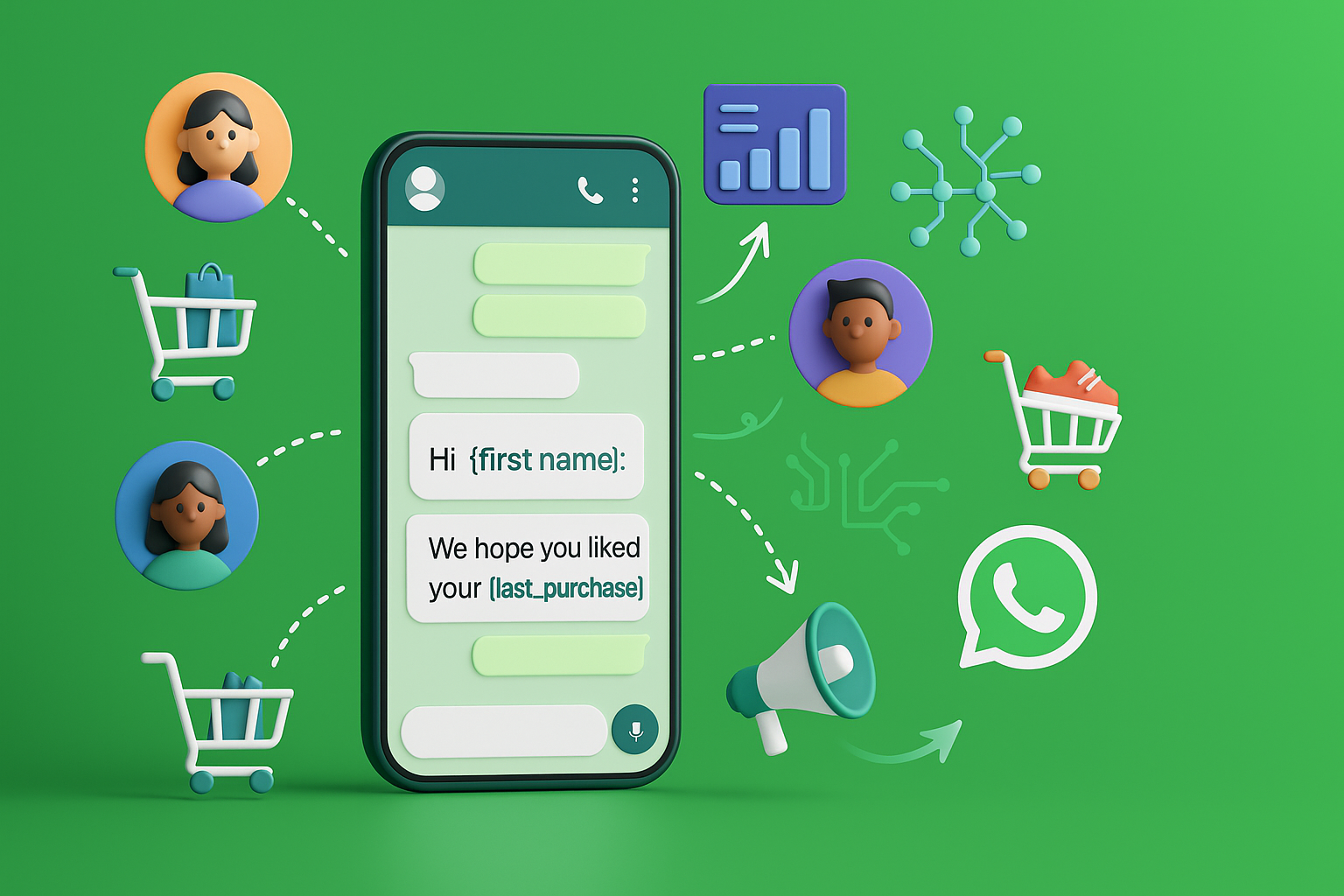
The difference is simple: personalization that goes way beyond "Hi {{first_name}}."
And in this guide, we show you how to transform bulk WhatsApp messages from ignored broadcasts into conversations that convert—whether you're sending 500 messages or 50,000.
Think about the last time you received a generic promotional message. Did you read it? Probably not. Now think about a message that addressed you by name, referenced your recent purchase, or offered something perfectly timed to your needs. That's the power of personalization.
Generic bulk WhatsApp messages feel like spam—impersonal, interruptive, and irrelevant. Personalized messages, on the other hand, feel like a conversation with a brand that actually knows you. The difference isn't subtle.
Compare the below messages:
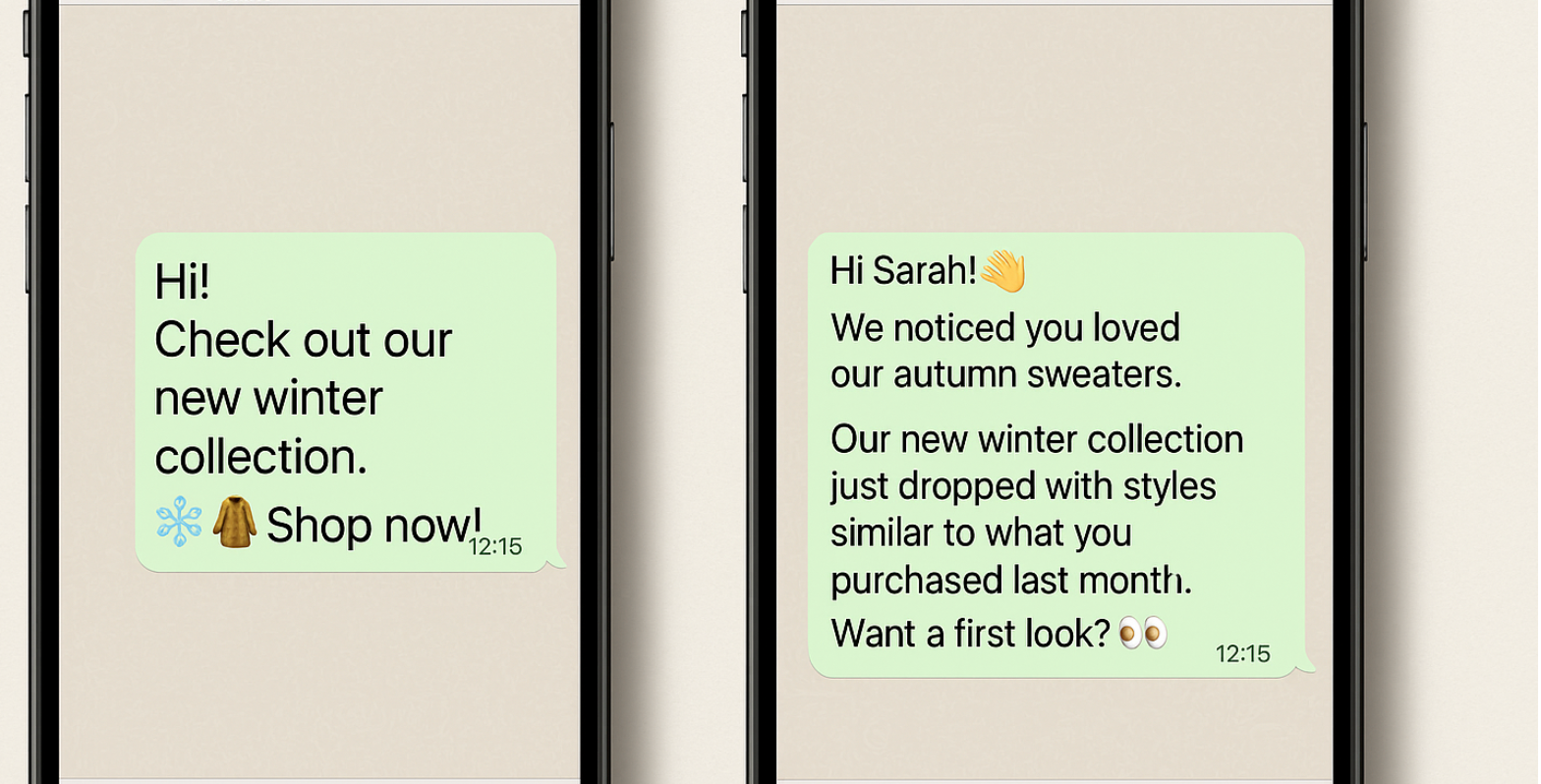
The second message acknowledges Sarah as an individual, references her actual behavior, and offers relevant value, and is actually helpful!
Personalization directly impacts your key metrics in measurable ways:
Before diving into personalization tactics, you need to understand the different approaches to sending bulk WhatsApp messages. Each method has its strengths and limitations when it comes to personalization capabilities.
The native WhatsApp Business app is the simplest entry point for very small businesses and solopreneurs. However, it comes with significant limitations:
You can create broadcast lists and use basic features like quick replies, but if you're serious about personalization or need to scale beyond a small contact base, you'll quickly outgrow this option.
This is where personalization truly shines. The WhatsApp Business API is designed for growing businesses and enterprises that need sophisticated messaging capabilities.
Important: You cannot access the API directly from Meta. You must work through approved Business Solution Providers (BSPs), which come in two flavors:
These providers give you raw API access for complete customization. You'll build your own integrations, design your dashboards, and create custom workflows from scratch.
These platforms package the WhatsApp API with ready-to-use marketing features, so you can start sending personalized campaigns immediately. You'll get user-friendly interfaces with drag-and-drop campaign builders, visual workflow editors, and pre-designed templates.
Both approaches provide the same core API capabilities:
Regardless of which provider you choose, the WhatsApp Business API allows you to integrate with your customer relationship management system, customer data platform, and other business tools to send highly targeted, data-driven bulk WhatsApp messages.
Your choice depends on three critical factors:
Now for the exciting part—the actual personalization strategies that transform generic broadcasts into engaging conversations.
The foundation of personalized bulk WhatsApp messages is using dynamic variables that insert recipient-specific information into your templates.
Basic variables give you a starting point:
Here's a simple example: "Hi {{first_name}}! We're excited to announce our {{location}} store is now offering same-day delivery. Order by 2 PM and get your favorites delivered today!"
Advanced variables take personalization to the next level by pulling from deeper customer data:
With advanced variables, you can create highly targeted messages like this:
"Hey {{first_name}}! We noticed you've been eyeing the {{product_name}}. Good news—it's now 20% off! Plus, as a {{loyalty_tier}} member, you get an extra 10% off. Grab it before it sells out!"
This level of personalization transforms a generic promotion into a message that feels tailor-made for the recipient.
Not all customers are the same, so why would you send them the same message? Segmentation is the key to relevance, and there are several powerful ways to slice your audience.
Demographic segmentation considers basic attributes:
This ensures your messages are culturally appropriate and geographically relevant. You wouldn't send winter coat promotions to customers in tropical climates, right?
Behavioral segmentation digs deeper into how customers interact with your brand:
Lifecycle stage segmentation recognizes that customers need different messaging depending on where they are in their journey:
Let's see how this plays out with real examples:
For new customers: "Welcome to the family, {{first_name}}! As a thank you for your first order, here's 15% off your next purchase. What are you shopping for next?"
For high-value repeat customers: "{{first_name}}, you're one of our top customers! We're giving you exclusive early access to our new collection—24 hours before anyone else. Ready to shop?"
For at-risk customers: "We miss you, {{first_name}}! It's been {{days_since_purchase}} days since your last order. Here's 25% off to welcome you back. Your favorite {{product_category}} items are waiting!"
Each segment receives a message that acknowledges their specific relationship with your brand.
Understanding personalization strategies is one thing—implementing them effectively is another. Here's how to make it happen technically.
If you're using a turnkey platform like ZEPIC, implementation is straightforward. These platforms are designed to handle the technical complexity so you can focus on strategy:
If you're working with developer-focused BSPs like Twilio or MessageBird, you'll need a more hands-on approach. This involves building custom integrations via API, managing data formatting and CSV uploads, setting up webhooks, and manually mapping variables to your message templates. This path offers maximum flexibility but requires technical expertise—typically a developer familiar with REST APIs and data management.
For most businesses focused on marketing results rather than technical implementation, turnkey platforms deliver faster time-to-value without the complexity.
This is where personalization becomes truly powerful. Instead of manually deciding who gets which message and when, automation workflows trigger the right message to the right person at exactly the right moment—all based on their actual behavior.
Think of workflows as "if-then" sequences that run 24/7 in the background. When a customer takes a specific action (or doesn't take one), the workflow automatically sends a personalized message tailored to that moment in their journey.
Goal: Nurture new opt-ins while their interest is fresh, guiding them from subscriber to first-time buyer through educational and value-driven messages.
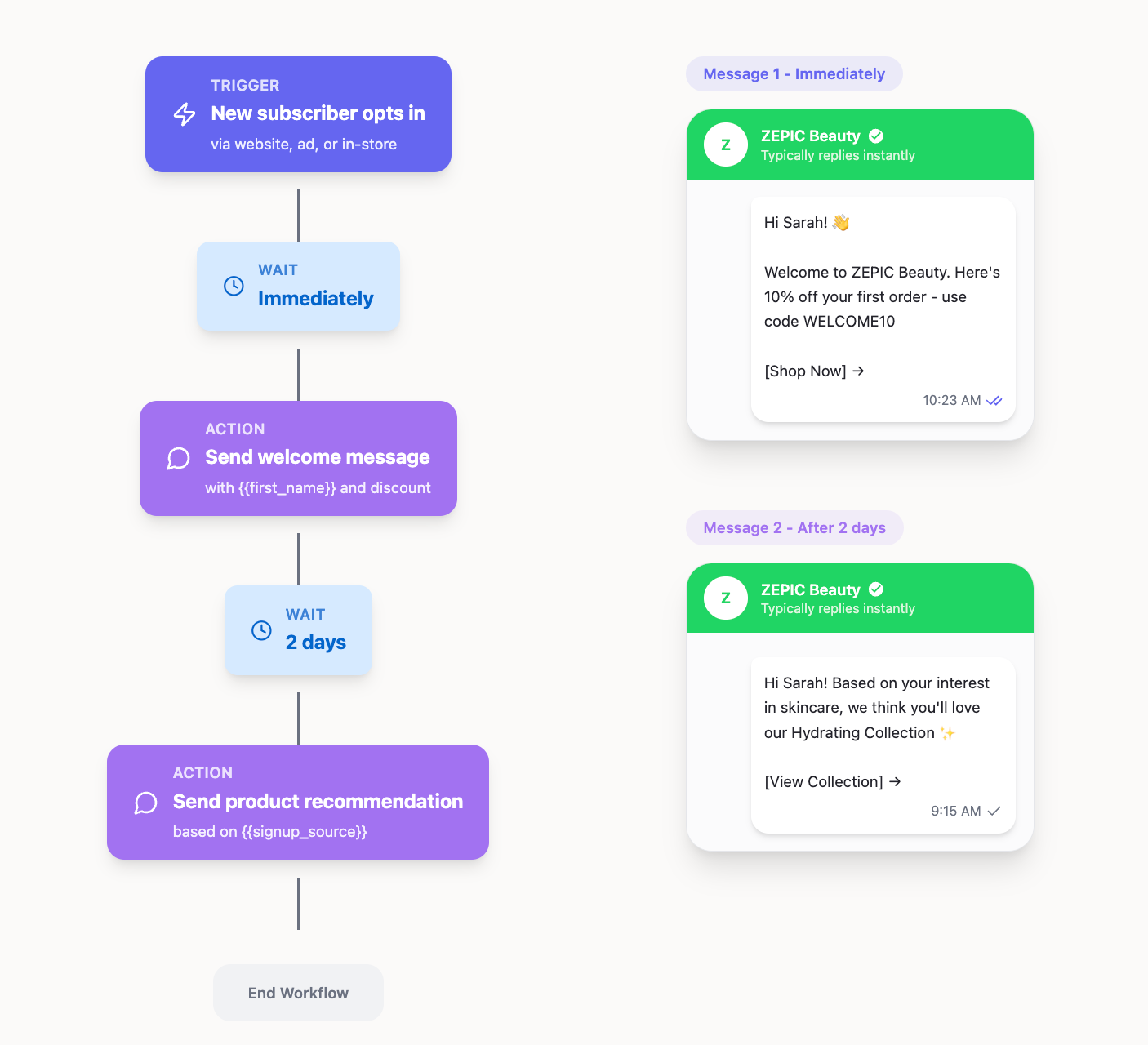
Key insight: The immediate welcome message with {{first_name}} creates instant personalization and capitalizes on peak interest—subscribers are most likely to convert within the first hour of opting in. The 2-day follow-up uses {{signup_source}} to recommend relevant products based on how they discovered you, making the suggestion feel tailored rather than random.
Goal: Bring customers back to complete their purchase with a three-touch sequence that escalates from friendly reminder to incentive to final urgency.
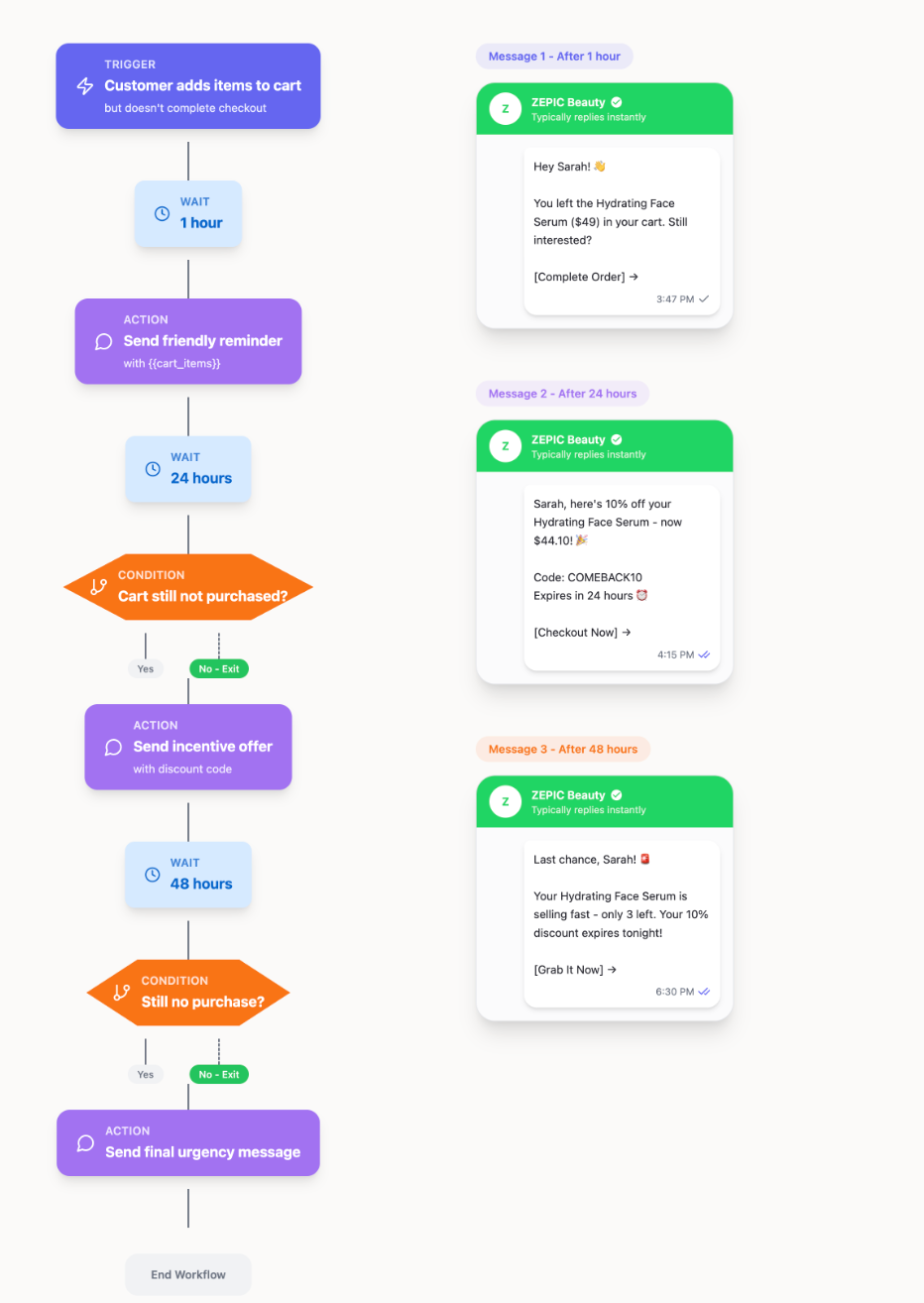
Key Insight: The 1-hour wait in the first message gives shoppers time to return on their own without feeling pressured, while the 24-hour follow-up with a discount catches those who need an extra nudge. The third message creates urgency without being pushy.
Goal: Reconnect with customers who've gone quiet by acknowledging their absence, offering compelling incentives, and gathering feedback if they remain unresponsive.
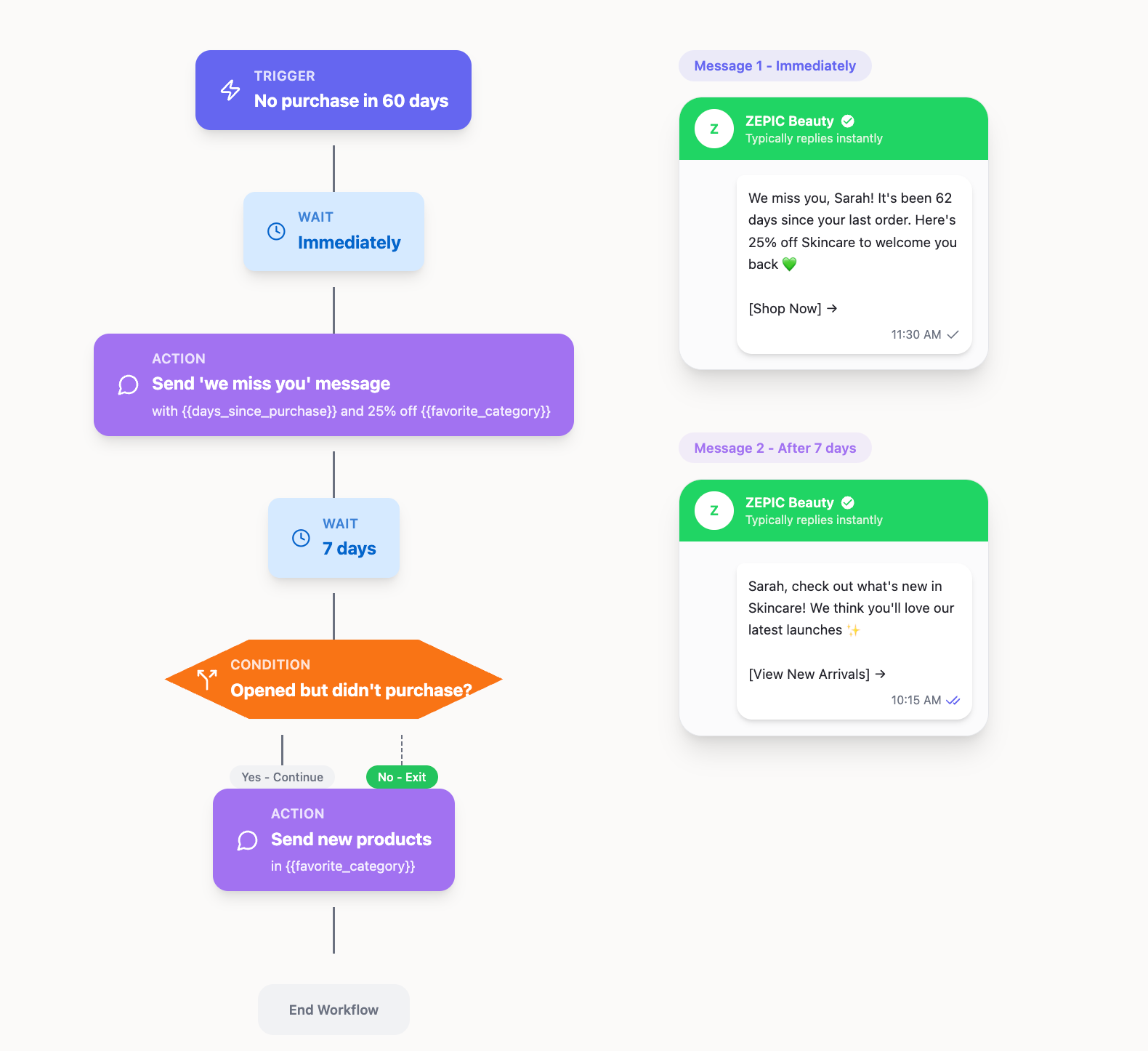
Key Insight: The 60-day trigger should be adjusted based on your typical purchase cycle—30 days for fast-moving consumables, 90+ days for durable goods. The escalation from discount to new products to feedback request ensures you're testing different motivations rather than repeating the same offer.
Goal: Transform one-time buyers into loyal repeat customers by ensuring satisfaction, gathering social proof, and timing reorder reminders perfectly.
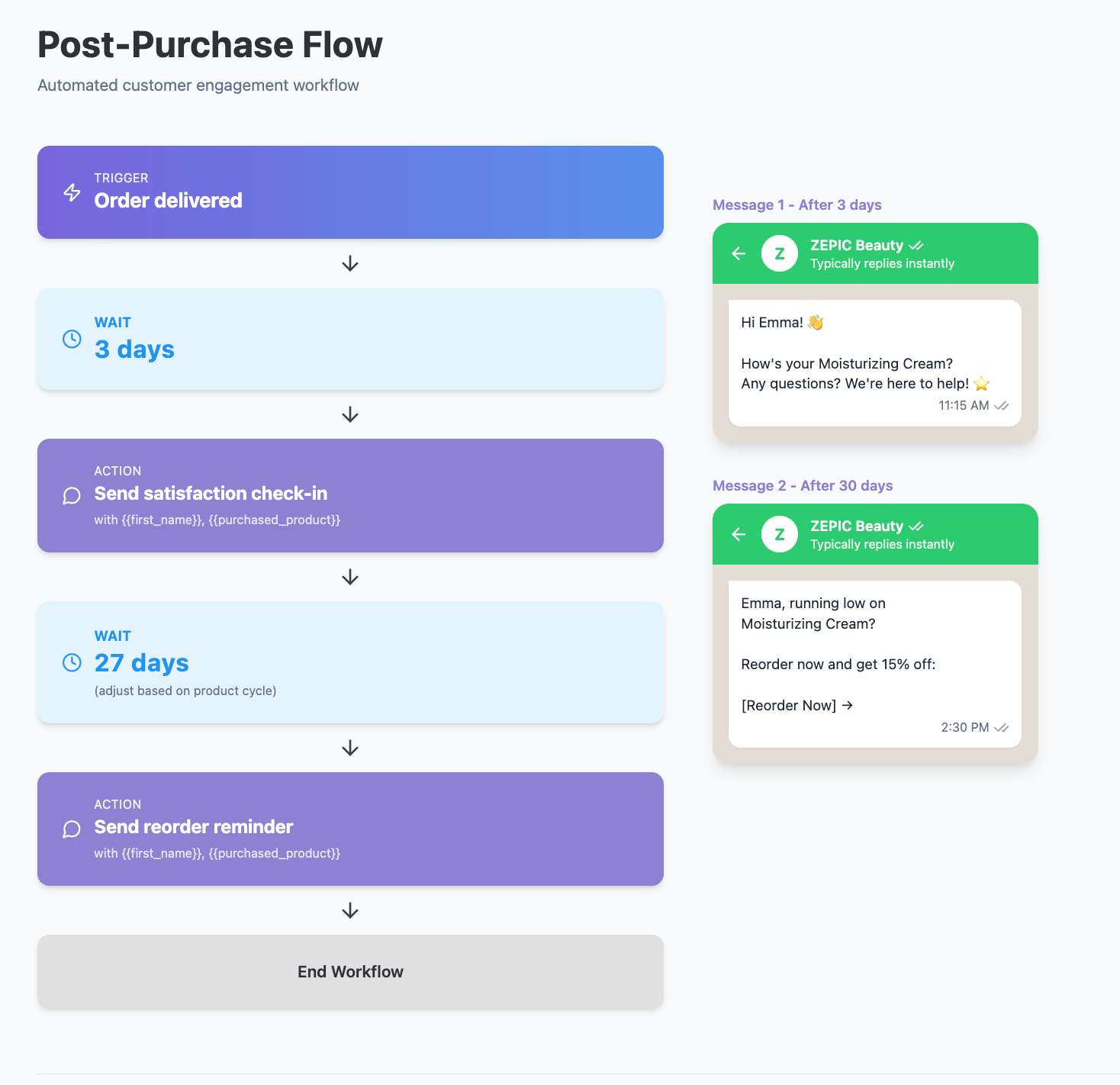
Key Insight: The 3-day wait before the first check-in gives customers time to actually use the product—asking too soon feels pushy and yields unhelpful feedback. The 30-day reorder reminder should be adjusted based on your product's consumption cycle to hit customers right when they're running low.
Even successful brands sometimes miss personalization opportunities in their WhatsApp campaigns. Let's analyze real examples and see how you can do better.
Example 1: Bath & Body Works
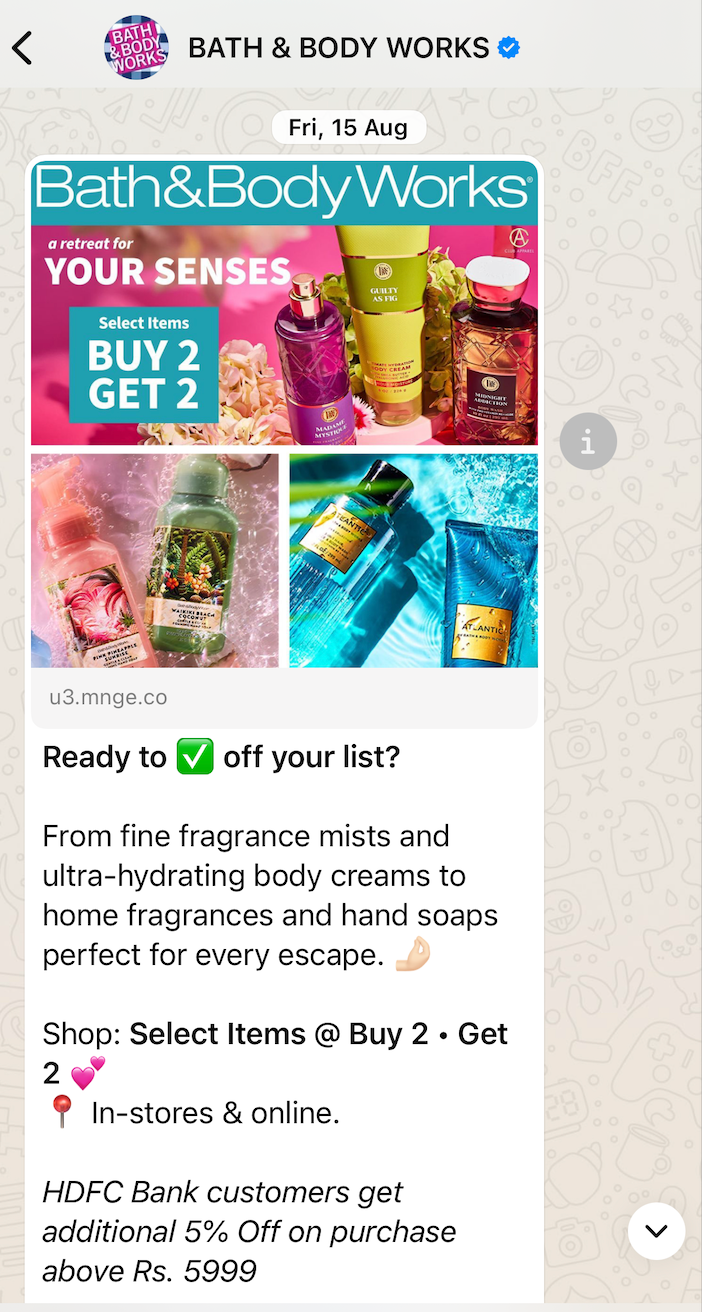
What's working well: Strong visual communication with attractive product imagery, well-organized categories (fragrance mists, body creams, home fragrances), and flexible shopping options. The bank offer adds targeted value for specific customers.
The personalization opportunity: Every subscriber receives the same message regardless of their preferences or purchase history. Whether someone loves floral scents or fresh fragrances, everyone sees an identical promotion.
Your opportunity to differentiate: Add personalization layers: "Hi {{first_name}}! Based on your recent purchase of {{product_name}}, we think you'll love these items in our Buy 2 Get 2 sale." Reference {{favorite_category}} or {{last_purchase_date}} to make promotions feel curated, not broadcast. When you acknowledge individual preferences, engagement and conversions increase significantly.
Example 2: Dyson India
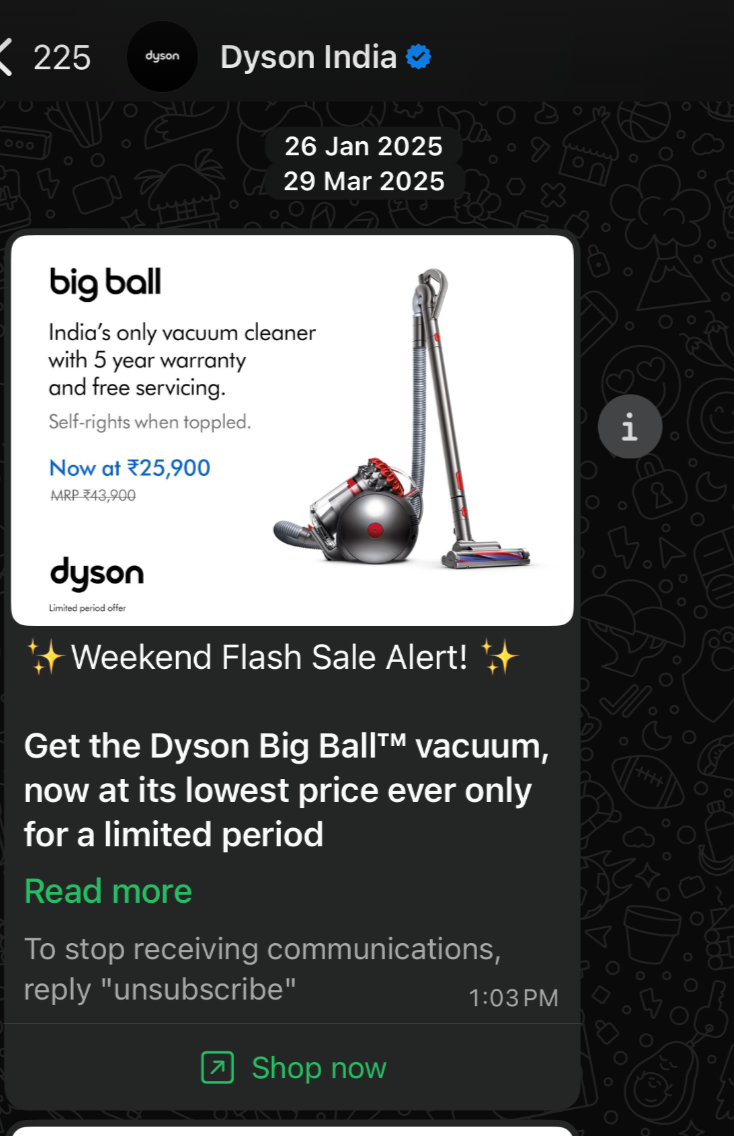
What's working well: Creates effective urgency with "Weekend Flash Sale Alert" and clear value (₹25,900 down from ₹43,900). Time-bound dates encourage quick action, premium product visualization reinforces quality, and clear CTAs guide customers toward purchase.
The personalization opportunity: Cart abandoners, first-time visitors, repeat customers, and browsers all receive identical messaging. This universal approach doesn't account for individual customer context or purchase readiness.
Your opportunity to differentiate: Segment by behavior and lifecycle stage. For browsers: "Hi {{first_name}}, remember the Big Ball vacuum you explored? It's now {{discount_percentage}}% off this weekend only." For existing customers: "As a valued Dyson owner, here's exclusive early access plus {{loyalty_discount}}% off accessories." For new subscribers: "Welcome! Our most popular vacuum is on special—perfect timing to experience Dyson quality." Same promotion, personalized delivery.
Following best practices ensures your personalized messages deliver results without annoying recipients or violating WhatsApp policies.
Before sending any bulk WhatsApp messages, you must have explicit opt-in consent from recipients. This is non-negotiable and legally required under GDPR, CCPA, and other privacy regulations.
Your opt-in mechanisms should be clear and visible, with transparent communication about what customers are signing up for. Every message must include easy opt-out options.
Example opt-in copy: "Get exclusive offers and personalized product updates via WhatsApp. Opt in to receive messages from [Brand Name]. Reply STOP to unsubscribe anytime."
Personalization should enhance the experience, not make customers uncomfortable. The key is finding the balance between being helpful and being intrusive. If personalization feels creepy rather than convenient, you've crossed the line.
To maintain trust:
When you send matters almost as much as what you send. Avoid early mornings (before 9 AM) and late nights (after 9 PM), and always respect time zones for different locations. Test different send times and analyze response rates to find what works best for your audience.
For frequency, follow these guidelines:
WhatsApp is intimate—your messages land in the same app where people chat with friends and family. Your tone should be conversational and friendly rather than corporate and stiff. Focus on being helpful rather than pushy, stay authentic to your brand voice, and ensure your messaging is culturally appropriate.
Compare these approaches:
❌ Bad: "URGENT: LIMITED TIME OFFER. BUY NOW OR MISS OUT!!!"
✅ Good: "Hey {{first_name}}! Quick heads up—that sweater you liked is almost sold out. Want us to hold one for you? 😊"
The difference is clear: one feels like spam, the other feels like a helpful friend looking out for you.
WhatsApp monitors message quality through user feedback, and maintaining a good quality score is essential for continued platform access. A poor quality score can restrict your messaging capabilities or even get your number banned.
To keep your quality score high:
Before sending to your entire list, run thorough tests to catch issues early. Send test messages to yourself and team members to check how personalization renders on different devices. Verify all links work correctly and test fallback values for missing data—you don't want messages saying "Hi {{first_name}}" because the name field was empty.
Essential testing checklist:
A few minutes of testing can save you from embarrassing mistakes that damage your brand reputation.
You can't improve what you don't measure. Focus on these key metrics to evaluate your personalized WhatsApp campaigns:
If you've made it this far, you understand that personalization is essential for WhatsApp bulk messaging success—but you might also be wondering how to implement all these strategies without a massive technical team or complex setup.
This is where ZEPIC transforms the game.
One of the biggest challenges in creating personalized bulk WhatsApp messages is the time it takes to craft compelling templates, design visuals, and set up campaigns. ZEPIC's AI engine, Zenie, eliminates this bottleneck entirely.
Here's how prompt-to-campaign creation works: Simply describe your campaign goal to Zenie in plain English. You might say, "Create a cart abandonment campaign for customers who left skincare products in their cart." Then watch as Zenie:
What used to take hours or days now happens in minutes. No design team needed. No copywriting struggle. Just smart, personalized WhatsApp campaigns ready to launch.
ZEPIC isn't just a WhatsApp messaging tool—it's a complete customer engagement platform with a built-in customer data platform (CDP). This makes all the difference for personalization.
Unlike traditional WhatsApp tools, where you're manually updating CSV files and hoping your data is current, ZEPIC's unified platform ensures your personalization is always relevant.
ZEPIC makes it easy to capture high-intent leads from Click-to-WhatsApp Ads on Facebook and Instagram. When someone clicks your ad, they're automatically added to your ZEPIC database with context about which ad they came from.
For example, if someone clicked a CTWA ad for your "Summer Collection Sale," your first WhatsApp message can reference that specific collection and their interest, creating a seamless, personalized experience from ad to conversation.
Personalization doesn't stop when you hit send on your bulk WhatsApp messages. Many recipients will reply with questions, requests, or concerns, and ZEPIC's Team Inbox ensures these conversations remain personalized and productive.
Complete Customer Context: When a team member opens a WhatsApp conversation in Team Inbox, they see:
This 360-degree view means your team can respond personally and intelligently, turning every reply into a potential conversion opportunity. They're not asking customers to repeat information or making irrelevant suggestions.
AI-Assisted Responses: When customers reply to your campaigns or reach out for support, Zenie provides intelligent response suggestions to your team. It suggests replies that match your brand voice, automatically personalizes based on customer context, and helps your support team respond faster without sacrificing quality.
Prioritization and Tagging: Easily identify and prioritize high-intent conversations. Tag CTWA leads for quick follow-up, flag VIP customers for special handling, and keep your entire team organized and responsive.
What makes ZEPIC different from other WhatsApp bulk messaging platforms?
✓ No Technical Expertise Required: Create personalized campaigns without coding, complex integrations, or data science teams. If you can describe what you want, Zenie can build it.
✓ Unified Platform: Everything you need—customer data, campaign creation, Team Inbox, analytics—lives in one place. No more jumping between tools or losing context.
✓ True Personalization: Not just {{first_name}} tags, but deep personalization powered by unified customer data and AI intelligence.
✓ Speed to Market: Launch campaigns in minutes instead of days. Test, learn, and optimize faster than ever.
✓ Scalable: Whether you're sending 500 or 50,000 bulk WhatsApp messages, ZEPIC's infrastructure scales with your business.
The era of spray-and-pray bulk WhatsApp messages is over. Today's consumers expect and respond to personalized, relevant communication that respects their time and understands their needs.
Whether you're just starting with WhatsApp bulk messaging or looking to level up your existing campaigns, personalization is the key that unlocks WhatsApp's full potential for your business. And if you’re ready to send bulk WhatsApp messages that actually convert,
try ZEPIC free for 14 days to experience how AI-powered personalization transforms customer engagement.

%201.png)


.png)