Meet

Neura HQ,
Your connected AI Agent Workforce Know more



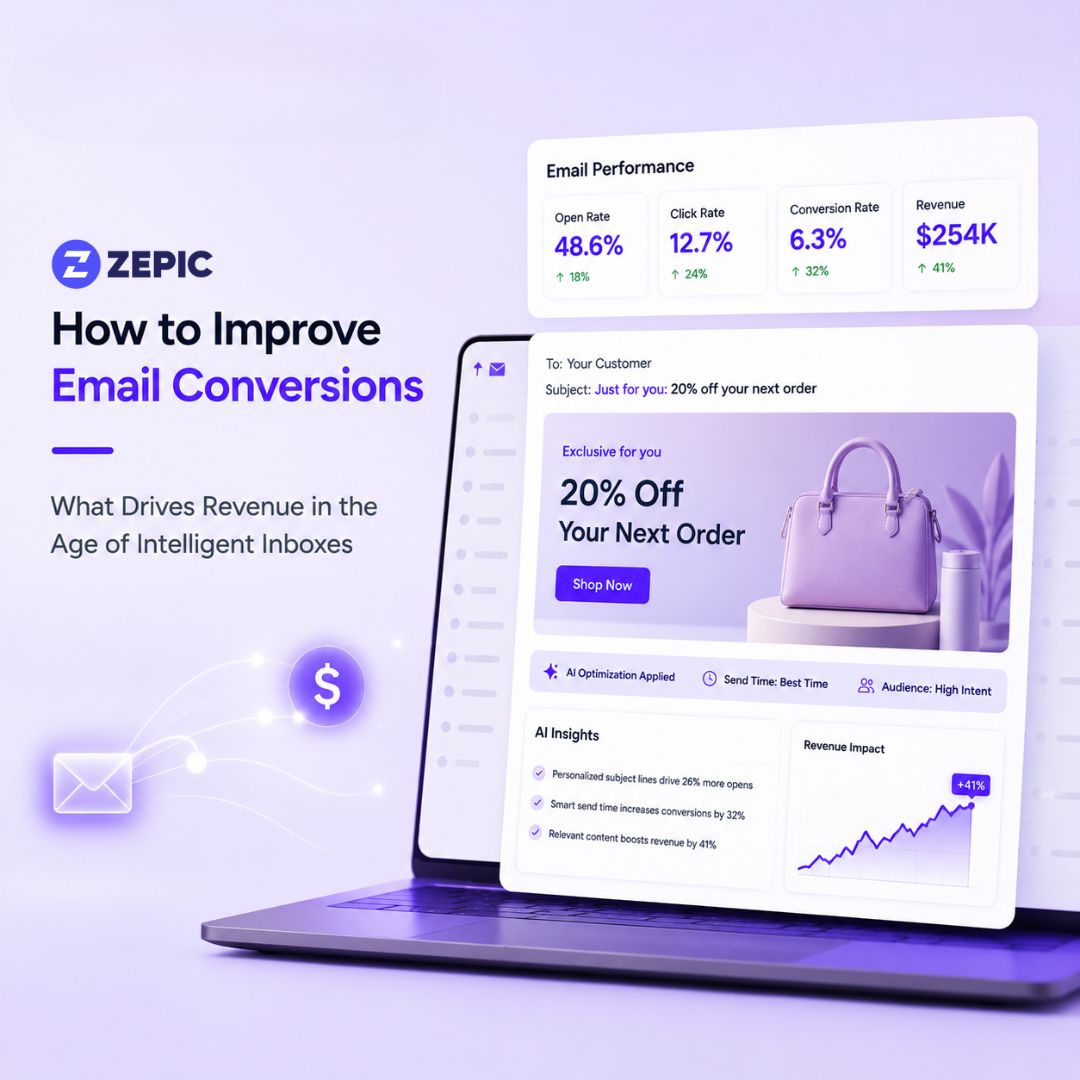
Email marketing has come a long way from simple newsletters and one-size-fits-all promotions. Today, it remains one of the most effective ways to drive customer action, but the inbox has become far more competitive. The average person now receives over 120 emails per day, meaning subscribers are making faster decisions than ever about what to open and what to ignore.
The conversion rate for e-commerce email campaigns is 1-3% as of 2025. That may sound small, but for brands sending thousands of campaigns each month, even a slight improvement can translate into significant revenue growth.
Almost every business wants to increase these odds, but various factors like AI-powered inboxes, privacy regulations, and inbox overload make it challenging to increase conversion rates.
This year, marketers everywhere are racking their brains to create campaigns that appeal to both customers and AI gatekeepers of the inbox. Platforms like Gmail and Apple Mail are using smarter systems to prioritize content that feels genuinely useful. At the same time, subscribers are becoming more selective about what they want; one wrong move and they hit the unsubscribe button.
How can brands increase email conversions in 2026? Let’s unpack some actionable strategies in this guide.
When it comes to email marketing, open rates have been the core metric for years. If a customer opened an email, it was assumed that the campaigns were working. However, in 2026, Apple and Gmail are rewriting the rules with their AI-powered inboxes.
Apple Mail Privacy Protection andGmail’s have made open tracking less accurate. In many cases, an email may register as “opened” even if the subscriber never actually read it, because tracking pixels are loaded automatically in the background.
At the same time, AI-powered inbox features are reducing the need to click into emails at all. Subscribers may see a preview that gives them the key message without triggering a recorded open.
This means marketers can no longer rely on open rates to understand true engagement.
For years, email marketing followed a predictable pattern:
Email delivered → Subscriber opens → Subscriber clicks → Subscriber converts
That model is no longer reliable in 2026 because inbox providers like Gmail and Apple Mail are increasingly using AI to filter messages before the subscriber even interacts.
A user might see:
This creates a new conversion funnel:
Email delivered → Inbox interprets → Subscriber decides instantly → Action happens only if the value is obvious
The bottom line is a subscriber may never fully open an email unless the offer feels immediately relevant.
This is why conversion optimization today starts before the click. It starts with how your email appears inside the inbox environment.
Apple's Mail Privacy Protection (MPP), which began with iOS 15, has reached a state of total saturation by 2026. MPP works by routing email content through a proxy server before it ever reaches the user. During this process, Apple's servers download every image—including your 1x1 tracking pixel—effectively "opening" every email in the background.
This means marketers see "Ghost Opens" from almost every Apple user (nearly 50% of the market), leading to artificially inflated open rates that can hover between 50% and 70% while actual human engagement remains flat.
If your automated "Abandoned Cart" flows are triggered based on a "user did not open" condition, MPP will break them. The system will think the user opened the email, and the follow-up will never trigger.
While Google hasn't branded a feature as "MPP," it has solidified its use of the Google Image Proxy. In fact, Gmail accounts for nearly 30% of global email opens, so its tracking impact is significant.
Here is what happens: Gmail downloads and caches email images on Google’s own servers. This helps protect user privacy, but it also means marketers cannot accurately see a subscriber’s real location or device details through open tracking.
Gmail has also made it easier for users to limit personalization and tracking through its “Smart Features” settings, giving people more control over how their email activity is used across Google services.
Between Apple's pre-loading and Google's caching, the open rates have become a technical signal rather than a human one.
That’s why in 2026, we need to prioritize Click-to-Open Rate (CTOR) and Revenue Per Email (RPE). These are the only metrics that prove a human interacted with your brand with intent.
In a world where AI-generated phishing and deep-mail scams are at an all-time high, trust is the primary driver of conversion. In 2026, BIMI (Brand Indicators for Message Identification) is a non-negotiable to improve your credibility.
BIMI allows your verified brand logo to appear directly in the inbox list view, even before the email is opened. This provides an immediate visual green light to the user.
With the iOS 26 updates, Apple has expanded its Business Connect features to include email. Brands that integrate their identity through these verified channels see their emails prioritized in the "Primary" tab, directly bypassing the AI-driven "Promotions" filters that catch unverified senders.
In 2026, "Hello [First_Name]" is the bare minimum brands can offer. High-converting brands are moving from static segmentation to real-time behavioral personalization that shows the customers that they truly know them.
Traditional segmentation groups people based on broad categories like “new subscriber” or “past buyer.”
Intent-based personalization focuses on what someone is doing right now.
For example, a user who:
is showing buying intent.
A conversion-focused email triggered within minutes can outperform a generic weekly newsletter.
For example, imagine a subscriber browsing a skincare website. Within a single session, they: view the same moisturizer twice, spend time reading reviews, add it to their cart, but leave without completing checkout.
They are clearly interested in the product; all they need is a little nudge to complete the sale.
If an intent-based email is sent within a day, while their memory is still fresh, they are more likely to buy the product
We’ve already established that AI summaries play a crucial role in boosting email conversion rates in 2026. Tools like Apple Intelligence and Google Gemini provide 1-3 sentence overviews of your email in the user's notification. Here’s what you can do to put your best foot forward:
The first 50 characters of your email text are now more important than your header image. This is the metadata the AI uses to summarize your offer.
AI agents use Semantic HTML (proper use of <h1>, <h2>, and <p> tags) to "read" and summarize your value proposition. If your email is just one big image, the AI can't summarize it, and the user will likely ignore it.
The biggest conversion leak in 2026 is the "Click-to-Web" drop-off. Every time a user has to leave their mail app to a mobile browser, you lose a significant portion of your audience.
Using AMP (Accelerated Mobile Pages) for Email, you can allow users to complete the entire buyer's journey inside the message:
Standard STO used to mean "send when the user usually opens." In 2026, we use Micro-Moment Targeting.
Even though AI overviews play a major role in email conversions in 2026, subject lines remain the "billboard" of your message. Think of the subject line as the headline and the AI summary as the sub-headline; they must work together to convince a skeptical subscriber (or their AI assistant) that your email is worth the cognitive load.
The subject lines packed with emojis and ALL CAPS may have worked in the past, but now trigger aggressive "Low Quality" filters in modern inboxes. To increase your conversion rates in 2026, your subject lines must be precise and phonetically clear.
With 85% of emails being read on mobile devices or summarized in notification shades, the most effective subject lines have around 6-8 words.
One of the most surprising trends in 2026 is the "Lowercase Bias." Data shows that subject lines written in sentence case or entirely in lowercase see a higher conversion rate than those in Title Case.
As more users check their emails via smart assistants (Apple Intelligence, Google Gemini, or Alexa) while driving or multitasking, your subject line must be readable by a machine.
Pro Tip: Test your subject lines before sending out the email to increase your odds.
Accessibility is often discussed as a compliance requirement, but in 2026, it is also a conversion strategy.
With regulations like the European Accessibility Act (EAA), brands sending emails to EU audiences must ensure their campaigns can be read and interacted with by everyone, including subscribers using assistive technologies.
More importantly, accessible emails perform better for all users.
An email that is easy to read, easy to scan, and easy to click will convert better than one that is visually cluttered or difficult to navigate.
To improve accessibility and conversions, focus on:
As we've established, Open Rates are a "Trust Signal" to ISPs, but they are a vanity metric for marketers. To increase conversions, your dashboard should focus on these four pillars:
| Metric | Why it Matters in 2026 | Benchmark |
|---|---|---|
| CTOR (Click-to-Open) | Measures if your content delivered what the subject line promised. | 18% - 25% |
| RPE (Revenue Per Email) | The ultimate proof of campaign health and commercial relevance. | $0.25+ |
| Scroll Depth | Uses heatmap data to see if users are reading or just scanning for the AI. | >55% |
| Negative Signals | Tracking "Delete without Opening" as a primary risk to sender reputation. | Less than 1.5% |
Improving email conversions in 2026 is a game of trust, speed, and technical precision. But executing these strategies consistently also depends on using the right email marketing platform.
Modern conversion-focused email requires more than basic campaign scheduling. You need software that can support:
This is where platforms like ZEPIC make a difference. ZEPIC is built for high-performing ecommerce teams that want to scale bulk email while still delivering trust and measurable revenue. From smarter segmentation to conversion-ready automation flows, the right platform helps you turn inbox engagement into real purchases.
Book a demo today and learn how ZEPIC can help you level up your email marketing in 2026.

%201.png)


.png)