Meet

Neura HQ,
Your connected AI Agent Workforce Know more



TLDR
Imagine it is a Friday evening. You just received a package from your favorite online clothing brand, but there is a problem. The dress is the wrong shade of blue, and the zipper is stuck. You want a replacement before your event on Sunday. You open the brand’s website and a chat window pops up.
In the first scenario, you click through a rigid menu of buttons. "Returns" leads to "Damaged Item," which leads to "Please email support@brand.com." Your frustration spikes because you need an immediate solution, not a ticket that will be answered on Monday. This is the traditional chatbot experience. It follows a script, lacks flexibility, and often feels like a digital dead end.
In the second scenario, you type: "Hey, my blue dress arrived damaged and I need a replacement by Sunday. Can you help?" The system responds instantly. It recognizes your order, confirms the blue dress is in stock at a nearby physical store for pickup, and initiates the exchange. It even apologizes for the inconvenience in a tone that feels genuinely helpful. This is conversational AI. It understands context, handles complex requests, and solves problems in real time.
The distinction between these two technologies is the difference between a frustrating barrier and a seamless service experience. As we move through 2026, the projected to groe from USD 17.97 billion in 2026 to USD 82.46 billion by 2034,
Businesses are no longer asking if they should use automation; they are deciding which level of intelligence their customers deserve.
Choosing the wrong one can lead to bot fatigue, where 63% of users report unresolved problems from interactions. The right one can reduce support costs by 40% while driving repeat purchases.
Lets break down the technical and functional differences between a chatbot and a conversational AI.
A traditional chatbot, often called a rule-based or scripted bot, is the most basic form of automated communication. Think of it as a digital version of a phone tree or an interactive FAQ page. These bots operate on "if-then" logic. If a user clicks button A, the bot provides response B.
Because they rely on predefined workflows, chatbots are excellent for handling highly predictable, repetitive tasks. They do not think or learn, instead, they match keywords or button selections to specific answers stored in their database.
While these bots are affordable and easy to deploy, they have many limitations in modern customer service. If a customer makes a typo or asks a question in a way the developer didn't anticipate, the bot will likely reply with a generic "I didn't understand that" message.
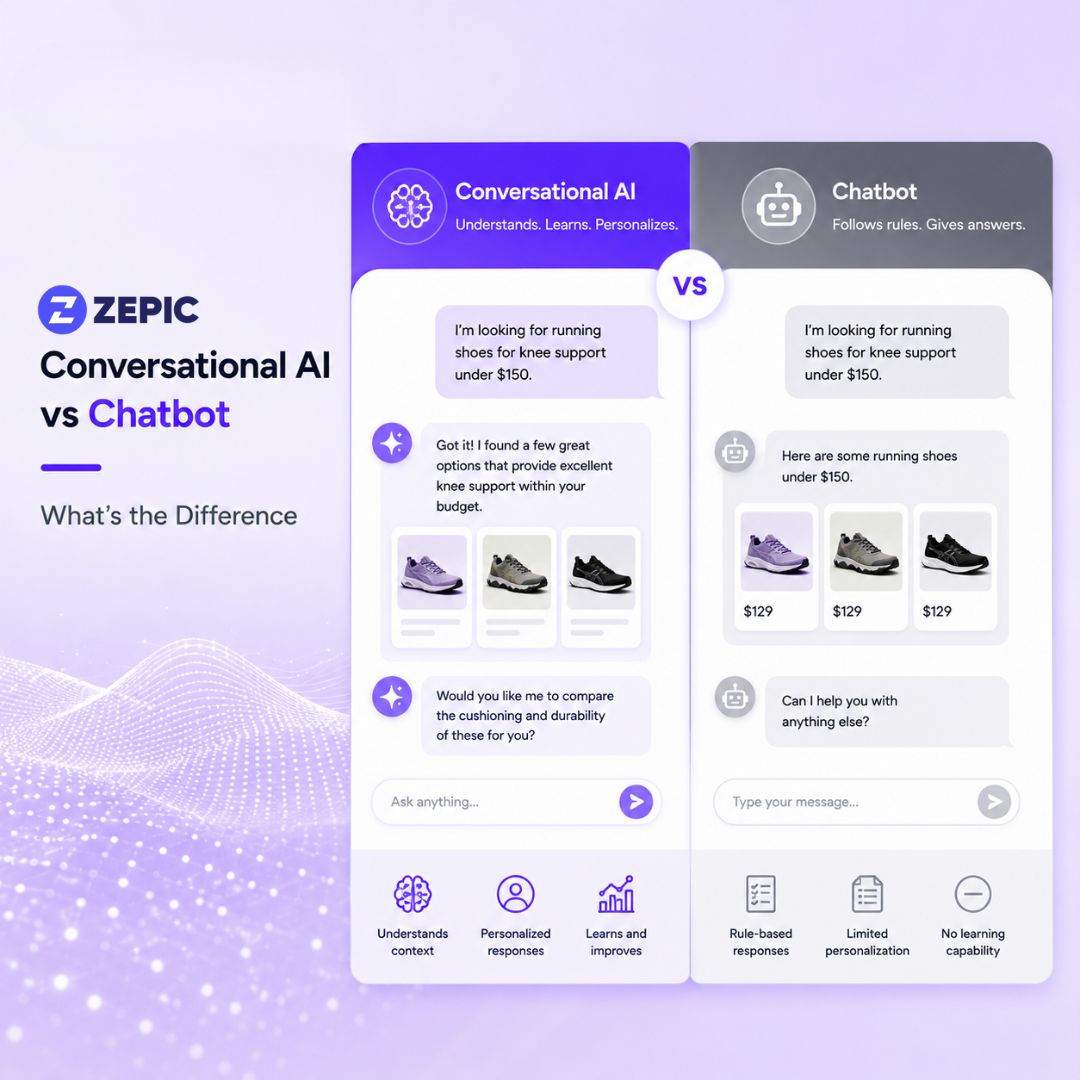
Conversational AI is a more sophisticated technology that uses Natural Language Processing (NLP), Machine Learning (ML), and Large Language Models (LLMs) to simulate human-like dialogue. Unlike a rule-based bot, conversational AI does not just look for keywords. It tries to understand the "intent" and "sentiment" behind a user’s message.
In 2026, conversational AI has reached a level of maturity where it can handle tangents. If a customer starts by asking about a return and suddenly asks if a different product is in stock, the AI can switch contexts seamlessly. It learns from every interaction, becoming more accurate over time without requiring constant manual updates to its script.
For an ecommerce brand, this means the AI can actually do the work. It can process a refund, track a package in real-time, or suggest a product based on the user's past browsing history.
Understanding the technical gap helps in choosing the right tool for your specific business needs. Here is a quick comparison:
| Feature | Rule-Based Chatbot | Conversational AI |
|---|---|---|
| Technology | "If-Then" logic and decision trees | NLP, Machine Learning, and LLMs |
| User Input | Button clicks and specific keywords | Free-form natural language and voice |
| Understanding | Interprets exact matches only | Understands intent, context, and emotion |
| Learning | Static; requires manual updates | Dynamic; learns from data and interactions |
| Scalability | Limited to predefined scripts | Handles complex, unique queries at scale |
| Integration | Often acts as a standalone FAQ | Deeply integrated with CRM and APIs |
| Customer Feel | Mechanical and restrictive | Fluid and human-like |
One of the most visible areas where this difference plays out is on messaging platforms. When comparing a WhatsApp chatbot vs agent or AI, the rule-based bot forces the user to type "1" for sales or "2" for support. Conversational AI allows the user to simply state their problem and get an immediate, personalized solution.
To see the impact on customer service, let’s look at a detailed scenario for a D2C skincare brand using WhatsApp.
A customer named Sarah sends a message: "I want to change my shipping address for my last order."
In this case, the chatbot failed because it couldn't map "change address" to its rigid menu. Sarah is left waiting, and the company now has a high-cost human agent handling a routine task.
Sarah sends the same message: "I want to change my shipping address for my last order."
The AI recognized Sarah, accessed her recent order, understood the nuance of her request, and executed the change via API. This interaction took 30 seconds, required zero human intervention, and likely increased Sarah's brand loyalty.
While conversational AI is more advanced, rule-based chatbots still have a place in a modern support strategy. For many small to medium businesses, they serve as an effective entry point into automation.
The most immediate benefit is providing 24/7 coverage. Even a basic bot can handle "What are your opening hours?" or "Where is your return policy?" at 3 AM. This ensures that customers never feel completely ignored.
For brands that deal with thousands of identical queries, a chatbot is a cost-effective filter. If 70% of your tickets are "Where is my order?", a simple bot can prompt for an order number and provide a tracking link. This keeps your support queue manageable.
In marketing, chatbots are excellent for qualifying leads. They can ask a series of standard questions to determine if a visitor is a high-value prospect before passing them to a human sales representative. This ensures your team spends time on the most promising opportunities.
The limitation, however, is the ceiling of utility. A 2026 report found that while 74% of customers are happy to use bots for simple queries, satisfaction drops significantly if the bot cannot resolve a complex issue in under three exchanges.
Conversational AI moves beyond simple deflection and focuses on resolution. It transforms support from a cost center into a value driver.
According to 2026 industry data, organizations using conversational AI have seen a 39% reduction in average resolution time. Because the AI can process data and execute tasks simultaneously, the customer does not have to wait for an agent to "look into the system."
Conversational AI can use AI-driven personalization to greet customers by name, reference their past preferences, and offer tailored advice. If a customer previously bought running shoes, the AI might ask how their training is going before helping with a new request.
When customers feel understood, their satisfaction (CSAT) scores rise. 2026 surveys show that AI-powered interactions can achieve satisfaction rates of over 80%. when the system is well-integrated. Customers value their time; an AI that solves a problem in seconds is often preferred over a human agent who takes ten minutes to reach.
Conversational AI can be proactive. It can detect when a user is struggling on a checkout page and offer assistance before the cart is abandoned. It can also suggest relevant add-ons in a helpful way, leading to a 15% to 35% increase in revenue for ecommerce brands.
Not every business needs a multi-million dollar AI system on day one. However, there are clear signals that your current chatbot is no longer sufficient.
"Where Is My Order?" (WISMO) remains the most common query in ecommerce. Conversational AI doesn't just give a tracking number; it can tell the customer exactly where the truck is, provide an updated delivery window, and even offer a discount if the package is late.
Traditional returns are a friction point. Conversational AI can turn a return into an exchange. By asking "Was the fit wrong or the style?", it can suggest a better size or a different product, keeping the revenue within the business while making the customer happy.
By integrating with your product catalog, the AI acts as a digital personal shopper. It can answer questions like "Which of these moisturizers is best for dry skin in the winter?" with specific, data-backed recommendations.
Many brands are now using WhatsApp marketing automation to re-engage customers. Conversational AI makes these messages interactive. Instead of a "one-way" blast, it creates a "two-way" conversation where customers can ask questions about the promotion and buy directly within the chat app.
Don't try to automate everything at once. Look at your support data and find the three most common questions that take up your team's time. For most ecommerce brands, this is order tracking, returns, and sizing questions.
Your AI is only as smart as the data it can access. Choose a platform that has pre-built integrations for your tech stack:
Work with your team to map out how a perfect conversation looks. However, also plan for rare cases. What should the AI do if it can't find an order? What if the customer is clearly angry? Ensure there is always a clear and quick path to a human agent for complex or sensitive issues.
Modern AI tools can "read" your existing help center articles, product descriptions, and past successful support transcripts. This provides the AI with the baseline knowledge it needs to answer questions accurately from day one.
Start by launching the AI on a single page or for a specific segment of your audience. Use real-time analytics to see where the AI is getting stuck. In 2026, the best platforms offer agent training dashboards where you can correct the AI’s mistakes with one click, making it smarter for the next customer.
The choice between a chatbot and conversational AI comes down to your business goals.
If you are a very small business with a limited budget and only need to provide basic contact info or business hours, a rule-based chatbot is a practical and affordable tool. It provides a level of structure and 24/7 availability that is better than no automation at all.
However, if you are a growing ecommerce or D2C brand looking to scale, reduce operational costs, and improve customer lifetime value, conversational AI is the standard. It provides the speed customers expect while maintaining the personal touch that builds long-term loyalty.
The future of customer service is not about replacing humans. It is about using intelligence to remove friction so that every interaction—whether with a bot or a person—is valuable, efficient, and pleasant.
Yes. Many businesses begin with rule-based chatbots that handle simple FAQs and gradually add AI capabilities over time. By connecting your existing chat interface to an AI engine and integrating it with internal data sources, the system can evolve from a basic menu-based bot into an intelligent assistant that understands requests and responds dynamically.
A simple chatbot works best when the use case is narrow and the budget is limited. For example, if the goal is to collect email addresses for a newsletter or direct users to a static help page, a rule-based bot can be quicker to deploy and more cost-effective. Complex AI systems are unnecessary for straightforward tasks like sharing store hours or office addresses.
Conversational AI does not experience emotions, but it can detect them using sentiment analysis. By analyzing wording, punctuation, and context, AI systems can identify signals of frustration, satisfaction, or confusion. Based on these cues, the system can adapt its responses, use more empathetic language, or escalate the conversation to a human agent if necessary.

%201.png)


.png)