Meet

Neura HQ,
Your connected AI Agent Workforce Know more



TLDR
In the last two years, AI has evolved from a co-pilot to an assistant that can take care of tasks on your behalf. In retail, these agents are already transforming e-commerce operations for founders like you. These autonomous systems are cutting operational errors by 60% and redefining how brands interact with customers.
While many businesses used basic chatbots in previous years, AI agents are transforming how modern brands operate.
Typically, a chatbot follows a rigid script to answer specific questions. In contrast, an AI agent is an autonomous system designed for decision-making and execution. It can process complex tasks, reason through problems, and take action within your retail ecosystem. This is what industry leaders call Agentic Commerce.
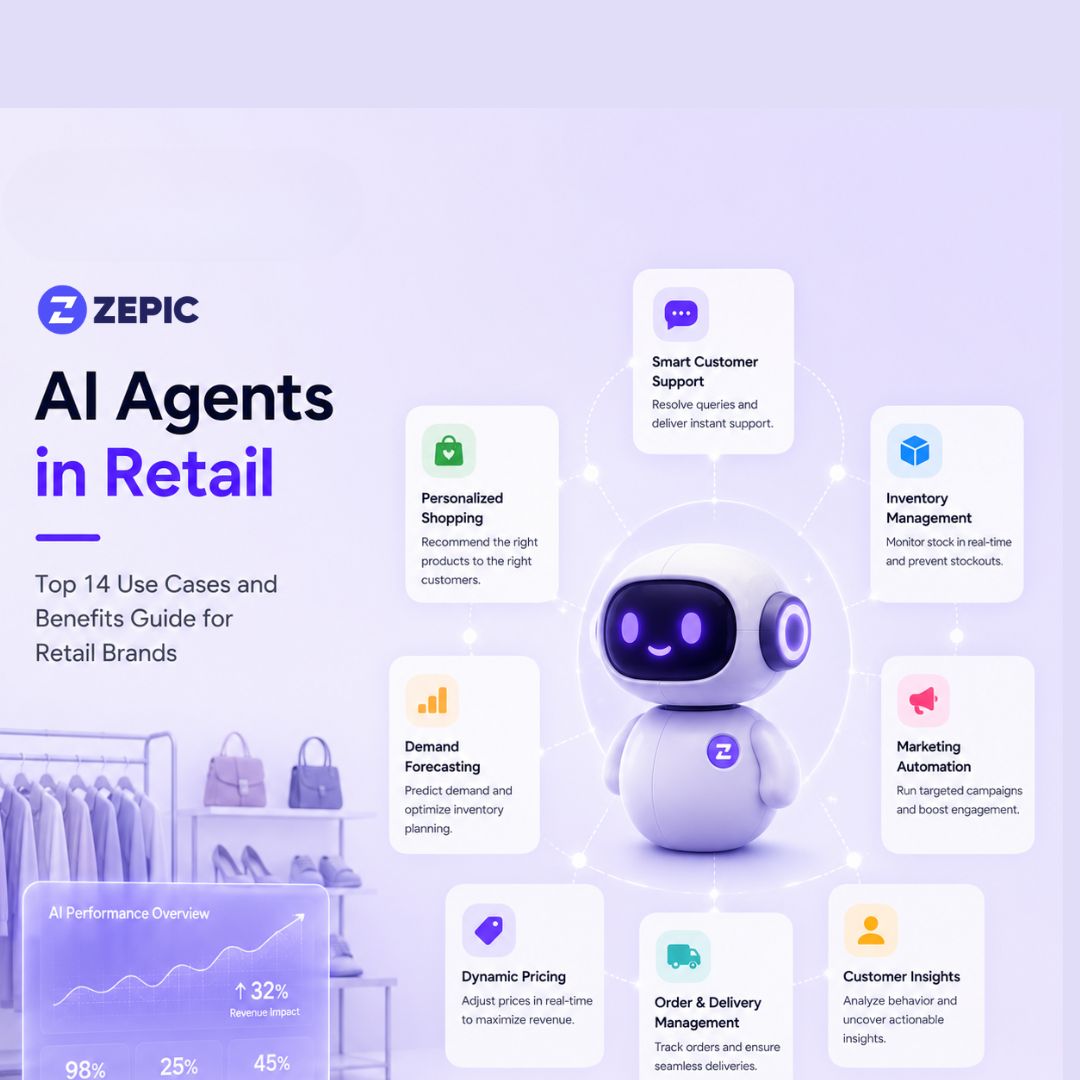
The following guide explores 14 high-impact use cases for AI agents in retail. These applications deliver deep personalization and operational efficiency.
AI agents analyze individual customer behavior, purchase history, and real-time browsing patterns to provide precise suggestions. Unlike static recommendation engines, agents adapt to the context of the current session.
Modern AI agents allow customers to use natural language for complex queries. This helps them avoid clicking through dozens of filters.
Agents can perform real-time competitor analysis and monitor market demand to adjust prices instantly. This ensures that a retailer remains competitive while maximizing revenue.
Predictive agents analyze historical sales data and current market trends to forecast future demand. They can autonomously trigger restocking orders or alert the team to potential overstock.
AI agents provide 24/7 support across multiple languages. They go beyond simple FAQs by handling ticket routing and complex problem-solving that previously required human intervention.
When a customer leaves an item in their cart, an AI agent can take proactive, personalized measures to recover the sale.
Security is a major concern for e-commerce founders. AI agents monitor every transaction in real-time to identify suspicious patterns that manual review might miss.
Agents can predict potential disruptions in the supply chain, such as weather delays or port congestion. Once a problem is identified, the agent can autonomously suggest or execute rerouting strategies.
In categories like fashion and home decor, AI agents enable visual search features. A customer can upload a photo of a style they like, and the agent finds similar items in the store's inventory.
Traditional loyalty programs often offer generic rewards. AI agents analyze individual shopping patterns to offer rewards that are actually relevant to the customer.
During the checkout process, AI agents suggest add-ons based on the specific items in the cart and the customer's history.
Content creation is time-consuming for e-commerce teams. AI agents can assist by clustering keywords and generating optimized product descriptions that appeal to both humans and AI search engines.
AI agents can manage entire marketing campaigns by personalizing segments across various channels. Whether it is email, WhatsApp, or Instagram, the agent ensures that the right message reaches the right person.
Processing returns is often a manual burden. AI agents can handle the entire process, including sentiment analysis to gauge customer satisfaction.
Major retail companies have moved beyond basic AI tools and deployed agentic systems that make decisions and act autonomously across core business functions. These implementations show where AI agents deliver measurable impact in real operations rather than theory.
Walmart has built and deployed advanced AI agents under initiatives such as Sparky to enhance shopping experiences and operational workflows. These systems support personalized interactions for customers, help manage inventory and customer service tasks, and are expected to evolve into autonomous action players within the Walmart app. The company’s investments and scaling of agentic AI have made it a competitive leader in AI-powered retail.
Walmart has also integrated conversational AI with structured commerce workflows, allowing customers to find and purchase products via ChatGPT-powered Instant Checkout. This feature enables conversational discovery and checkout without standard website navigation.
At Sephora, AI agents augment in-store and online experiences. Customers can interact with AI-driven assistants that offer personalised product recommendations based on skin tone, preferences, and historical data. These agents enhance convenience and shopping relevance.
H&M uses AI-enabled systems to optimise operations and enhance customer engagement. By applying these technologies, the brand improves inventory planning and customer experience, supporting both front-end personalization and back-end supply chain responsiveness.
Both platforms embed AI agents to drive personalized shopping and assist customers throughout the browsing and checkout journeys. These agents analyze customer behaviour, adjust recommendations in real time, and help surface tailored offerings based on ongoing interaction data, improving both discovery and conversion outcomes.
1. Identify Friction Points: Look at your current operations and find where the bottlenecks are. Is your customer support team overwhelmed? Are you losing sales due to stockouts? Use these pain points to choose your first AI agent use case.
2. Choose Your Technology Stack: In 2026, many e-commerce platforms offer native agentic features. If you have a specific need, consider using low-code platforms to build custom agents that connect to your APIs.
3. Integrate with Your CRM and Data: For an AI agent to be effective, it needs access to your data. Ensure your agent is integrated with your Customer Relationship Management (CRM) system, your inventory database, and your shipping providers. This allows the agent to make informed decisions based on real-time information.
4. Start with a Pilot Program: Run your first AI agent on a small segment of your traffic or for a specific product category. This allows you to test the agent’s logic and ensure it provides a positive experience. Monitor the results using GA4 or other analytics tools to track metrics like conversion rate and customer satisfaction.
5. Scale and Iterate: Once the pilot is successful, expand the agent's responsibilities. You might start with a customer service agent and later add an inventory management agent. As you add more agents, ensure they can communicate with each other to create a cohesive ecosystem.
In the near future, brands are going to be moving toward multi-agent systems. In this model, different agents work together to achieve a goal. For example, a marketing agent might identify a high-value customer, a personalization agent creates a custom offer, and a logistics agent ensures the product is shipped via the fastest possible route.
This level of coordination is supported by new industry standards like the Universal Commerce Protocol. This protocol allows agents from different brands and platforms to communicate, making it easier for customers to shop across the entire internet using their own personal AI assistants.
The shift toward AI agents is not a temporary trend. It is a fundamental change in how retail operates. For e-commerce founders and marketers, the message is clear: those who adopt agentic technology will gain a significant competitive advantage. When you automate routine tasks, personalize every customer interaction, and respond to market changes in real-time, you can build a more resilient and profitable business.
The tools are available, the data supports the transition, and the customers are already moving toward AI-driven shopping. Now is the time to start your journey into agentic commerce and secure your place in the future of retail.
The fundamental difference is autonomy versus assistance.
• Chatbots: Are reactive and supportive. They wait for a user to ask a question and provide a pre-programmed or generated response based on a defined knowledge base.
• AI Agents: Are proactive and operational. They do not just answer questions such as “Where is my order?”; they can autonomously investigate shipping delays, contact carriers via API, and issue partial refunds without human intervention.
The Bottom Line: If a chatbot is a digital librarian, an AI agent is a digital employee with permission to take action.
A growing concern known as the Trust Gap is emerging as customers begin using personal AI assistants to shop on their behalf. Brands may lose visibility into the early browsing phase when assistants handle discovery and comparison.
• The Risk: Brands may see fewer website visits as AI agents manage discovery and evaluation before the customer reaches the brand directly.
• The Opportunity: Brands that optimize their data for machine readability through structured product feeds and APIs are more likely to be recommended by personal assistants. In 2026, SEO is evolving into GEO (Generative Engine Optimization).
Many founders fail by attempting to build an all-knowing AI agent from the start. Industry leaders recommend beginning with a single-function Minimum Viable Agent (MVA).
• Pick one high-friction metric, such as return processing or inventory restocking.
• Define strict guardrails, for example allowing automatic refunds under a specific amount for high-loyalty customers.
• Scale horizontally once profitability is proven by deploying additional agents, such as pricing or inventory agents. Over time, these agents evolve into a multi-agent ecosystem that works together.

%201.png)


.png)