Meet

Neura HQ,
Your connected AI Agent Workforce Know more



TLDR
If you’ve been staring at Google Analytics, wondering why your content is showing up everywhere but hardly anyone is clicking, you’re not alone.
For a long time, the brand discovery was linear; the traditional marketing funnel relied heavily on moving users from search engines to websites. We are now entering the era of zero-click marketing. This shift is driven by a fundamental change in how people interact with the internet. Users no longer want to click through multiple pages to find an answer or buy a product. They want immediate gratification and seamless experiences within the apps they already use.
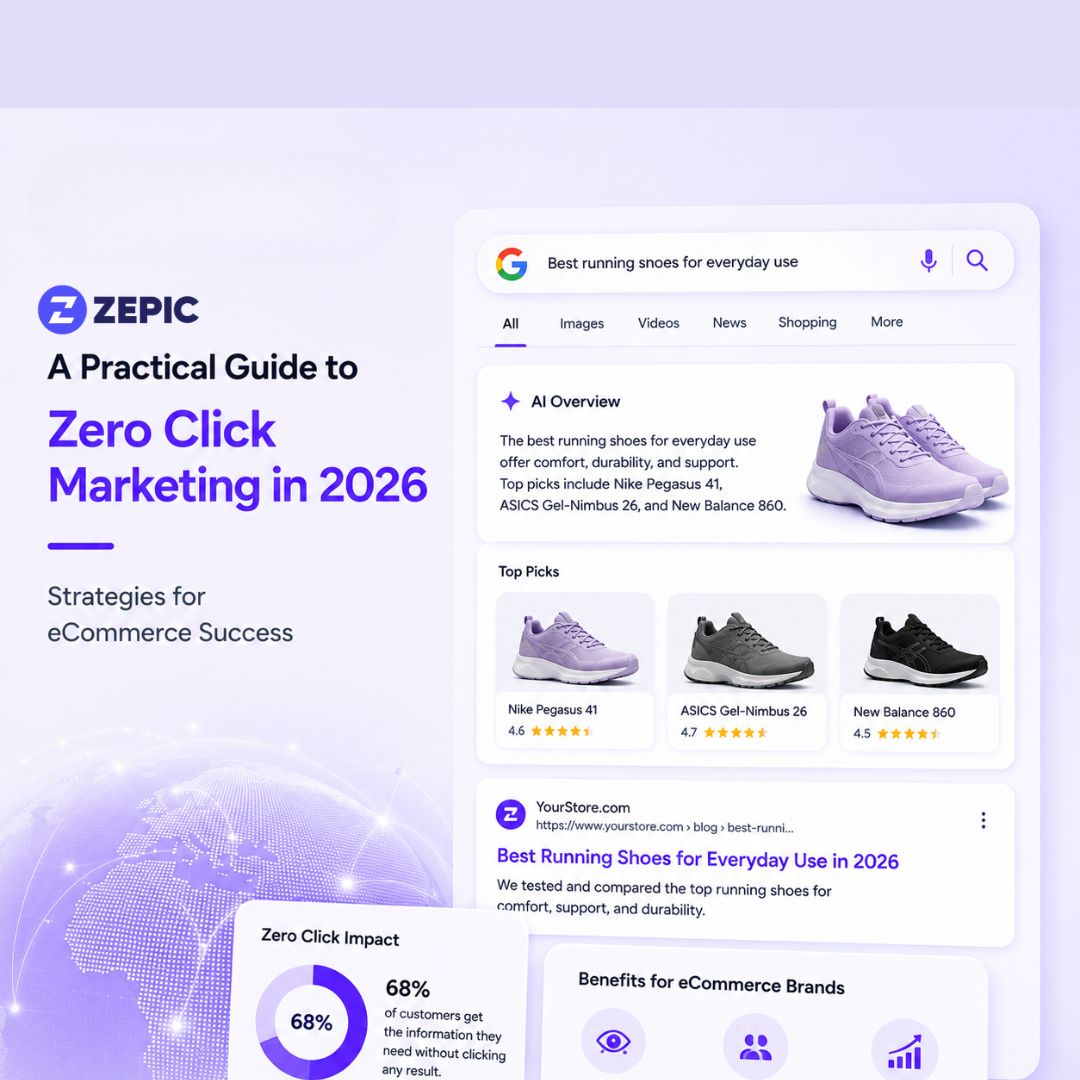
Bain’s recent survey finds that about 80% of consumers now rely on “zero-click” results in at least 40% of their searches.
Platforms like Google, Instagram, and WhatsApp have adapted to these expectations. Google now shows AI-generated summaries directly on the search results page, so users often get answers without clicking through.
At the same time, Instagram and WhatsApp have become full shopping ecosystems. People can discover products, ask questions, and even make purchases without ever opening a browser.
This shift is happening faster because of the privacy-first era. Third-party cookies are disappearing, and many users are tired of constant consent pop-ups. As a result, traditional tracking is becoming less effective.
In this guide, we’ll explore:
Zero-click marketing is a set of strategies that help users find what they’re looking for, where they are, without redirecting them to a website.
Examples of Zero-Click Experiences
Traditional SEO focuses on driving traffic to a website to increase page views and sessions. Performance ads are typically optimized for Click-Through Rate (CTR).
Zero-click marketing, on the other hand, prioritizes Impression Utility. It values the fact that a user saw your brand and got their answer, even if they stayed on Google or Instagram.
Here’s what brands need to remember:
When you provide the best answer for an AI summary, you earn brand authority and recall, which often leads to a direct purchase later through a different channel.
Social platforms want to keep users on their apps. They actively suppress outbound links in favor of native content. If your strategy relies on pulling people away from their feed, you are fighting against the platform's algorithms.
The death of cookies has also made retargeting much harder. First-party data, which is information you collect from your own site, is still useful but often limited. Brands need a more direct way to understand their customers. This is where zero-party data becomes the most valuable asset a business can own.
Many brands see declining organic CTR even as their impressions rise. This is a clear signal that the old model is breaking. If you fail to adapt, your brand loses visibility.
Users will simply interact with the competitor whose information appears in the AI summary or the Instagram DM bot.
Success in 2026 depends on owning direct intent signals rather than relying on third-party tracker data.
Zero-party data is information that a customer intentionally and voluntarily shares with a brand. This is different from first-party data because it does not involve tracking behavior. Instead, it involves asking questions.
Zero-party data is the perfect fuel for zero-click strategies. It feeds AI-driven personalization
When a customer shares their preferences through a WhatsApp poll or an Instagram DM quiz, you can respond with the right product or answer immediately.
This works especially well in a cookie-free world because the customer is directly telling you what they want.
It also improves your visibility in AI Overviews and platform recommendations. When your brand consistently matches specific needs, like “eco-friendly running shoes for beginner marathon runners,” you are more likely to appear as a top suggestion
To win in this environment, you must optimize for intent answers rather than page views. This requires a shift in how you create and distribute content.
Your content should be structured so that AI models can easily extract the most important information.
Instead of sending a user to a mobile site that might load slowly, use automation to respond to them instantly.
If someone asks a question on your Instagram post, an automated response can provide the answer and a "buy now" button within the DM. This removes friction and keeps the momentum of the purchase intent.
In the zero-click world, a click to a website is a macro-conversion. You should also value micro-conversions, such as:
In 2026, email has transitioned from a promotional tool to a primary data collection channel. Because you own the relationship with the subscriber, you can use email to gather the deep preferences that fuel your zero-click interactions on other platforms.
The data you collect via email shouldn’t stay in a vacuum. You have to make sure it flows back into your CRM to power your entire zero-click ecosystem.
Email provides the long-term stability that third-party platforms cannot guarantee. It ensures that even if a platform changes its rules for zero-click visibility, you still possess the data necessary to reach your customers through other conversational channels.
WhatsApp and Instagram have become the primary capture layers for e-commerce. They let you provide a high degree of personalization at a massive scale.
WhatsApp is the ultimate tool for one-to-one communication.
Instagram automation allows you to turn engagement into a data-gathering opportunity.
This entire process happens without the user ever visiting a traditional website. Engagement replaces clicks as the primary success signal.
Beyond just answering questions, zero-click strategies can handle the entire customer lifecycle.
Traditional metrics like CTR and Bounce Rate are no longer the best way to judge success. In 2026, you need a new set of Key Performance Indicators (KPIs).
Look at how deeply a user interacts with your brand on the platform.
The quality of the data you collect is a metric in itself.
To implement a zero-click strategy effectively, follow these guidelines:
Zero-click marketing is a mandatory requirement for e-commerce survival in 2026. As search engines and social platforms become more protective of their users' time and attention, the brands that provide the most value within those platforms will win.
Zero-party data is the fuel that powers this entire system. When you move away from intrusive tracking and toward transparent, conversational interactions, you build a foundation of trust that traditional advertising cannot match.
Executing a zero-click strategy requires a platform that unifies your data and automates your engagement across every channel. ZEPIC is the AI-infused Marketing OS designed for this new era.
With ZEPIC, you can:
Stop losing visibility to the zero-click void. Ready to turn every interaction into a conversion? Book a demo today and start building your zero-click engine.
Zero-party data is information users voluntarily share with a brand, such as style preferences, budget, or purchase intent. In a zero-click environment, this data allows automated systems to provide instant and highly relevant recommendations directly within chats or AI-generated summaries. As a result, users receive answers and product suggestions without needing to browse a website, reducing friction and accelerating decision-making.
Zero-click marketing often results in lower traditional website traffic, but this is not necessarily negative. The visitors who do reach your website typically have much higher intent. At the same time, conversions happening directly on platforms such as messaging apps or AI summaries compensate for reduced sessions by creating a faster and smoother user experience.
WhatsApp automation enables complete sales journeys to happen within a conversation. Brands can run quizzes, qualify leads, answer customer questions, recommend products, and even process payments without redirecting users to external pages. Keeping customers within a familiar chat environment significantly reduces friction, especially on mobile devices.
Yes. Personalization in 2026 increasingly relies on a value exchange model. By offering something useful, such as a personalized style guide or a discount in exchange for preference information, brands can collect voluntary data that is often more accurate and actionable than cookie-based tracking.
The most important metrics include engagement depth, such as saves and shares, the volume of zero-party data collected, and the conversion rate of automated conversational flows. These indicators provide a clearer view of customer intent and brand health than traditional click-based metrics alone.

%201.png)


.png)