TL;DR
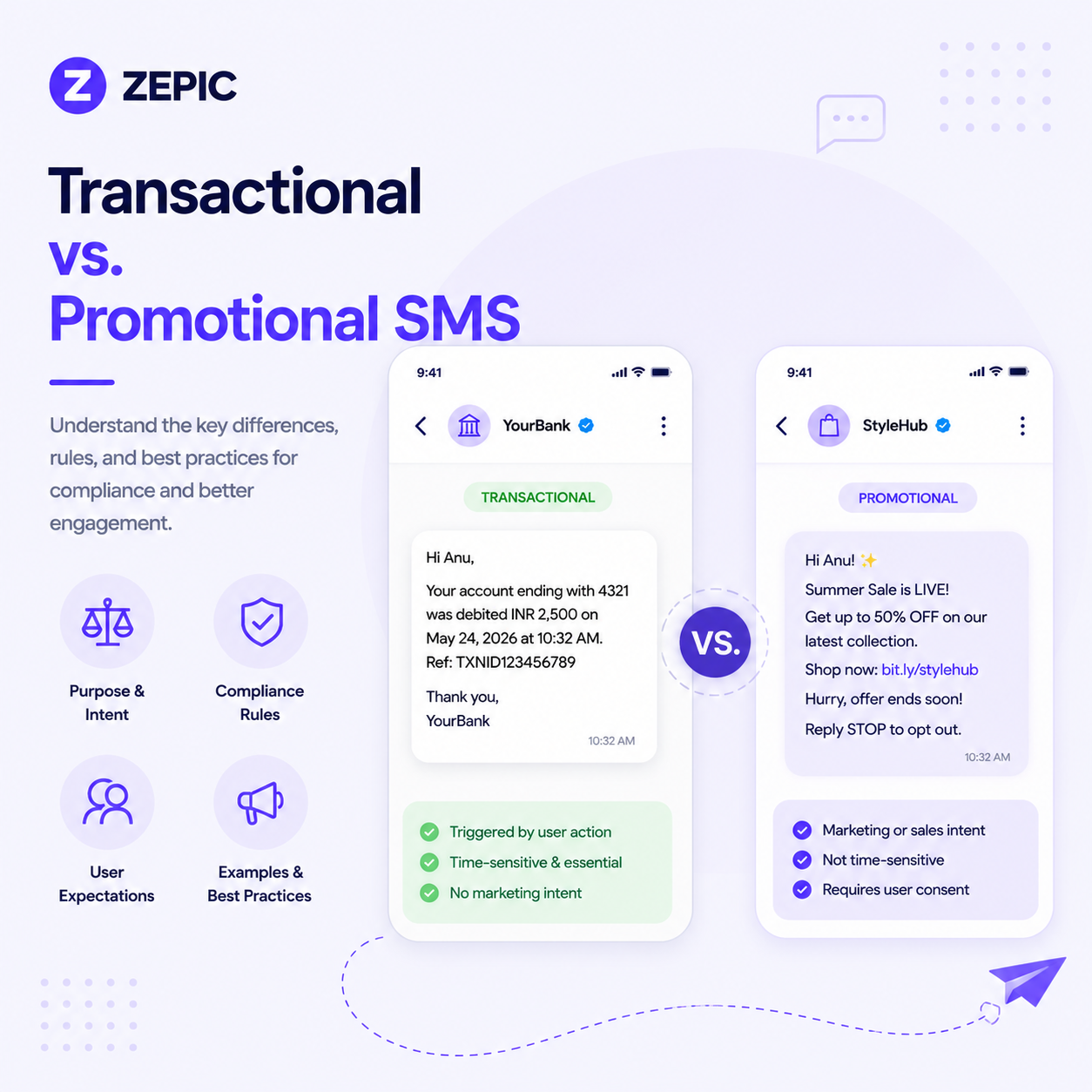
- Transactional SMS is triggered by a customer action, such as order confirmations, OTPs, shipping updates, appointment reminders, and payment alerts.
- Promotional SMS is sent to market products or services, including sales, discounts, product launches, loyalty updates, and abandoned cart reminders.
- Every SMS campaign in the US must be registered under the correct 10DLC use case. Carriers compare your registered campaign type with the messages you actually send.
- Mixing transactional and promotional messages on the same registered campaign hurts deliverability.
- Poor registration or campaign mismatches can reduce delivery rates and lower your Trust Score, limiting how many messages you can send.
- Use separate 10DLC campaigns for different message types to improve compliance, throughput, and deliverability.
If you've ever wondered why some of your text messages reach customers instantly while others seem to vanish into thin air, the answer usually comes down to how carriers classify them.
Businesses send two broad categories of SMS—transactional and promotional. They might seem similar on the surface, but the rules governing consent, timing, content, and carrier registration are different. Mixing them up can wreck your delivery rates pretty fast.
Let’s look at what separates the two and how to keep both types of messages actually reaching your customers.
What Is Transactional SMS?
Transactional SMS refers to the messages triggered by something a customer already did. These texts confirm the customer action or give them the information they need in the moment.
Common examples are,
- One-time passwords and two-factor authentication codes
- Order confirmations and shipping updates
- Appointment reminders and reschedule notices
- Payment receipts and billing alerts
- Account security notifications, like login alerts or password changes
- Delivery status updates
These messages exist to help the customer complete or track something they already started. They're time-sensitive and generally welcomed, which is part of why carriers prioritize and route them with fewer obstacles than marketing content.
What Is Promotional SMS?
Promotional SMS, also called marketing SMS, are messages designed to drive a sale or engage customers. Customer actions do not trigger these texts. Instead, businesses send them on their own schedule to a list of people who agreed in advance to hear from them.
Common examples include:
- Sale announcements and discount codes
- New product launches
- Abandoned cart reminders
- Loyalty program updates
- Event invitations
- Re-engagement or "we miss you" campaigns
Carriers and regulators want clear proof the customer agreed to be marketed to, along with an easy way to say no whenever they change their mind.
The Core Differences Between Transactional and Promotional SMS
- Consent standard: Marketing and promotional messages generally require express consent, and in many jurisdictions (such as the U.S. under the TCPA for automated marketing texts), prior express written consent is required. Transactional messages related to an action the customer has already taken, such as an order confirmation or appointment reminder, typically have a lower consent threshold.
- Timing: Promotional texts are typically restricted to between 8 AM and 9 PM in the recipient's local time zone. Transactional alerts often need to go out immediately, any time of day, because the information itself is time-sensitive.
- Frequency: Promotional SMS should be sent sparingly to avoid subscriber fatigue and opt-outs. While there is no universal legal limit on how many marketing messages you can send, many brands keep promotional campaigns to a few messages per month. The ideal frequency depends on your audience, industry, and the value of your messages. Transactional SMS, on the other hand, are sent whenever a customer-triggered event occurs.
- Content rules: Promotional copy needs clear sender identification, a frequency disclosure, and an opt-out line. Transactional copy should stay tightly focused on the transaction itself, with no upsells blended in.
- Opt-out handling: Both message types must honor STOP, UNSUBSCRIBE, and CANCEL, but an opt-out from marketing texts shouldn't silence a customer's fraud alerts or appointment reminders unless that's clearly what they meant.
- Legal exposure: Sending promotional messages without proper consent has financial risk. Under the Telephone Consumer Protection Act, violations can trigger statutory damages of $500 to $1,500 per message, with no cap on total liability, and the law lets individuals file private lawsuits.
Why Carriers Care So Much About the Label
In the US, businesses send SMS using a system called 10DLC (10-digit long code). Before they can send messages, they must register their business and each messaging campaign with the Campaign Registry.
During registration, every campaign is assigned a use case based on its purpose, such as marketing, customer support, or notifications. This label helps mobile carriers understand what type of messages will be sent and determines the rules the campaign must follow.
A few things make this matter even more heading into 2026:
- Since February 2025, the major US carriers have blocked unregistered application-to-person traffic from 10-digit numbers outright, with no grace period. Messages simply fail to arrive, often without any clear signal to the sender that something went wrong.
- Unregistered or improperly categorized campaigns can see delivery rates fall into the 60 to 70 percent range, a steep drop for any business relying on SMS for time-sensitive communication.
- The category a campaign is registered under shapes how aggressively carriers filter it, and in some cases, whether the business is even eligible to send that kind of content at all.
Carriers score and route traffic based on what a campaign says it will send versus what actually shows up in the pipeline. When those two things don't match, filtering kicks in.
Part of that scoring is based on a trust score and a throughput tier assigned to your brand and campaign during registration. That score depends on things like
- How well your business identity was verified during registration
- Whether your actual traffic matches your registered use case over time
- Complaint rates, opt-out rates, and how quickly you honor them
- How long your brand has been in good standing on the registry
A low trust score caps how many messages per minute your number can send. This becomes a real bottleneck when you run a time-sensitive flash sale campaign or a mass appointment reminder.
Why Mixing the Two Costs You Delivery
Say you register a 10DLC campaign as transactional, using it for order confirmations and shipping alerts. A few months later, the marketing team decides to reuse that same number for a flash sale. On paper, that seems harmless, but in practice, it can damage your entire messaging program:
- Filtering spreads to your whole number: Sending promotional content through a transactional route, because it tends to skip the tighter marketing filters, is a compliance violation. It can lead carriers to filter your entire sender ID, including the legitimate transactional messages that previously went through without issue.
- Campaign mismatches get flagged: Carriers expect a business to only send the type of message it registered for. A campaign registered for delivery updates that suddenly starts pushing promotional offers is exactly the kind of mismatch carrier systems are built to catch.
- Registration has to match reality: If a campaign is registered as account alerts but the business is actually sending promotional offers, that gap creates both delivery and compliance problems.
- Combined campaigns inherit the strictest rules: A mixed-use campaign that sends more than one message type, such as appointment reminders along with occasional promotional offers, is convenient to set up, but it is subject to strict consent and content requirements.
- Separate campaigns tend to perform better: When a business runs two separately registered campaigns instead of one mixed-use campaign, the delivery rates are generally higher. Most providers link one 10DLC number to one active campaign anyway.
- Rejections compound the delay: Common reasons carriers reject a campaign outright include unclear opt-in language, missing brand identification, mismatched campaign types, sample messages that don't reflect actual copy, and missing opt-out instructions.
None of this shows up as a major error message on your end. Your messages just start failing quietly, and by the time anyone notices the drop in open rates, the damage to your sender reputation is already done.
A Real-World Example
Imagine a clinic that uses the same phone number to send both appointment reminders and promotional offers. If that number is registered only for appointment reminders, carriers expect every message to fit that purpose.
When promotional messages start coming from the same number, carriers may view them as a mismatch and begin filtering messages more aggressively. That can affect even legitimate appointment reminders, causing patients to miss important notifications.
The solution is to register separate campaigns for each use case. One campaign can be dedicated to appointment reminders, while another handles marketing messages with its own opt-in process. This helps carriers classify the messages correctly and improves deliverability.
Keeping Both Message Types Compliant and Deliverable
Whether you send transactional messages, promotional messages, or both, a handful of practices keep carriers satisfied and your delivery rates healthy.
For transactional SMS:
- Keep the content tightly tied to the triggering action or account event
- Avoid slipping marketing language or offers into a transactional message, even a small one
- Support STOP, UNSUBSCRIBE, and CANCEL even though this traffic is lower risk overall
- Register the campaign under the correct, specific use case (OTP, account notification, delivery update, and so on) rather than a generic catch-all
For promotional SMS:
- Get prior express written consent before sending anything, and keep consent records on file for at least five years
- Send only between 8 AM and 9 PM in the recipient's local time zone
- Identify your brand clearly in the first message of any new conversation
- Disclose message frequency and note that message and data rates may apply
- Cap sends to a reasonable cadence, generally a handful of messages per month, rather than sending every day
- Honor plain-language opt-out requests, not only the standard keywords, and follow any opt-out with a single confirmation message rather than more persuasive copy
For both message types:
- Register each distinct use case as its own 10DLC campaign rather than bundling everything together
- Keep the sample messages you submit during registration identical to what you actually send later
- Centralize your suppression list so an opt-out in one system doesn't get quietly reversed by a CRM sync or a separate list import somewhere else
- Track delivery receipts by campaign so a filtering problem shows up in your data early, rather than as a mystery drop in engagement weeks later
If you text customers outside the US, add one more layer to this checklist. Rules like GDPR in the EU require consent that is explicit, specific to the purpose of the message, and freely given, with pre-checked boxes or bundled consent generally falling short of that standard regardless of what US carriers require.
Building your consent flow around the strictest rule that applies to any part of your audience is usually simpler than maintaining separate standards for separate regions.
It's also worth knowing that consent rules keep changing. The FCC's push toward requiring a single revocation request to apply across all future calls and texts from a business, sometimes called the "stop-all" rule, has been delayed more than once, and regulators have signaled they may not let it take effect in its current form.
That's good reason to build your opt-out handling to be more careful than whatever the bare legal minimum happens to be this year, since that minimum keeps moving.
How to Tell Which Bucket a Message Belongs In
When you're not sure whether a message counts as transactional or promotional, ask yourself:
- Did the customer do something specific that triggered this message? If yes, it's likely transactional.
- Is the goal of the message to get the customer to buy, click, or engage with something new? If yes, it's promotional.
- Would the customer be surprised to receive it? Transactional messages should never be a surprise. Promotional ones require the customer to have said yes ahead of time.
- Does the message include an offer, discount, or call to action unrelated to a transaction already underway? That's a sign it belongs in the promotional bucket, even if it's dressed up in transactional-sounding language.
If a message could plausibly go either way, treat it as promotional. Carriers and regulators default to the stricter standard, and it costs far less to over-comply on a borderline message than to have your entire number filtered later because you guessed wrong.
What Will it Cost if You get it Wrong
Lost delivery is the most immediate cost, but it's rarely the only one. When a business blurs the line between transactional and promotional SMS, the damage tends to show up in layers:
- Delivery drops without any warning: You’ll see a slow decline in messages actually reaching phones without any notification about the reason.
- Legal exposure: Promotional messages sent without documented consent expose a business to TCPA claims, and those claims are filed often enough that they've become a routine part of the compliance conversation for anyone texting at scale.
- Customer trust erodes: A customer who gets a marketing text on a number they gave you strictly for order updates tends to opt out of everything, including the alerts they actually wanted.
- Fixing it takes time: Re-registering a campaign correctly, rebuilding a Trust Score, and re-earning carrier confidence take weeks, which is a long stretch to go without reliable delivery if your business depends on it.
Treating the distinction seriously from the start is a lot cheaper than untangling it after your numbers are already filtered.
Wrapping Up
Transactional and promotional SMS look alike on the surface, but the rules behind them (who has to consent, when you can send, what the message can say, and how it gets registered) are different enough that treating them the same is one of the most common reasons businesses watch their delivery rates quietly decline.
Register each use case separately, keep your registration honest about what you actually send, and keep your consent records current. Carriers reward businesses that are precise about what they're sending and why, and they penalize the ones that blur the lines, often without any warning at all.
Get the classification right from the start, and delivery stops being something you have to troubleshoot after the fact.
```html id="transactionalsmsfaq1"
Frequently Asked Questions
Is an appointment reminder promotional or transactional?
Appointment reminders are considered transactional messages as long as they are limited to appointment-related information. However, if the message includes promotional content—such as advertising a new service, special offer, or seasonal discount—it is no longer purely transactional and becomes subject to the stricter consent and compliance requirements that apply to marketing messages.
Do you need 10DLC registration for transactional SMS?
Yes. In the United States, all Application-to-Person (A2P) SMS traffic—including transactional messages—must be sent through a properly registered 10DLC campaign using the appropriate use case. Major mobile carriers actively block unregistered traffic, making registration essential for reliable message delivery.
Can a customer who opts out of promotional texts still receive transactional messages?
In most cases, yes. If a customer specifically opts out of promotional messaging, businesses may continue sending essential transactional messages such as order confirmations, shipping updates, or appointment reminders. It's important to clearly communicate this distinction in the opt-out confirmation so customers understand which messages they will continue to receive.
What are the penalties for misclassifying SMS messages?
Under the Telephone Consumer Protection Act (TCPA), sending promotional SMS messages without the required consent can result in statutory damages ranging from $500 to $1,500 per message. There is no overall cap on liability, and individuals have the right to bring private legal action. In addition to legal exposure, carriers may filter or block misclassified messages, reducing deliverability and campaign effectiveness.
Can transactional consent be used to send promotional messages later?
No. Consent to receive transactional messages does not extend to marketing communications. A customer who provides their phone number for order updates or service notifications has not automatically agreed to receive promotional messages. Separate, express consent is required before sending marketing SMS campaigns.
Is CTIA the same thing as TCPA?
No. The TCPA is a federal law enforced by the Federal Communications Commission (FCC) and through private lawsuits, while the CTIA publishes industry guidelines that mobile carriers enforce across their networks. Although both emphasize consent, transparency, and opt-out compliance, violating TCPA can result in legal penalties, whereas violating CTIA guidelines typically leads to message filtering or carrier restrictions.
```





%201.png)


.png)