Meet

Neura HQ,
Your connected AI Agent Workforce Know more



TLDR:
Remember the last time a website chatbot actually helped you? We’re not talking about looping you through a decision tree or handing you off to a human. We’re talking about a time when it actually understood what you meant and moved you closer to buying.
For most shoppers, that memory is hard to recall, because for the better part of a decade, chatbots were basically glorified FAQ pages. However, that era is ending fast.
The chatbot wave actually delivered scripted menus, frustrating loops, and zero memory. Ask it something outside its decision tree, and you'd get a polite non-answer or an instant handoff to a human.
Brands deployed them because they promised cost savings. Even though some of those savings were real, the customer experience was almost universally mediocre. Shoppers learned quickly that chatbots weren't worth engaging with, and click-through rates reflected that.
The core problem was that rule-based chatbots were reactive and rigid. They could only follow a path someone had pre-programmed. They had no understanding of intent and no ability to reason across multiple steps.
That’s why many brands are now deploying AI shopping agents that can understand context, remember preferences, handle multi-step tasks, and, in some cases, complete a purchase entirely on their own.
Here is what is actually happening, why it matters, and what your brand needs to do about it.
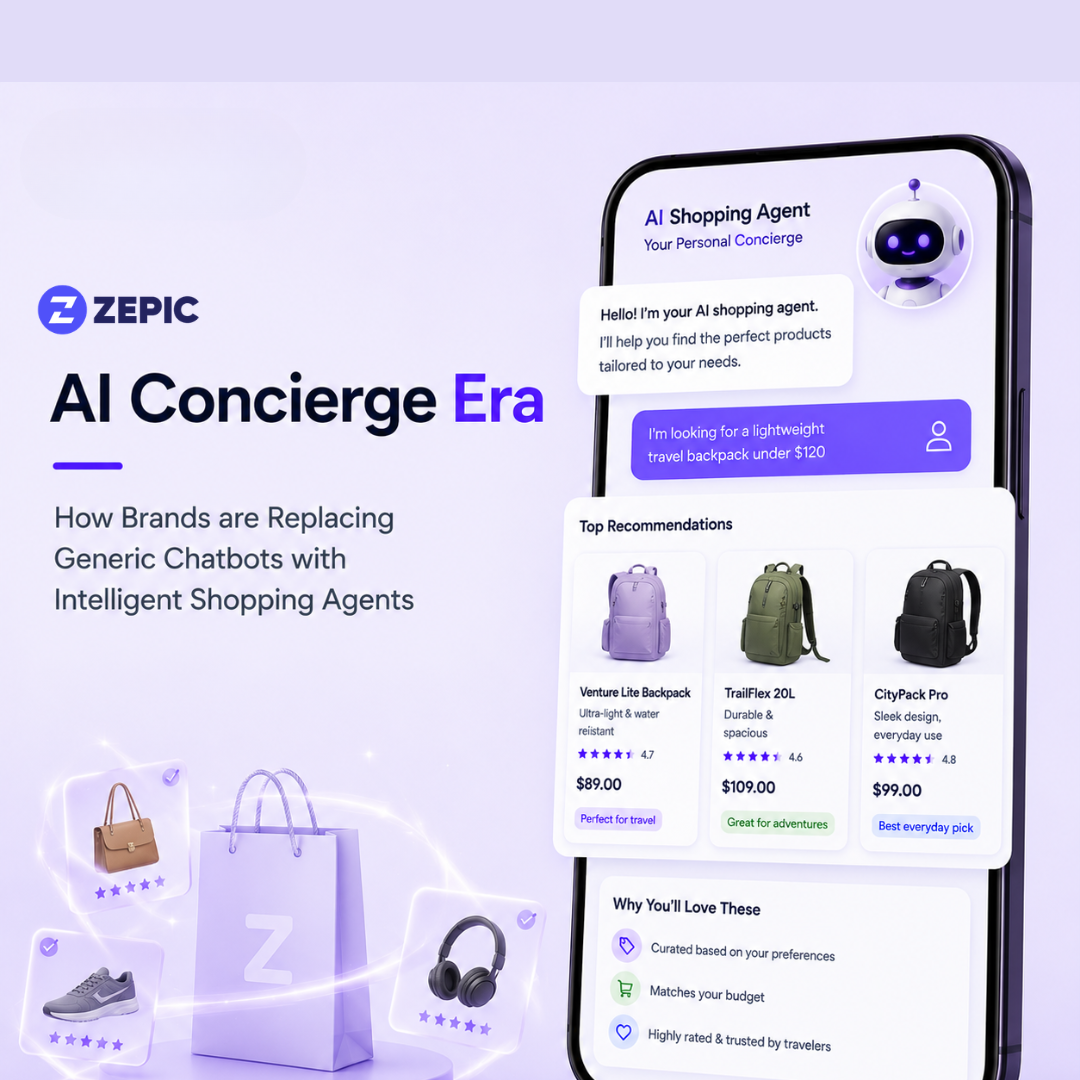
An AI shopping agent uses a large language model (LLM) to understand natural language, reason across multiple steps, remember context, and take action inside your systems. Instead of following a script, it interprets what the shopper is trying to accomplish and figures out how to get them there.
Let’s look at a few capabilities that separate AI shopping agents from chatbots:
The data coming in from early deployments is hard to argue with.
Conversion is the headline metric:
Average order value goes up too:
The market is moving at speed:
Amazon's AI shopping assistant Rufus launched in early 2024 and by the end of 2025 had reached 250 million users, with monthly active users up 149% and interactions up 210% year-over-year (Amazon Q3 2025 earnings call).
The numbers it is driving are significant. CEO Andy Jassy confirmed Rufus is projected to generate over $10 billion in incremental annualized sales. Customers who engage with Rufus during a shopping trip are 60% more likely to complete a purchase compared to those who don't.
Amazon trained Rufus on its entire product catalog, customer reviews, community Q&As, and web data, turning it into a context-aware shopping companion rather than a simple search tool.
Walmart took a different route by partnering with OpenAI to build Sparky, giving it access to the most advanced models without building from scratch. The result is a conversational assistant that offers product recommendations, summarizes reviews, and handles a range of shopping tasks within the app.
By fall 2025, 81% of surveyed Walmart customers reported using Sparky to check product availability and review specifications before buying, according to Walmart's own internal survey data. Walmart also integrated ChatGPT's Instant Checkout into Sparky, allowing customers to complete purchases within the chat interface in a single tap for returning users.
Walmart's automated fulfillment centers supported by AI have already cut unit costs by 20% compared to manual sites.
Amazon's and Walmart's scale are unique, but the playbook is not. Smaller and mid-market brands are deploying purpose-built AI agents for specific use cases: personalized product finders, reorder automation, bundle builders, and post-purchase support agents. The infrastructure to do this, through platforms and APIs, is increasingly accessible.
If you are thinking about what this looks like in practice for your brand, the architecture breaks down into four areas:
1. Product Data Quality: AI agents can only surface what they can read. Clean, structured product data with full-sentence descriptions, complete attribute tagging, and accurate inventory signals is the foundation. Poorly structured catalogs produce poor recommendations, regardless of how good the underlying model is.
2. Personalization Infrastructure: The agent layer needs to connect to behavioral data to be useful. If the agent cannot see purchase history, browsing behavior, or segment data, it resorts to generic recommendations, which defeats the purpose. Your customer data platform (CDP) needs to feed the agent in real time.
3. Generative Engine Optimization (GEO): As more product discovery happens through AI agents rather than traditional search, the optimization game changes. Brands need indexable review sections, clear metadata, FAQ-style product descriptions, and content structured for how AI agents retrieve and surface information, not just how search engines index keywords.
4. Scope Before You Scale: The brands seeing the best early results are narrowing down on specific AI agent use cases. Here are some examples:
These contained deployments generate real data, build internal competency, and create a foundation for broader rollout.
Consumer adoption is still early. A YouGov study from July 2025 found that while 43% of consumers have heard of AI shopping agents, only 14% have actually used one. The technology is ahead of behavior change, which means brands need to actively drive discoverability and adoption rather than assuming shoppers will find it on their own.
The attribution picture is murky: As third-party AI agents like ChatGPT and Perplexity drive traffic and influence purchases, traditional attribution models break down. Amazon filed a federal lawsuit against Perplexity AI in November 2025 over unauthorized AI agents accessing its platform. The retailer-agent relationship is still being defined, and brands need clear data strategies before that landscape settles.
Brand control requires intentional design: An agent that hallucinates product details or recommends the wrong item is worse than no agent at all. Brand-trained, catalog-grounded agents with guardrails and human escalation paths are not optional; they are the standard to build toward.
The trust gap is real. 71% of consumers say they are frustrated by impersonalized shopping experiences (EComposer, citing multiple survey sources), but 87% still prefer a hybrid model that combines AI efficiency with human empathy (Shopify / NVIDIA data). Agents need to know when to hand off, not just when to close.
The shift from chatbot to AI shopping agent is a structural change in how consumers discover and buy products. The data is consistent across sources: AI-assisted shoppers convert more, spend more, and buy faster.
The question for marketing and e-commerce teams is not whether this shift is happening. It already is. The question is how quickly you want to build a position in it.
A few things to act on now:
The brands that treat agentic AI as a core commerce channel, rather than a chatbot upgrade, will own the next wave of customer relationships. The window to be an early mover is narrow, and it is closing.
We are working on something exciting at ZEPIC. If you're thinking about deploying AI agents, talk to our team.

%201.png)


.png)