Meet

Neura HQ,
Your connected AI Agent Workforce Know more



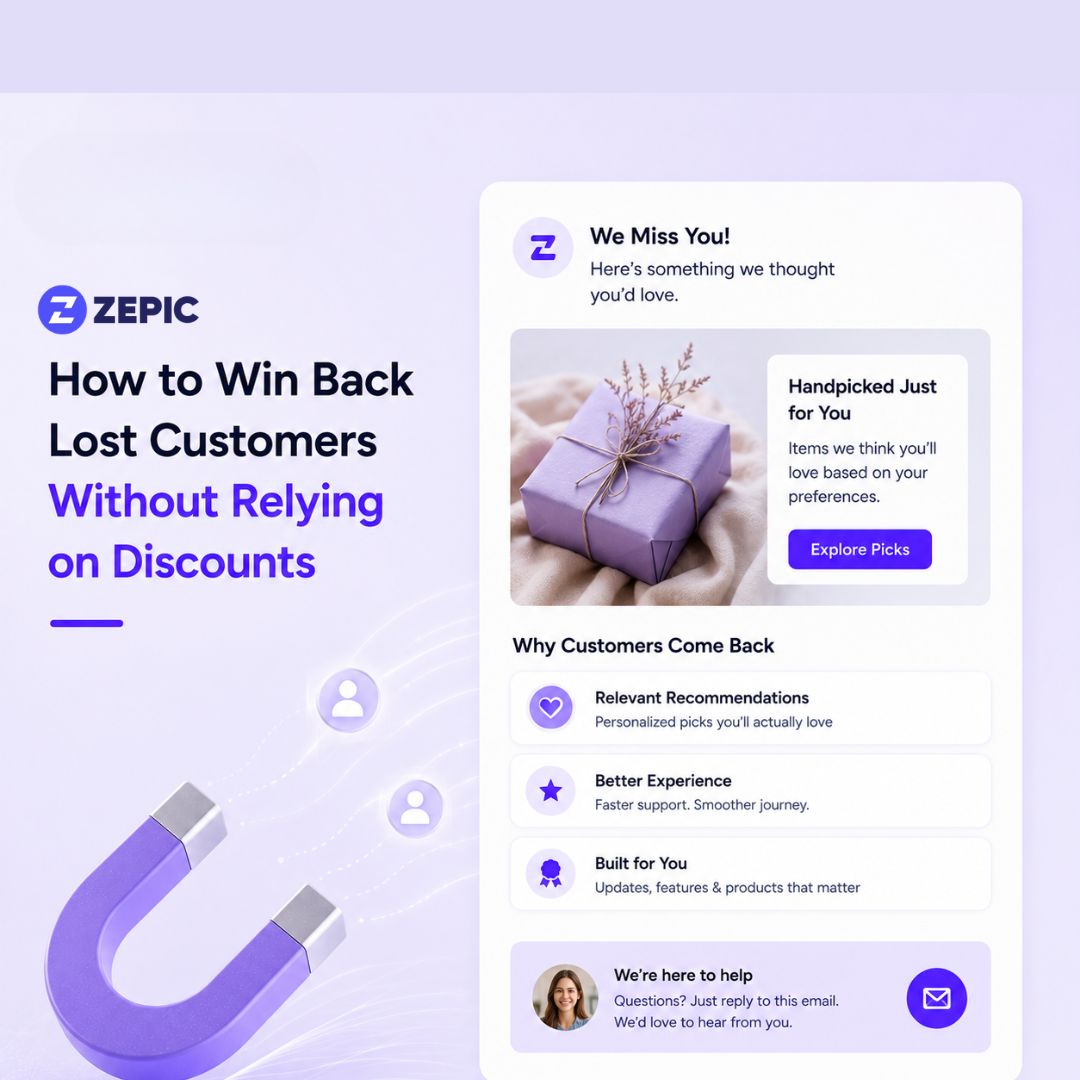
Let’s talk about a tale that is as old as time. You’re an e-commerce brand that spent thousands on getting new customers. They buy once, maybe twice, and then they go quiet.
So, you do what most brands do: send a 20% off email. There are two possibilities in this scenario.
1. Your discount email is ignored. But you’re not giving up that easily; you send another one. However, the customer finds it intrusive, and they unsubscribe.
2. They come back, but now they know that you'll fold the moment they go quiet. So they do it again. And again. Every lapse becomes a negotiation, and you're always the one paying for it.
Either way, the discount did not solve the problem. It either pushed the customer out or trained them to wait for a discount.
But, you can’t stop trying to get them back because businesses have a 20–40% chance of winning back a lost customer, compared to just 5–20% for converting someone brand new.
At the same time, you can’t keep cutting into your margins every time you want to win back a customer.
So what actually works?
Your customers leave behind behavioral signals every time they interact with your store. These can be wishlisted products, browsed categories, purchase history, or items they kept coming back to. This means you know what they want. You just need a system that uses it before you ever think about a coupon.
This guide covers four campaigns that do exactly that. We’ll walk you through how to build a complete customer reactivation system using Wishlist product tease, social proof nudges, trending now campaigns, and re-engagement quizzes.
The bottom line is that winning back an existing customer is more profitable and requires less effort than acquiring a new one. Now, let’s look at four strategies you can use to reacquire lost customers without relying on discounts.
A wishlist abandoned email campaign is one of the most underused tools in D2C lifecycle marketing.
When a customer saves a product, they are telling you exactly what they want. That is the strongest behavioral trigger available short of an actual purchase. Unfortunately, most brands either ignore this data and send a generic win-back email with no product-level personalization.
That is a big missed opportunity. Because wishlist data removes the need to guess. The customer has already picked a product. Your only job is to re-create the desire and make purchasing feel easy.
When personalized outreach around wishlisted products has not converted, the next move is to change who is doing the convincing. A social proof winback email shifts the authority from your brand to your customers—and that change alone can move people who have fully tuned out your messaging.
This campaign works because sometimes lapsed customers are just uncertain.
Reviews and testimonies address the unspoken question every inactive subscriber carries: "Is it still worth it?" without the brand having to say a word.
“Displaying reviews can increase conversion rates by up to 270%.” — Spiegel Research Center
A what is trending now campaign taps into a straightforward behavioral pattern: people want to stay in sync with what others like them are choosing. It creates relevance by proxy when direct intent signals are absent. This approach works best for customers 60–120 days lapsed with no recent site activity.
The re-engagement quiz is a smarter final move when the customer has been gone too long. Instead of telling lapsed customers what to buy, ask them what they want next.
The reason this works is that it fundamentally changes the interaction. Every other campaign in this system broadcasts to the customer. The quiz invites them in. That shift from one-way to two-way communication is often the only thing standing between a permanently lapsed contact and a reactivated buyer. And the preference data collected can fuel every future campaign, making this the highest long-term ROI touchpoint in the entire win-back system.
Each campaign in this system is designed to hand off to the next. The sequence matters as much as the individual campaigns. Here is how the full winback flow maps across the customer journey:
| Phase | Campaign | Entry Trigger | Primary Goal |
|---|---|---|---|
| Phase 1 | Wishlist Product Tease | Saved item + inactivity (45–60 days) | Re-engage highest-intent lapsed customers |
| Phase 2 | Social Proof Nudges | Browse signal or no Phase 1 conversion | Rebuild trust via peer validation |
| Phase 3 | Trending Now | Category affinity only, no active signal | Re-engage with FOMO grounded in real data |
| Phase 4 | Preference Quiz | Full lapse, all signals exhausted | Restart relationship and collect first-party data |
The wishlist tease uses the strongest behavioral trigger first — maximizing conversion before intent signals age out. Social proof picks up the customers who need peer validation to move. Trending Now catches the remainder using category-level relevance when individual product signals are gone. The quiz is the safety net, and the first-party data it generates feeds back into Phase 1 for the next lapse cycle, making the whole system progressively smarter.
P.S: Running suppression logic correctly across all four campaigns is as important as the content itself. Sending to disengaged segments without suppression rules harms domain reputation and reduces deliverability for every other campaign you run. Always prioritize list health alongside conversion metrics.
Discounts may create short bursts of revenue, but they erode margins, weaken brand positioning, and train customers to delay purchases. When you activate the signals customers have already given you, you replace guesswork with precision.
Wishlist reminders reignite intent.
Social proof removes hesitation.
Trending products restore relevance when signals fade.
Preference quizzes reopen the conversation and generate data that strengthens every future interaction.
Together, these campaigns form a system that gets smarter with every lapse cycle. Instead of reacting with price cuts, you respond with insight. Reactivation is one of the highest-ROI levers in retention marketing when executed with timing, segmentation, and behavioral intelligence.
Because the goal isn’t simply to bring customers back once. It’s to give them a reason to keep coming back without needing a discount to do it.
Ready to turn lapsed customers into loyal buyers without sacrificing margins?
ZEPIC brings your behavioral, transactional, and engagement data into a single unified view, enabling you to activate precise win-back journeys at the right moment.
See how ZEPIC can power your retention strategy and drive predictable repeat revenue.
Start monitoring lapse signals around 30 days after the last purchase. At this stage, signals such as browse abandonment or wishlist inactivity become meaningful indicators that a customer may be drifting away.
The 30–60 day window is typically where the highest-performing win-back email campaigns operate. Customer reactivation benchmarks drop significantly after 90 days, so launching your sequences earlier can recover revenue that would otherwise be lost.
If your current flow waits until 90 days before sending the first email, adjusting that timing alone can significantly improve recovery rates.
The best-performing win-back email subject lines are specific rather than generic. For example, “Still thinking about [Product Name]?” tends to outperform broad messages like “We miss you” because it references a real action taken by the customer.
Subject lines that introduce social proof, such as “Here is what 2,400 customers are saying,” often outperform discount-focused subject lines in open rate.
Curiosity-driven subject lines like “Quick question for you” or “Tell us what you want” also perform strongly, particularly when paired with preference quizzes or feedback requests that feel conversational rather than promotional.
Start with RFM segmentation to determine which customers should enter each campaign first. High-frequency and high-monetary customers who have recently lapsed should enter the Wishlist Product Tease flow immediately because their behavioral data is rich and their recovery value is high.
Mid-tier customers without wishlist activity can enter a Social Proof Nudge sequence, while customers who only show category affinity can move into a Trending Now campaign. Customers who pass through all of these sequences without converting are strong candidates for a re-engagement quiz.
Suppression logic is essential. No customer should be in more than one win-back sequence at a time, and any customer who converts should exit the system immediately.
Customer retention focuses on keeping active customers engaged and purchasing regularly, preventing churn before it occurs. Customer reactivation, on the other hand, targets customers who have already gone inactive.
Reactivation campaigns are designed for subscribers or buyers who have not purchased within your defined lapse window. While both strategies are part of the broader retention playbook, they rely on different triggers, messaging approaches, and performance metrics.
A lapsed customer is someone who has not purchased within a time period longer than their typical buying cycle. For many D2C brands, this window falls between 45 and 90 days.
The most reliable way to identify lapsed customers is through RFM segmentation, which evaluates Recency (time since last purchase), Frequency (how often they buy), and Monetary value (how much they spend).
Customers who fall outside their normal recency window should be prioritized for re-engagement campaigns, beginning with those who historically purchased most frequently and spent the most.

%201.png)


.png)