Meet

Neura HQ,
Your connected AI Agent Workforce Know more



TL/DR
Writing the perfect email with a flawless CTA won’t matter if no one ever actually opens it. You can spend hours agonizing over the graphic design, tweaking the margins, and choosing the exact shade of "buy now" green for your button. But if your subject line falls flat, your masterpiece is going straight to the digital graveyard.
With email open rates hovering around 28% in 2026, attention becomes your most expensive currency. This is because consumers receive dozens, sometimes hundreds, of promotional messages every single day.
This is where artificial intelligence steps in. How do you go from a blank screen to a high-converting, AI-optimized email campaign?
Let’s break down how you can use AI to stop guessing and start connecting, beginning with the most critical few words you will write all day.
“When you have written your headline, you have spent eighty cents out of your dollar.” – David Ogilvy
People rely on subject lines to decide whether to open an email. It is a ruthless mental spam filter. If your hook looks like clickbait or simply bores them to tears, you are getting swiped into the trash.
Mobile devices now account for 68% of all email opens, and most phone inboxes display only 28 to 50 characters before the email subject line gets cut off. That's roughly five to eight words. Every single one has to pull their weight.
As a marketer, it’s important not to treat the subject line as the last thing they write rather than the first thing they optimize. The result is a line dashed off in two minutes to send a campaign that took two weeks to build. AI flips that dynamic by making subject line testing fast, data-driven, and iterative—rather than a one-time gut call.
There's a lot of noise around AI in marketing, so it's worth being precise about what it's actually doing when it helps optimize subject lines. It isn't guessing creatively. It's pattern-matching at a scale no human team can replicate.
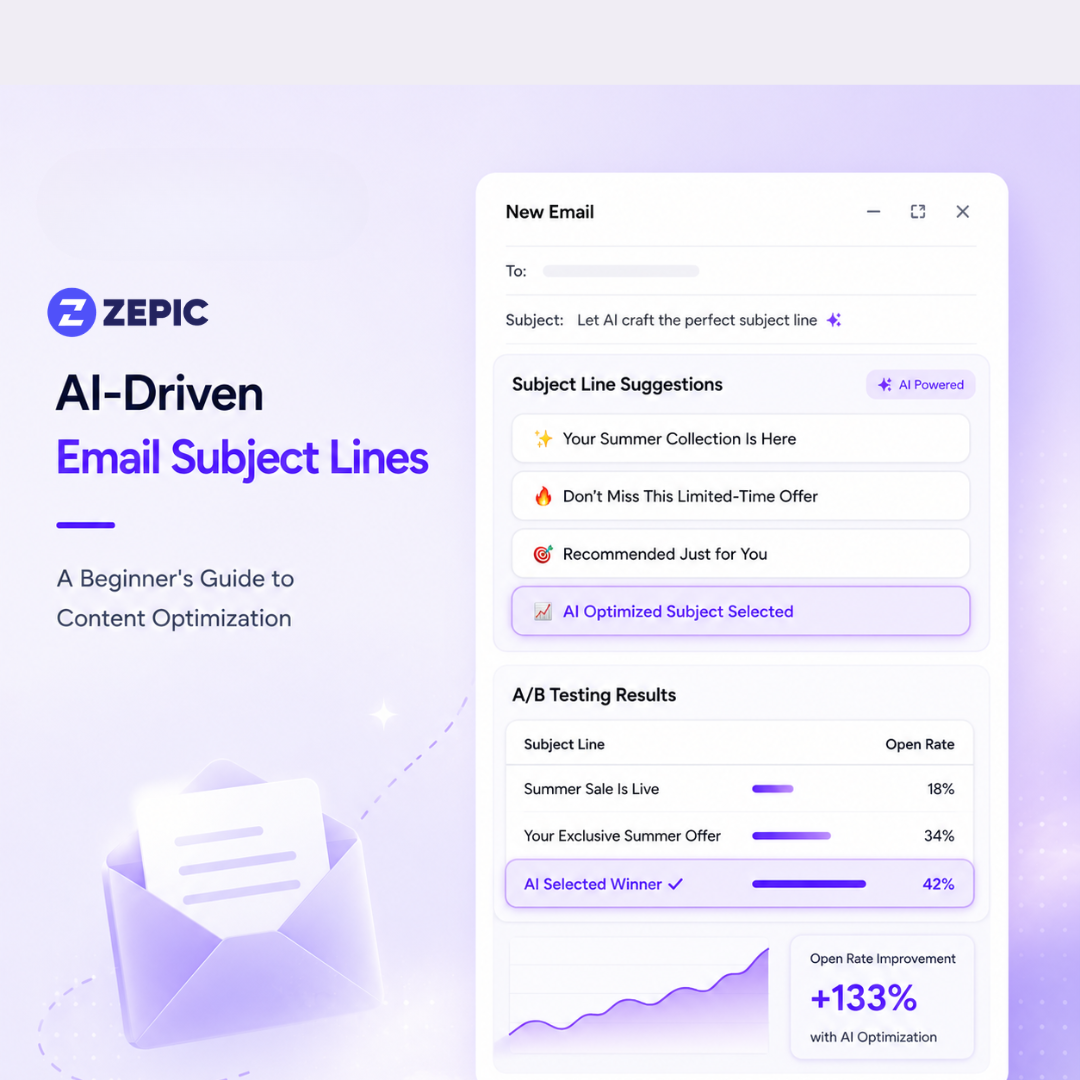
AI tools are trained on vast datasets of email campaigns and real performance outcomes. They learn which words, lengths, tones, and structures correlate with higher open rates across different industries and subscriber behaviors. Across the industry, AI-optimized subject lines produce up to 50% higher open rates than manually written ones. This is not because AI writes better than humans, but because it tests more variables, faster, and remembers what it learns.
Traditional A/B testing compares two subject lines. That's a start, but it's slow. AI-powered multivariate subject line testing can evaluate five to ten variants simultaneously, analyzing emotional tone, word choice, length, personalization, and structure in a single campaign cycle. The feedback loop compounds: each campaign makes the next one smarter.
The best subject line in the world can't save an email that arrives when your subscriber is in a meeting, driving, or asleep. AI send-time optimization analyzes each person's individual engagement history and delivers at their personal peak-attention window. The result is a 15 to 23% improvement in open rates from timing alone, with zero changes to your copy or design.
While AI gives you the testing infrastructure, you still need to write the variants worth testing. Here are some patterns that hold up across industries and audience types:
Inboxes are not the place for a slow build-up. With over 60% of all emails now opened on mobile devices, screens routinely chop off subject lines after 40 characters. If your main selling point is buried at the end of the sentence, it simply doesn't exist. Instead of writing, "Check out our amazing new features to save time," AI testing consistently favors leading with the outcome: "Save 10 hours a week with these features." Put the punchline first.
Humans are hardwired to resolve incomplete information. A curiosity gap gives them just enough context to be intrigued, but not quite enough to satisfy the itch without clicking. AI tools are excellent at calibrating this so it doesn't cross the line into spammy clickbait. A subject line like, "The strategy your competitors are using to scale..." is far more magnetic than a dry, factual summary.
In 2026, the best subject lines are reactions, not broadcasts. If an AI agent detects that a user lingered on a pricing page but didn't buy, it shouldn't send a generic "Happy Tuesday!" newsletter. It should trigger a highly contextual hook: "Still thinking about that upgrade, [Name]?" These behavior-driven hooks consistently pull open rates north of 45% because they align perfectly with user intent.
The power of email marketing is in the consistent touchpoints. The more you engage, the more trust you build - Russell Brunson
Getting the open is a victory, but it’s only half the battle. Once the subscriber is inside, the body copy has to deliver on the promise made by the subject line. If your subject line is a witty joke and your body copy reads like a dense legal document, the reader is going to bounce.
For years, personalization meant slapping a "Hi [First Name]" at the top of an email and calling it a day. In 2026, that is the email equivalent of a lukewarm handshake. True personalization requires context, and AI is exceptionally good at parsing context.
AI algorithms can analyze a subscriber's past purchase behavior, browsing history, and engagement patterns to dynamically alter the content of the email. If you run a sporting goods store, your AI can ensure that a customer who frequently buys yoga gear sees a hero image of a yoga mat, while a customer who buys running shoes sees apparel suited for marathons. The core promotional message remains the same, but the wrapper is uniquely tailored to the individual.
AI can swap product recommendations, images, and offers inside an email based on each subscriber's data. So, two people open the same campaign and see completely different content. This isn't reserved for large enterprise teams anymore. Modern platforms make it accessible for any brand with a reasonably structured customer profile. The case for it is hard to ignore: segmented, personalized campaigns generate up to 760% more revenue than one-size-fits-all sends.
Rather than editorially choosing which products to feature, AI can predict what a given subscriber is most likely to engage with based on their browsing behavior, past purchases, and engagement history. The email shifts from "here's what we decided to promote" to "here's what the data says you actually want to see." That's a fundamentally different starting point.
In the Gemini era, the inbox isn't sorted by time but by trust. Earn that trust with every email you send.
There's a structural shift in how emails are being read that most marketers haven't fully reckoned with yet. In January 2026, Google rolled out a major Gmail upgrade powered by Gemini 3. The update introduced AI-generated email summaries, smart inbox prioritization, and context-aware replies.
Gmail now ranks emails by relevance rather than recency. If your emails don't match a subscriber's demonstrated interests, they get deprioritized before the subscriber even sees them. The subject line that once determined the open now has to survive an AI pre-filter first.
Average click-through rates dropped from approximately 4.35% to 3.93% following Gmail's AI summary rollout. The likely cause is that subscribers extract key information from AI-generated snippets without opening the email at all. Open rate benchmarks that made sense six months ago may need recalibrating.
The implication for marketers is uncomfortable but clear: relevance isn't just a conversion optimization play but a deliverability play.
Most email tools give you a drag-and-drop builder and call it a day. ZEPIC's email marketing works differently.
The core distinction is data depth. ZEPIC comes with a built-in Customer Data Platform (CDP), which means every email you send is powered by a unified customer profile that pulls from your website, CRM, helpdesk, e-commerce platform, and more. You're not personalizing with just a first name and purchase history. You're working with a dynamic, continuously updated view of each subscriber across every touchpoint.
In practice, this means a few things that matter for AI-driven email:
AI doesn't make email marketing easier in the sense of requiring less thought. It makes it faster, more precise, and more scalable. The thinking still has to happen, but it shifts from guessing what to write to defining who you are writing for and why they should care. In a world where algorithms pre-read emails before humans do, and attention spans are measured in milliseconds, resting on your laurels is a guaranteed path to the spam folder.
When you combine human empathy with machine intelligence and plug both into a unified data platform like ZEPIC, you stop playing the volume game and start playing the relevance game.
And in 2026, relevance is the only game in town.
Ready to stop guessing and start growing? Book a demo to see how ZEPIC and Zenie AI can transform your email campaigns from ignored blasts into anticipated conversations.

%201.png)


.png)