Meet

Neura HQ,
Your connected AI Agent Workforce Know more



TLDR:
Something changed in your subscribers' inboxes in January 2026, and if your email metrics have changed recently, this is likely part of the reason.
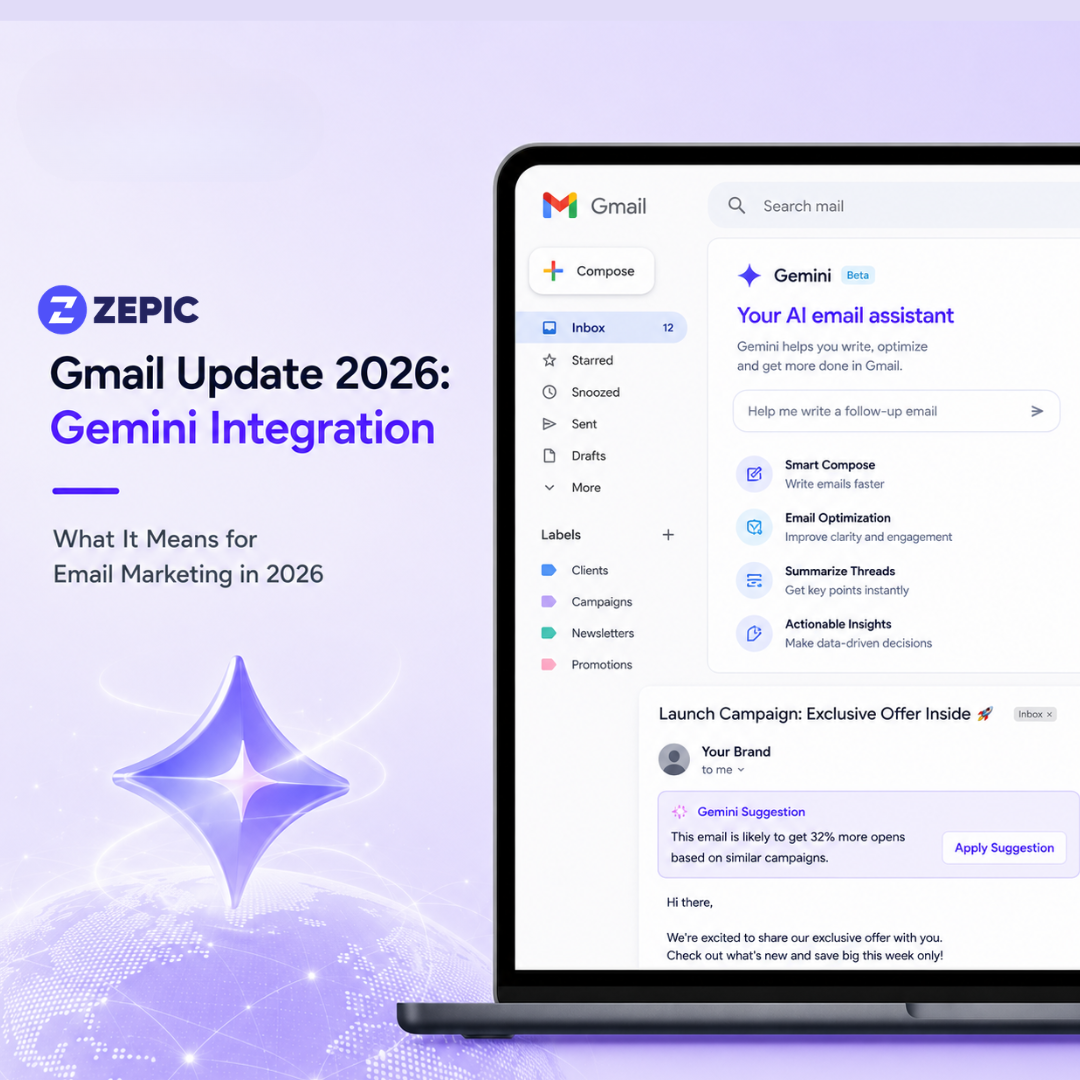
Google rolled out a major upgrade to Gmail powered by Gemini 3, its most advanced AI model. The update introduced AI-generated email summaries, smart inbox prioritization, context-aware replies, and an entirely new way of reading and sorting messages.
For everyday Gmail users, it is a convenient upgrade. But for email marketers, it is a structural shift in how inbox visibility is earned.
Gmail now has over 3 billion users, and Gmail's share of all email opens is 25 to 32%. That means if you send marketing emails, most of your audience is now reading them inside an AI-mediated inbox. Understanding what that means for your campaigns, your deliverability, and your metrics is not optional anymore.
This post breaks down exactly what the Gmail Gemini update includes, how it is already affecting email marketing performance, and the practical steps brands can take to adapt.
When a subscriber opens an email thread with multiple replies, Gemini now generates a condensed summary of the conversation rather than displaying the full thread. While this is a time saver for transactional messages and personal emails, your audience might just read the three-sentence AI-generated synopsis instead of the body of your well-crafted promotional email.
The implication is straightforward. If your most important message, your offer, your deadline, or your value proposition is buried deep in the email body, Gemini's summary may not surface it. What the AI cannot condense, it will skip.
This is the change with the most significant long-term impact for email marketers in 2026. Gmail's AI Inbox is a new view that reshapes the inbox around relevance rather than chronology. Instead of a traditional list of messages in the order they arrived, the AI Inbox presents a curated briefing: conversations it considers important, tasks flagged from emails, and updates it thinks matter most to that specific user.
Google has already updated the Promotions tab to sort by relevance rather than by recency, though users can still manually switch to chronological order. The expectation is that this toggle will eventually disappear, with relevance becoming the default and only sorting logic.
To put it simply, delivery no longer guarantees visibility. An email can land in the inbox and still go unseen if Gmail's AI determines it is low-priority for that recipient.
Gmail now offers AI-assisted drafting through "Help Me Write," which lets users compose or refine messages using generative AI. Suggested Replies have also been upgraded to reflect individual tone and conversation history more accurately, making one-click responses feel genuinely personal rather than robotic.
These features matter for marketers primarily because they accelerate the speed of subscriber interaction. Replies and click-through behavior are becoming stronger relevance signals, and tools that make replying easier could meaningfully increase two-way engagement.
Subscribers with Google AI Pro or Ultra subscriptions can now ask their inbox natural language questions: "What hotel did I book in March?" or "Did my order ship?" Gmail uses Gemini to surface a synthesized answer drawn from past emails. A separate AI Inbox tab is currently in testing with a limited group of users and is expected to expand more broadly throughout 2026.
Click-through rates are declining: Average click-through rates dropped from approximately 4.35% to 3.93% following Gmail's AI summary rollout. The likely cause: subscribers extract the key information from the AI-generated snippet without opening the email at all.
Open rates may be misleading: Because Gmail auto-opens emails to generate summaries, some platforms are recording opens that do not reflect a human actively reading the message. Open rate benchmarks that made sense six months ago may need to be recalibrated.
The relevance gap is widening: Brands with strong engagement practices, clean lists, and behavior-based segmentation are holding their inbox position. Those relying on high-volume, batch-and-blast strategies are seeing more visible performance erosion. Gmail's AI now creates a gradient of visibility within the inbox, not a binary inbox-versus-spam outcome.
Promotional tab position is becoming dynamic: With the Promotions tab now sorting by relevance in the Gmail app, an email's position within that tab is no longer determined by when it arrived. A highly engaging brand can appear near the top even if its email was sent hours earlier than a less-engaged competitor's message.
Google has not published an exact ranking formula, but various analyses point to a consistent set of signals that Gemini uses to evaluate and position emails.
Engagement depth over volume: Open rates are weak signals. Click activity, reply behavior, sustained interaction over time, and the speed with which a subscriber engages after receiving an email are all stronger indicators of relevance in Gemini's model.
Sender reputation and authentication: Technical compliance with SPF, DKIM, and DMARC remains non-negotiable. As Gemini evaluates sender trustworthiness at scale, senders with marginal authentication or inconsistent sending patterns will face reduced visibility. This has not changed. What has changed is how aggressively it is enforced.
Content quality as a deliverability signal: Gemini reads what your email actually says, not just whether it passes spam filters. Repetitive discount-heavy language, vague subject lines, and generic copy are now disadvantages not because they trigger a spam rule, but because they signal low relevance to Gemini's language model. Gmail has moved from rule-based filtering to meaning-based inbox ranking. The question has shifted from "Will my email pass spam filters?" to "Does my email deserve attention?"
The first 100 to 200 characters carry more weight than before: Gemini uses the opening of your email to determine how to summarize it. If your lead content is a greeting, a logo banner, or a generic introduction, that is what shapes the summary. Your actual offer may never surface.
Engagement history with similar senders: Perhaps the most significant long-term shift is that Gemini's behavioral modeling may allow engagement with one sender to influence how similar senders are ranked. A subscriber who consistently opens and clicks emails from outdoor lifestyle brands may find other outdoor lifestyle brands surfaced more prominently, regardless of relationship history. Inbox position is becoming predictive, not just reactive.
The good news is that the Gmail Gemini update is not killing email marketing. It is exposing weak habits. The fundamentals of good email marketing have not changed. Gemini has made them more decisive.
Here are the concrete adjustments that matter most right now.
Gemini's summary reads your email from the top. Whatever you put in the first sentence is what shapes the AI's interpretation of your message. Stop wasting that real estate on "Hi [First Name]," banner images, or brand pleasantries.
A strong opening looks like this: "Your 30% off welcome offer expires in 48 hours—here's what to shop."
That sentence does three things: states the offer, creates urgency, and tells the reader exactly what to do next. Gemini can summarize it accurately. A human can act on it immediately.
MarTech's analysis suggests that if Gmail's AI summaries expand to replace preheader text the way Apple Mail already does, your subject line becomes the only piece of real estate you fully control. Vague, clickbait subject lines that rely on curiosity to earn the open will perform worse in an AI-mediated inbox.
Prefer:
Over:
The more specific the subject line, the better Gemini can classify and surface your email to the right recipient at the right time.
List size does not protect you in a relevance-ranked inbox. Sending a broad promotional email to 80,000 subscribers generates weak engagement signals across a large audience. Sending a targeted email to 4,000 subscribers who browsed a specific product category last week generates strong engagement signals from a primed audience.
Behavioral segmentation sends Gemini a clear signal that your emails are relevant to the people receiving them. That signal compounds over time, gradually improving your inbox position with each send.
Segments worth building right now:
MarTech flagged two visual elements that are gaining importance in a Gemini-ranked inbox: BIMI (Brand Indicators for Message Identification) and Gmail Annotations.
BIMI attaches your verified brand logo to emails in the inbox header. In a relevance-sorted Promotions tab, where subscribers are scanning rather than reading, a recognizable logo creates visual trust before a single word is read.
Gmail annotations allow marketers to surface offers, countdowns, and deal highlights directly in the Promotions tab preview before the email is even opened. Access to annotations is earned through consistent engagement and sender reputation. They are not available to all senders, which is exactly why investing in the underlying engagement quality that qualifies you for them pays compound returns.
Gmail's AI is increasingly efficient at identifying low-engagement subscribers and deprioritizing content they are unlikely to engage with. Sending to a large, stale list does not improve your reach. It actively harms your sender reputation with every unengaged send.
Practical list hygiene steps to take immediately:
Open rates are becoming an unreliable signal. As Gmail auto-opens emails to generate summaries, inflated open data will distort your understanding of actual engagement.
Shift your primary performance metrics toward:
Gmail's Gemini 2026 rollout is still in progress. A few developments worth tracking closely:
The direction is clear regardless of the timeline. Gmail is moving toward an inbox where relevance, earned through genuine engagement, consistent sending quality, and behavioral alignment with subscriber interests, determines who gets seen.
Gmail's Gemini update makes one thing clear: email programs built on volume, generic content, and untargeted sends are going to face increasing headwinds. Campaigns built on behavioral segmentation, relevant personalization, and genuine subscriber engagement are going to benefit from algorithmic reinforcement.
ZEPIC is built for exactly that kind of email campaign. With a built-in CDP that unifies customer behavior data, AI-powered segmentation, and automated lifecycle flows triggered by real subscriber actions, ZEPIC helps brands send emails that Gemini's AI will recognize as relevant because their subscribers already do.
Ready to build context-rich campaigns that perform in the Gemini era? Book a demo today

%201.png)


.png)