TL;DR
- Instagram’s 2026 algorithm relies more on OCR and semantic analysis than hashtags for content discovery.
- Instagram officially limited posts to five hashtags, signaling the end of hashtag-heavy growth strategies.
- Hashtags now function mainly as classification signals that confirm what the AI already understands about a post.
- Meta’s Rosetta AI system scans images and video frames in real time to read text overlays, product labels, and visual details.
- Instagram’s semantic analysis understands context, intent, and topic relationships rather than relying only on exact keywords.
- The algorithm combines visuals, captions, spoken audio, and metadata to determine content relevance and reach.
- Keyword-rich captions, text overlays, spoken keywords, and optimized alt text are now essential for discoverability.
- Automation tools like keyword-triggered DMs and content audits help brands boost engagement velocity and improve reach.
- Instagram has evolved into a visual search engine where social SEO matters more than hashtag stuffing.
- Brands that align captions, visuals, audio, and metadata consistently are more likely to succeed in Instagram’s AI-driven discovery system.
The landscape of social media marketing changed forever in December 2025. Instagram officially enforced a hard limit of five hashtags per post. This move signaled the end of the 30-tag strategy that brands relied on for a decade. Today, Instagram functions as an intent-based recommendation engine rather than a hashtag-driven social network.
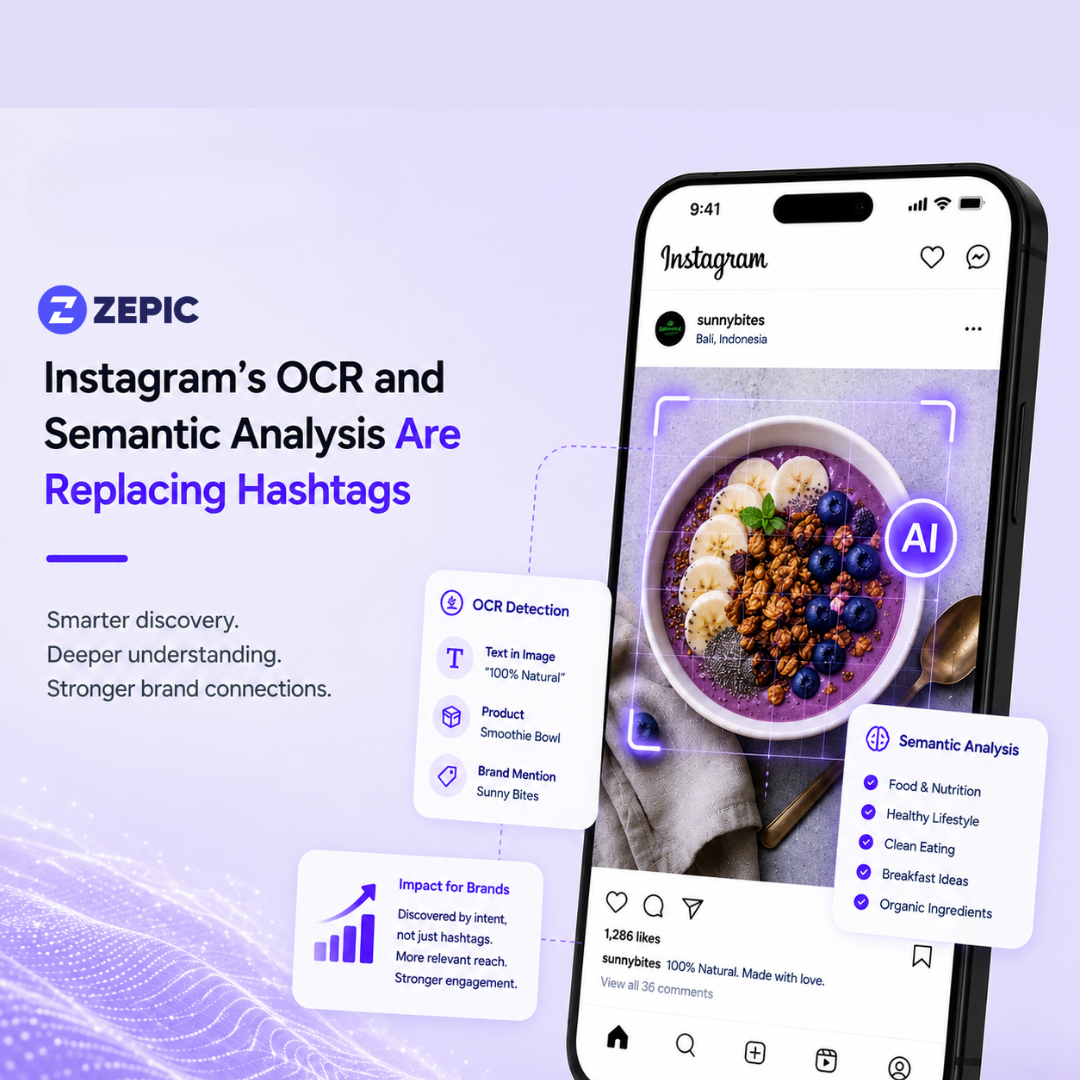
Brands that still try to stuff keywords into hidden comments are finding their reach stalled. The algorithm no longer needs a list of tags to understand what you are posting. Instead, it uses Optical Character Recognition (OCR) and semantic analysis to read your images, listen to your audio, and categorize your content with surgical precision.
Are hashtags still effective on Instagram in 2026?
Hashtags still play a role, but their purpose has shifted from discovery to classification. They act as a confirmation signal for the AI. If your image shows a skincare routine and your hashtag says #SkincareTips, the AI feels confident about where to place your content. However, the hashtag itself will not push your post to new people. The discovery happens because the AI recognizes the physical objects in your video and the keywords in your caption.
The Death of Hashtag-First Discovery
The transition away from hashtags began on December 13, 2024. On that day, Instagram removed the ability for users to follow hashtags. This change was a fundamental shift in how content reached home feeds. Previously, a brand could appear in a user's main feed simply because that user followed a specific tag.
Once that feature disappeared, the passive reach from hashtags vanished. Instagram replaced this system with an AI-driven "Suggested for You" model. By December 2025, the platform solidified this direction by capping hashtags at five.
What replaced hashtags for reach?
Reach is now driven by three primary factors:
- Content Retention: How long a user stays on your post or video.
- Private Shares: How many times your content is sent via Direct Message (DM).
- AI Indexing: How accurately Meta's systems can categorize your content based on visual and text signals.
Instead of broad tags, the algorithm looks for an intent match. It tries to predict what a user wants to see based on their past behavior, then scans its massive index to find content that matches those specific visual and semantic markers.
Meet the Machine Reading Your Posts: Meta’s Rosetta System
Every time you upload a carousel or a Reel, an AI system called Rosetta begins to work. Meta introduced Rosetta to handle the massive scale of text embedded within images and video frames. By late 2026, this system will have evolved into a real-time indexing powerhouse that scans over a billion public images every single day.
Does Instagram use OCR to read text in images?
Yes. Rosetta uses Optical Character Recognition to identify text overlays, product labels, and even the branding on the shirt you are wearing. This text is extracted and turned into metadata that the search engine can crawl.
How Meta's Rosetta system works on Instagram:
- Real-time scanning: As soon as you hit publish, Rosetta breaks your video into frames and your carousels into individual slides.
- Contextual extraction: It doesn't just read the words; it looks at where they are placed. Text in a "header" font size is weighted more heavily than fine print at the bottom of a slide.
- Language support: It recognizes text in dozens of languages, allowing for global discoverability without the need for translated hashtags.
For brands, this means your infographic's bullet points are now searchable. If you create a slide about "5 Ways to Save for a Mortgage," the words on that slide are helping you rank in the Explore page even if your caption is empty.
Semantic Analysis: Instagram Now Understands What You Mean
The intelligence layer above OCR is semantic analysis. While OCR reads the literal words, semantic analysis understands the context and intent behind them. Instagram has moved from simple keyword matching to "concept mapping."
What is semantic analysis on Instagram?
Semantic analysis is the process of using Natural Language Processing (NLP) to understand the relationship between different topics. If you post about "burnout," the algorithm knows this is related to "mental health," "work-life balance," and "corporate culture." You do not need to tag all those terms; the AI makes the connection automatically.
How the algorithm understands image content and audio:
- Audio-to-concept mapping: Instagram transcribes every word spoken in a Reel. It goes beyond transcription by mapping these words to conceptual clusters. Speaking about sustainability will automatically associate your content with eco-friendly living and ethical fashion.
- Visual energy and tone: The AI analyzes the color palette, the speed of the cuts in your video, and the sentiment of the music. High-energy videos are routed to Discovery feeds, while calmer, educational content is often served to Niche Interest feeds.
- The Three-Signal Model: The system combines what it sees (visuals), what it reads (captions and OCR), and what it hears (audio) to build a 360-degree profile of your post.
What This Means for Brand Content Strategy
Because the AI is more sophisticated, your strategy must become more intentional. You can no longer rely on a list of tags to do the heavy lifting. Every element of your post must be optimized for machine reading.
Shift #1: Captions as Content Signals
Captions are now essentially mini-webpages. In 2026, keyword-rich captions generate significantly more reach than those relying on short one-liners.
- Natural Language: Write as if you are answering a user's question. Instead of "Check out our new shoes #shoes #fashion," try "Our new waterproof running shoes are designed for trail runners who need extra grip on wet surfaces."
- Front-Loading: Put your most important keywords in the first two lines. This helps both the user and the AI identify the topic immediately.
Shift #2: Visual Text as Indexable Real Estate
Treat the text on your images with the same care as your website's H1 tags.
- Keyword Overlays: Use text in your Reels to highlight your main point. If your Reel is about "Small Business Tax Tips," those exact words should appear on the screen.
- Branded Graphics: Ensure your brand name and key product features are legible. The AI reads labels on your packaging to verify authenticity and brand authority.
Shift #3: Alt Text is Essential
Alt text is no longer just for accessibility. It is a direct line to the algorithm's indexing system.
- Descriptive Keywords: Instead of leaving alt text blank or using "Image 1," write a detailed description: "Person using a stainless steel coffee grinder to prepare an espresso at home."
Shift #4: Spoken Keywords
What you say in your video is just as important as what you write.
- Verbal Branding: Explicitly mention your brand name and the specific service you provide.
- Clarity: Clear audio allows the AI to transcribe and categorize your content more accurately.
Scaling Intent: The Role of AI Automation in 2026
Automation is the bridge between AI discovery and actual business results. In 2026, Instagram automation is no longer about bot accounts that leave generic comments. It is a highly integrated tool for professional accounts that use the official Meta Graph and messaging APIs.
Why automation is relevant to the AI-first algorithm
The 2026 algorithm prioritizes engagement velocity. When your content receives immediate interaction, the semantic engine views it as high-authority content and pushes it to more users. Instagram DM Automation allows you to capture this momentum instantly.
- Keyword-Triggered DMs: Brands now use "Comment Triggers." When a user comments a specific word like "GUIDE" or "LINK" on a Reel, an automated DM is sent instantly. This interaction signals to Instagram that your content is valuable, which increases your organic reach.
- Automated Content Audits: New tools now scan your carousels and Reels before you publish. They use their own OCR and semantic models to tell you how the Instagram algorithm will likely categorize your post. This allows brands to fix confusing text overlays before they go live.
- Scaling Personalized Responses: Meta’s Messaging API now allows for 200 automated DMs per hour per account. This allows brands to handle thousands of customer inquiries triggered by a viral post without hiring a massive manual support team.
By automating the routine parts of engagement, brands can focus on the creative strategy that the semantic engine craves. Automation makes your account feel "always active," which improves your brand trust signals.
The New Hashtag Role: Classification, Not Amplification
Hashtags have not died; they have simply changed jobs. In 2026, they serve as labels that help the AI verify its own findings. If the AI thinks your post is about "remote work" and you use the hashtag #DigitalNomad, you have provided the confirmation it needs to push the post to that specific community.
The 5-Tag Framework for Brands
Since you only have five slots, you must use them strategically. A balanced approach looks like this:
- 1 Branded Tag: Your unique company name (e.g., #BrandName).
- 1 Niche Community Tag: A tag used by a specific group (e.g., #SolarEngineers).
- 1 Topic Tag: The broad category (e.g., #RenewableEnergy).
- 1 Format Tag: The type of content (e.g., #EducationalTutorial).
- 1 Intent-Based Tag: Why the user is looking for this (e.g., #HowToSaveElectricity).
Statistics show that mid-tier hashtags (between 10,000 and 500,000 total posts) consistently outperform "mega-tags" with millions of posts. Mega-tags are too broad for the AI to use as a precise classification signal.
Practical OCR + Semantic Optimization Checklist
Use this checklist to ensure every post you publish is fully optimized for Instagram’s 2026 AI infrastructure:
- [ ] Write natural captions: Use phrases your audience actually types into a search bar.
- [ ] Front-load keywords: Place the main topic in the first sentence of the caption.
- [ ] Use text overlays: Add 3 to 5 keyword-rich text boxes to your Reels and carousels.
- [ ] Add custom Alt Text: Manually edit the alt text for every image to include descriptive keywords.
- [ ] Speak clearly: Mention your brand and primary topic verbally within the first five seconds of video.
- [ ] Limit hashtags: Use exactly 3 to 5 highly specific tags.
- [ ] Use "Add Topics": Use the built-in "Add Topics" feature in the Reel upload screen to assist the AI's categorization.
- [ ] Audit visuals: Check that your background elements and product labels align with the topic of your post.
Instagram as a Search Engine: What’s Next?
Instagram has become a hybrid between a social network and a visual search engine like Pinterest or Google. Users are increasingly bypassing the traditional Follow feed in favor of the Search tab.
The Convergence of Social SEO and Traditional SEO
Since mid-2025, public posts from professional Instagram accounts have been indexed by Google by default. A well-optimized Instagram caption can now drive traffic from a Google search query. This makes the Mini-Webpage approach to captions even more valuable.
Multimodal Indexing
The future of brand discoverability lies in multimodal indexing. This means the algorithm does not just look at one signal; it looks at the harmony between all of them. If your video shows a beach, your audio mentions "vacation," and your caption describes a "resort," the AI has a high-confidence match. If any of these signals conflict (e.g., you use a trending "rock" song for a "meditation" video), the AI may struggle to categorize the content, leading to lower reach.
Wrapping Up
Winning on Instagram in 2026 requires a shift from gaming the system to feeding the system. The algorithm is no longer a mystery to be solved with a secret list of hashtags. It is a highly capable reader and listener that rewards clarity and consistency.
The brands that succeed are the ones that treat every pixel, every spoken word, and every line of text as an indexable signal. By focusing on OCR-friendly visuals and semantically rich captions, you can ensure your content finds its way to the right audience without ever needing to "stuff" a single comment again.
Next Steps for Brands:
- Audit your current caption style: Are you using searchable keywords?
- Review your Reels: Is your most important information spoken or shown on screen?
- Update your workflow: Make "Alt Text" and "Add Topics" a non-negotiable part of your posting process.
Use ZEPIC to turn every comment or story reply into a lead. Maximize your brand’s organic reach and revenue with ZEPIC today.
Frequently Asked Questions
Does Instagram use OCR to read text in images?
Yes. Meta uses its Rosetta AI system to scan images and video frames. It identifies text on graphics, product labels, and background elements to generate metadata that improves search and content discovery.
Are hashtags still effective on Instagram in 2026?
Hashtags now function more as classification signals than reach drivers. They help confirm the topic of a post, but due to platform limits and algorithm changes, they are no longer the primary mechanism for discovery.
How does Instagram's algorithm understand image content?
Instagram uses computer vision to detect objects, scenes, and visual patterns. This is combined with OCR to read embedded text and semantic analysis to interpret the overall context or meaning of the content.
What is semantic analysis on Instagram?
Semantic analysis is how Instagram’s AI understands meaning beyond exact keywords. It groups content into broader concepts, such as themes or intent, allowing the algorithm to match posts with users based on interests rather than exact phrase matches.
How does Meta's Rosetta system work?
Rosetta scans large volumes of public images and video frames in real time, extracting embedded text and converting it into searchable data. This allows Instagram to categorize and rank content more accurately across feeds and discovery surfaces.
How can brands get discovered on Instagram without hashtags?
Discovery now depends on Social SEO. Brands should use keyword-rich captions, descriptive alt text, and clear text overlays in visual content. These signals help the algorithm understand and surface content to relevant audiences.
Does Instagram read text in videos and Reels?
Yes. Instagram performs frame-by-frame OCR on video content to detect text overlays. It also transcribes spoken audio to extract keywords and better understand the topic of the video.
What replaced hashtags on Instagram for reach?
The AI-driven “Suggested for You” feed is now the main source of reach. Content is distributed based on engagement signals such as watch time, interaction rate, and relevance to user interests.
How does Instagram search work in 2026?
Instagram search is now multimodal. It analyzes captions, text within images through OCR, spoken audio in videos, and alt text to deliver the most relevant results for a query.
Should brands use keywords in captions instead of hashtags?
Yes. Captions are now the primary signal for discovery. Writing clear, keyword-rich, and intent-driven captions is more effective for reach than relying on large sets of hashtags.





%201.png)


.png)