TLDR:
- SMS remains one of the most reliable direct marketing channels in 2026, since it bypasses email inbox filters and social media's shifting algorithms.
- Global mobile infrastructure supports SMS at scale: 5.6 billion mobile subscribers worldwide (about 69% of the population), and SMS works on both smartphones and basic feature phones.
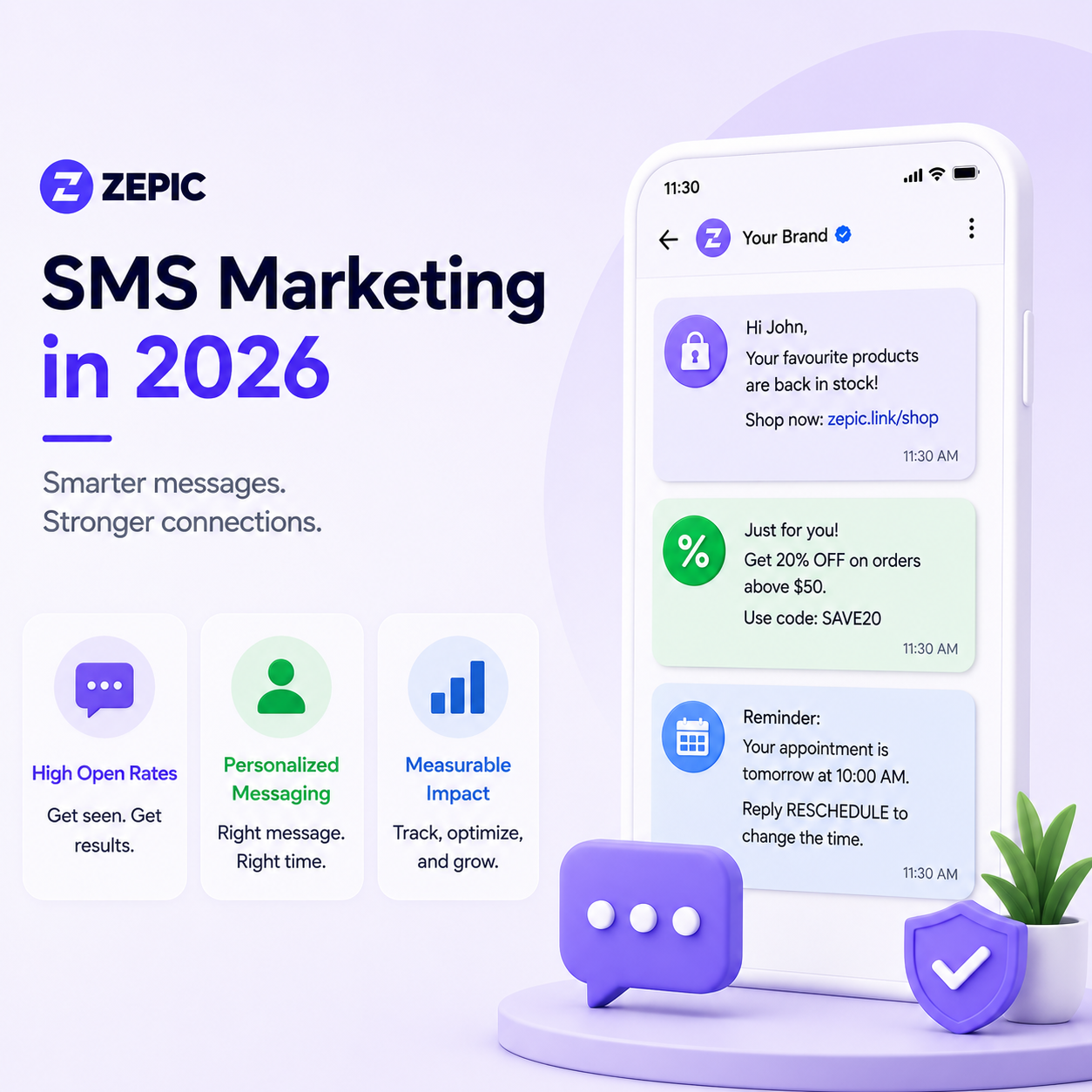
- Performance stats are strong: 98% average open rate, 90% of texts read within 3 minutes, and a 45% average campaign response rate.
- Click-through rates run 19-36%, conversion rates are lower for win-back texts (2-6%) and higher for abandoned cart messages (~8%).
- The SMS marketing industry is growing at a 20.3% CAGR as budgets shift from programmatic ads to owned-audience channels.
- 2026 benchmarks: 95-99.1% delivery rate, 92-98.5% open rate, 19-36% CTR, 5-12.5% conversion rate, and opt-out rates should stay under 1.5% per broadcast.
- Consumers increasingly avoid unknown calls (80% won't answer), making SMS a preferred channel for shipping alerts, promos, appointment reminders, and special-occasion messages.
- Legal compliance is critical: TCPA requires explicit written consent, documented opt-ins, and violations can cost $500-$1,500 per unauthorized text.
- CTIA/carrier rules enforce SHAFT content restrictions and mandatory STOP/HELP keyword handling.
- Best practices include double opt-in signups, respecting quiet hours (8 AM-9 PM), capping frequency at 1-2 texts/week, and avoiding spammy language or shortened links that trigger carrier filters.
- Choosing the right platform matters: prioritize deliverability infrastructure, segmentation/automation, omnichannel coordination, unified customer data, and strong analytics.
- The article closes with a nod to ZEPIC (currently email/WhatsApp/Instagram, with SMS support coming soon) and invites readers to get early access.
If you’re a brand trying to hack which channel is the best to reach customers in 2026, you’re not alone.
The communication landscape has become more complex than it was a decade ago. Email inboxes have AI guards, and Meta keeps adding new hurdles to WhatsApp and Instagram. Even if you successfully conquer all these challenges, there’s no guarantee a customer will read your message.
Amid all these uncertainties, SMS has been able to hold its position as a reliable channel for decades. However, the regulations and technicalities are ever-evolving in the text domain too.
This comprehensive guide outlines the state of SMS marketing in 2026 and what you can do to stand out from the crowd.
The Global Mobile Infrastructure
To understand why SMS marketing continues to grow, let’s first look at the underlying global mobile infrastructure. The channel relies on a universal protocol built into every mobile device. This means users don’t have to download a specific app or maintain a high-speed data connection.
Mobile Network Penetration
According to global data collected by GSMA Intelligence, there are 5.6 billion unique mobile phone subscribers worldwide, representing roughly 69 percent of the global population. Smartphone adoption makes up the vast majority of these connections. Thanks to standard cellular protocols, SMS functions are similar across advanced smartphones and basic feature phones.
Carrier Network Modernization
The widespread rollout of standalone 5G networks has improved the underlying speed and reliability of cellular communication. While internet-based apps require consistent data bandwidth, traditional SMS models utilize signaling channels that remain active even in areas with low data connectivity. This infrastructure guarantees high deliverability across diverse demographic groups.
SMS Marketing Statistics You Need to Know in 2026
High Visibility and Open Rates
Data from Gartner indicates that SMS maintains an average open rate of 98%. This figure has been stable for many years due to the personal nature of mobile notifications. In comparison, general business email open rates hover around 43%.
Delivery Speed and Read Windows
Customers open mobile messages quickly after receiving them. In fact, 90% of SMS are read within three minutes of delivery. This rapid consumption window makes the channel highly effective for time-sensitive announcements, transactional updates, and urgent alerts.
Consumer Response and Click Performance
According to data from Business.com, the conversion rate is 2 to 6% for win-back texts and about 8% for abandoned cart messages. The average response rate for text message campaigns is 45%. When campaigns include links, the average click-through rate ranges from 19 percent to 36 percent, depending on the relevance of the message and the industry sector.
Market Growth Projections
The economic value of the SMS channel continues to rise. A comprehensive market study by Grand View Research reveals that the global text message marketing industry is expanding at a compound annual growth rate of 20.3%. This growth is driven by businesses shifting budgets away from traditional programmatic advertising toward owned-audience channels.
2026 Industry Performance Benchmarks for SMS
You need clear metrics to evaluate the success of your SMS marketing efforts. So let’s look at some standard performance benchmarks for 2026.
| Metric |
Baseline Target |
High-Performance Target |
| Delivery Rate |
95.0% |
99.1% |
| Open Rate |
92.0% |
98.5% |
| Click-Through Rate (CTR) |
19.0% |
36.0% |
| Conversion Rate |
5.0% |
12.5% |
| Opt-Out Rate (Per Broadcast) |
Under 1.5% |
Under 0.5% |
| Monthly Unsubscribe Rate |
Under 3.5% |
Under 1.0% |
Understanding SMS Metrics
Delivery Rate
The percentage of sent messages that successfully reach the recipient device. Network filtering, invalid numbers, and carrier blocking can lower this number. If your delivery rate drops below 95%, it usually indicates list degradation or a lack of proper carrier registration.
Open Rate
Because cellular networks do not use tracking pixels like email, text message open rates are evaluated through device status reports and consumer panel tracking. A steady rate above 92% confirms that your messages are bypassing carrier spam filters.
Click-Through Rate
The percentage of recipients who click a link within the text. This metric provides a clear view of how engaging your content is. Higher rates occur when messages are personalized and offer clear value.
Opt-Out Rate
The percentage of subscribers who choose to unsubscribe after receiving a specific message broadcast. A sudden spike above 1.5% indicates that the frequency of your messages is too high or the content is irrelevant to the audience.
Evolving Consumer Communication Habits
Changes in consumer behavior explain why SMS or text messaging has become an essential channel for businesses. As digital spaces become more crowded, consumer preferences for interacting with companies have changed significantly.
Call Avoidance Trends
Data from the Pew Research Center indicates that 97% of adults own a smartphone. However, their willingness to answer traditional voice calls has dropped. 80% of consumers generally do not answer calls from numbers they do not recognize.
This is mostly due to the rise of automated robocalls and telemarketing. As consumers ignore unknown calls, text messaging serves as a reliable alternative for clear, brief communications.
When Do Customers Prefer SMS?
Consumers like the convenience of text alerts for specific tasks. According to various studies, users prefer text communications for certain types of information:
- Shipping and Delivery Notifications: 52% of consumers prefer text alerts for real-time tracking updates.
- Sales and Promotional Offers: 45% choose text messages to receive time-sensitive discounts.
- Appointment Reminders: 38% select text notifications to manage their schedules and confirm appointments.
- Special Occasion Alerts: 30% appreciate receiving messages tied to specific calendar events or personal milestones.
Legal Compliance and Carrier Governance
Text message marketing operates within a strict legal framework designed to protect consumers from spam. Violating these regulations can result in heavy financial penalties and carrier blocking.
The Telephone Consumer Protection Act (TCPA)
In the United States, the TCPA regulates commercial text messaging. The law requires businesses to get explicit written consent before sending automated marketing texts.
Key TCPA compliance rules include the following:
- Clear Disclosure: You must explicitly tell users they are signing up to receive marketing text messages.
- Separate Consent: Consent to receive text messages cannot be required as a condition of buying a product or service.
- Documented Proof: Companies must maintain timestamped records showing exactly when and how each subscriber opted in.
- Statutory Damages: Violations can cost between $500 and $1,500 per unauthorized text message, which can quickly lead to costly class-action lawsuits.
CTIA Guidelines and Carrier Filtering
The Cellular Telecommunications and Internet Association represents wireless carriers and establishes operational guidelines for text delivery. While the TCPA provides the legal framework, the CTIA enforces the practical rules for network traffic.
- SHAFT Restrictions: Carriers strictly block content related to Sex, Hate, Alcohol, Firearms, and Tobacco. Businesses working in regulated sectors must implement age-verification systems to prevent their messages from being filtered out by network operators.
- Standard Help and Stop Triggers: Every automated messaging program must support mandatory keywords. If a user texts STOP, QUIT, END, or UNSUBSCRIBE, the system must instantly remove them from the distribution list and send a single confirmation text. If a user texts HELP or INFO, the system must return clear details about the brand, message frequency, and support contact options.
How to Implement a Successful SMS Campaign
If you want to build a successful text message marketing program, you need clear strategies for content creation, timing, and audience management. Here are four practical playbooks based on industry data.
1. Subscriber Acquisition and List Management
Buying phone lists is illegal under consumer protection laws and harms your delivery rates. Instead, focus on building an organic, highly engaged subscriber base.
- The Double Opt-In Process: When a user enters their number on an online form, immediately send a confirmation text asking them to reply with a keyword like Y or YES. This process verifies the phone number is active and prevents accidental sign-ups.
- Clear Value Propositions: Make sure your sign-up forms clearly explain what subscribers will receive. Use clear terms like "Sign up for weekly delivery alerts and monthly promotional discount codes."
- Consistent Database Maintenance: Regularly remove numbers that fail to deliver over a 30-day window. This cleaning keeps your delivery rates strong and prevents carriers from flagging your account for texting disconnected numbers.
2. Campaign Timing and Frequency
Text messages disrupt a user's day, so timing is critical to maintaining a healthy subscriber list.
- Respecting Quiet Hours: Never send automated messages late at night or early in the morning. Federal regulations prohibit marketing messages before 8:00 AM and after 9:00 PM in the recipient's local time zone.
- Peak Engagement Windows: Performance data shows that click-through rates peak during two main daily windows: mid-morning between 8:00 AM and 10:00 AM, and early evening between 5:00 PM and 8:00 PM.
- Frequency Caps: 45% of consumers unsubscribe when a brand sends too many texts. To prevent list fatigue, limit your marketing messages to one or two texts per week.
3. SMS Copywriting and Formatting Rules
With limited character counts, your message copy needs to be direct, professional, and easy to read.
Example of an Optimized Marketing Message
BrandName: Your order has shipped! Track your package here: https://ex.com/v82j. Reply STOP to opt out.
- Put the Brand Name First: Always start your message with your company name. Consumers quickly delete messages from unknown senders or numbers they do not recognize.
- Use Clean, Direct Call-to-Actions: Use explicit, action-oriented verbs like "Use," "Show," "Claim," or "Track." Keep instructions simple so the reader knows exactly what to do next.
- Format Links Properly: Avoid generic link shorteners like bit.ly, as carrier spam filters often block them to protect users from phishing. Instead, use branded, short domains that match your company name.
4. Advanced Segmentation Strategies
Sending the same broadcast message to your entire list often leads to high unsubscribe rates. Grouping your audience into segments helps ensure your content stays relevant.
- Behavior-Based Segmentation: Sort your audience by their purchasing habits. For example, send exclusive early access offers to your frequent buyers, and offer introductory discounts to users who have not yet made a purchase.
- Location-Based Timing: Organize your contact lists by geographic region or area code. This segmentation guarantees that your promotions land at the ideal local time, whether your customers are on the East or West Coast.
- Product Preference Tracking: Group subscribers based on the specific product lines or service categories they selected during sign-up. This keeps your messaging targeted and prevents users from receiving unhelpful updates.
Troubleshooting SMS Deliverability Issues
When text message performance takes a hit, the cause is usually related to carrier filtering or poor database hygiene.
Identifying Carrier Filters
If your open rates or delivery numbers drop suddenly, carrier filters may be blocking your messages. This happens when the network flags your content or sending patterns as spam.
- Spam Keywords: Avoid phrases that sound overly transactional, such as 100% Free, Guaranteed Cash, or Act Now. Carrier filtering systems routinely block messages containing these terms.
- Excessive Capitalization: Do not use all-caps words or strings of exclamation marks. Formatting lines like "CASH BACK NOW!!!" triggers automated spam filters.
- Registry Compliance Check: Make sure your business has completed its 10DLC campaign registration with The Campaign Registry. Unregistered numbers face higher filtering rates and heavier carrier surcharges.
Reviewing Database Health
Low delivery rates can also point to issues with your phone number list.
- Deactivated Numbers: Mobile networks frequently reassign disconnected numbers to new users. If you text an inactive number, it returns a permanent routing error.
- Landline Incompatibility: Make sure your signup tools verify that numbers can accept text messages. Trying to text traditional landline numbers will lower your overall delivery rate.
Choosing the Right Marketing Platform for SMS
The statistics and benchmarks above only translate into results if the platform behind your campaigns can actually support them. Not every SMS tool is built the same way, and the wrong choice can quietly undermine deliverability, compliance, and subscriber trust. Let’s look at what to evaluate before you commit.
Deliverability infrastructure: Ask any vendor how they route messages and how they monitor delivery rates in real time. Platforms with direct carrier relationships and proactive list hygiene tools, such as automatic removal of numbers that fail to deliver, will consistently outperform tools that treat SMS as an afterthought bolted onto email.
Segmentation and automation depth: Blasting your full list with one message is the fastest way to spike opt-outs. Choose a platform that lets you segment by purchase behavior, location, product interest, and engagement history and that can trigger messages automatically based on real-time customer actions rather than static list exports.
Omnichannel capability: Text messages rarely work in isolation. The most effective programs coordinate SMS with email, WhatsApp, and other channels so a customer who ignores one message can still be reached through another, without duplicating effort or overwhelming the subscriber.
Unified customer data: Personalization requires context. A platform that pulls order history, browsing behavior, and support interactions into a single customer profile will produce more relevant texts than one that only stores a phone number and a name.
Reporting and analytics: You need visibility into delivery rate, open rate, click-through rate, conversion, and opt-out rate at the campaign level, not just aggregate totals. Real-time dashboards make it possible to catch a filtering problem or a fatigued segment before it damages your sender reputation.
Ease of use and support: Drag-and-drop journey builders, pre-built templates, and responsive customer support matter more than they seem to at first glance, especially for marketing teams without dedicated developer resources.
Weighing these factors against your team size, budget, and existing tech stack will narrow the field considerably. Most businesses find that a unified customer engagement platform, rather than a standalone SMS tool, delivers better long-term results because it treats text messaging as one coordinated piece of the customer journey instead of a siloed channel.
Wrapping Up
SMS marketing has earned its place as one of the most dependable channels available to modern marketers. High open rates, fast read times, and direct delivery to a consumer's mobile device give it an edge that crowded inboxes and algorithm-dependent social feeds cannot match. The businesses that succeed with SMS in 2026 will be the ones that treat it with the same discipline as any other regulated, permission-based channel: clean lists, thoughtful timing, clear compliance, and segmentation that respects the subscriber's inbox.
Getting all of this right on a standalone SMS tool is possible, but it takes more manual work than most teams have time for. ZEPIC is a customer engagement platform that supports email, WhatsApp, and Instagram. Soon, SMS is also going to be added to ZEPIC.
If you are ready to see how a unified approach compares to running SMS on its own, stay tuned for more updates. Talk to our team for early access.
Frequently Asked Questions
Is SMS marketing actually effective?
Yes. SMS marketing consistently delivers open rates above 90%, with most text messages being read within minutes of delivery. This combination of exceptional visibility and speed makes SMS one of the most effective channels for time-sensitive promotions, appointment reminders, order updates, and urgent customer communications.
How much does SMS marketing cost?
SMS marketing costs depend on message volume, carrier fees, destination country, and your provider's pricing model. Most platforms charge a monthly subscription plus a fee for each message sent. Businesses may also incur additional carrier charges if required registrations, such as 10DLC in the United States, are incomplete. Evaluating the total campaign cost provides a more accurate picture than comparing only per-message pricing.
What is a good open rate or click-through rate for SMS?
A well-performing SMS campaign typically achieves open rates between 92% and 98%, with click-through rates ranging from 19% to 36%, depending on the industry, audience, and message relevance. Results significantly below these benchmarks may indicate list quality issues, poor targeting, or carrier filtering rather than problems with the offer itself.
How is SMS marketing different from email marketing?
Email marketing is best suited for detailed content, newsletters, and visually rich campaigns, while SMS is designed for concise, immediate, and action-oriented communication. Because SMS messages are typically read much faster and have substantially higher open rates, they are particularly effective for urgent offers, reminders, and transactional updates.
How often should I text my subscribers?
Most best-practice guidelines recommend limiting promotional SMS campaigns to one or two messages per week. Sending messages too frequently can increase unsubscribe rates and reduce customer engagement. Every message should deliver clear value to justify its place in a subscriber's inbox.
How do I start an SMS marketing program?
Start by implementing a compliant opt-in process, ideally using double opt-in to verify customer consent. Register your messaging campaign under the appropriate regulations, such as the 10DLC framework where applicable, configure automatic HELP and STOP responses, and launch campaigns with a small, segmented audience. Using a customer engagement platform that unifies customer data makes it easier to personalize messages and scale your SMS marketing effectively.
Desperate times call for desperate Google/Chat GPT searches, right? "Best Shopify apps for sales." "How to increase online sales fast." "AI tools for ecommerce growth."

Been there. Done that. Installed way too many apps.
But here's what nobody tells you while you're doom-scrolling through Shopify app reviews at 2 AM—that magical online sales-boosting app you're searching for? It doesn't exist. Because if it did, Jeff Bezos would've bought (or built!) it yesterday, and we (fellow eCommerce store owners) would all be retired in Bali by now.
Growing a Shopify store and increasing online sales isn’t easy—we get it. While everyone’s out chasing the next “revolutionary” tool/trend (looking at you, DeepSeek), the real revenue drivers are probably hiding in plain sight—right there inside your customer data.
After working with Shopify stores like yours (shoutout to Cybele, who recovered almost 25% of their abandoned carts with WhatsApp automation), we’ve cracked the code on what actually moves the needle.
Ready to stop app-hopping and start actually growing your sales by using what you already have? Here are four fixes that will get you there!
Fix #1: Convert abandoned carts instantly (Like, actually instantly)
The Painful Truth: You're probably losing about 70% of your potential sales to cart abandonment. That's not just a statistic—it's real money walking out of your digital door. And looking for yet another Shopify app for abandoned cart recovery isn't going to fix it if you're not getting the fundamentals right.
The Quick Fix: Everyone knows you need multi-channel recovery that hits the sweet spot between "Hey, did you forget something?" and "PLEASE COME BACK!" But here's the reality—most recovery apps are a one-trick pony. They either do email OR WhatsApp, not both. And don't even get us started on personalizing offers based on cart value—that usually means toggling between three different dashboards while praying your apps talk to each other.
Enter ZEPIC: This is where we come in. With ZEPIC's automated Flows, you can:
Launch WhatsApp recovery messages (with 95% open rates!)
Set up perfectly timed email sequences (or vice versa)
Create personalized recovery offers not just on cart value but based on your customer’s behavior/preferences
Track and optimize everything from one dashboard

Fix #2: Reactivate past customers today
The Painful Truth: You're probably losing about 70% of your potential sales to cart abandonment. That's not just a statistic—it's real money walking out of your digital door. And looking for yet another Shopify app for abandoned cart recovery isn't going to fix it if you're not getting the fundamentals right.
The Quick Fix: Everyone knows you need multi-channel recovery that hits the sweet spot between "Hey, did you forget something?" and "PLEASE COME BACK!" But here's the reality—most recovery apps are a one-trick pony. They either do email OR WhatsApp, not both. And don't even get us started on personalizing offers based on cart value—that usually means toggling between three different dashboards while praying your apps talk to each other.
Enter ZEPIC: This is where we come in. With ZEPIC's automated Flows, you can:
Launch WhatsApp recovery messages (with 95% open rates!)
Set up perfectly timed email sequences (or vice versa)
Create personalized recovery offers not just on cart value but based on your customer’s behavior/preferences
Track and optimize everything from one dashboard

Offering light at the end of the tunnel is Google’s Privacy Sandbox which seeks to ‘create a thriving web ecosystem that is respectful of users and private by default’. Like the name suggests, your Chrome browser will take the role of a ‘privacy sandbox’ that holds all your data (visits, interests, actions etc) disclosing these to other websites and platforms only with your explicit permission. If not yet, we recommend testing your websites, audience relevance and advertising attribution with Chrome’s trial of the Privacy Sandbox.
Top 3 impacts of the third-party cookie phase-out
Who’s impacted
How
What next
Digital advertising and
acquisition teams
Lack of cookie data results in drastic fall in website traffic and conversion rate
Review all cookie-based audience acquisition. Sign up for Chrome’s trial of the Privacy Sandbox
Digital Customer Experience
Customers are not served relevant, personalised experiences: on the web, over social channels and communication media
Multiply efforts to collect first-party customer data. Implement a Customer Data Platform
Security, Privacy and Compliance teams
Increased scrutiny from regulators and questions from customers about data storage and usage
Review current cookie and communication consent management, ensure to align with latest privacy regulations