TLDR
- Proactive conversational AI increases conversions by engaging customers before they abandon a page, rather than waiting for them to ask for help.
- Many businesses lose revenue because their chatbots remain passive while users hesitate, compare options, or exit their sites.
- Effective proactive AI relies on three elements: the right behavioral signal, relevant messaging, and perfect timing.
- Key signals include pricing-page dwell time, exit intent, repeat visits, cart abandonment, support history, and declining product usage.
- Proactive engagement is especially valuable during pricing decisions, checkout abandonment, churn risk, post-purchase upsell opportunities, and support-to-sales transitions.
- Instead of generic pop-ups, proactive AI uses real-time behavioral data to initiate personalized conversations.
- Successful implementations require connected customer data, real-time signal processing, and coordination across multiple AI agents.
- Sales agents can proactively answer objections, explain plans, book demos, and recover abandoned purchases before users leave.
- Retention-focused agents can identify churn signals and intervene before customers cancel or disengage.
- Proactive AI works across industries, including SaaS, eCommerce, and B2B platforms, by responding to intent as it happens.
- When done correctly, proactive conversations feel helpful rather than intrusive because they are tied directly to user behavior and context.
The core problem modern enterprises face is simple: websites are bleeding revenue because their conversational AI is entirely passive. Companies spend millions driving high-intent traffic to pricing pages, checkout screens, and product listings, only to let those buyers slip away in silence. When a digital customer encounters friction or a sudden objection, they rarely click a support bubble to ask for help. Instead, they close the tab.
Relying on reactive AI means your system watches every signal of buyer hesitation and does nothing to stop the drop-off. This structural passivity turns your chatbot into an operational cost center instead of a revenue driver.
Consider this common online scenario:
- A potential customer spends four minutes analyzing your pricing matrix.
- They scroll back to the top and pause on your enterprise tier.
- They move their cursor toward the exit button.
- Your traditional chatbot bubble sits quietly in the corner, waiting to be noticed.
The user leaves, and the deal is gone forever. The reactive setup observed every single session signal, yet it acted on none of them. This is the exact revenue leak that proactive conversational AI solves.
The data surrounding modern digital commerce frames this problem clearly:
- 50% of all conversation-driven purchases during BFCM 2025 originated from proactive AI that initiated the conversation first
- Shoppers who engaged in AI-initiated conversations converted at 154% higher rates than those who did not.
- AI-influenced orders grew by 273% quarter-over-quarter in 2025.
- 79% of brands report that AI-driven conversational commerce has directly increased overall sales numbers.
The performance gap between brands using proactive conversational AI and those waiting for a customer to take the first step is structural. Waiting for customers to ask for help is a direct conversion killer. Understanding why proactive conversational AI increases conversion rates is the first step toward fixing this revenue leak.
What Proactive Conversational AI Actually Means (And What It Doesn't)
Deploying a proactive conversational AI strategy requires defining what the technology actually does.
To start, proactive AI is separate from standard web components:
- It is distinct from push notifications attached to a chat window.
- It does not refer to basic timed pop-ups that activate exactly 30 seconds after page load without analyzing user actions.
- It avoids pre-scripted outreach blasted indiscriminately to massive user segments.
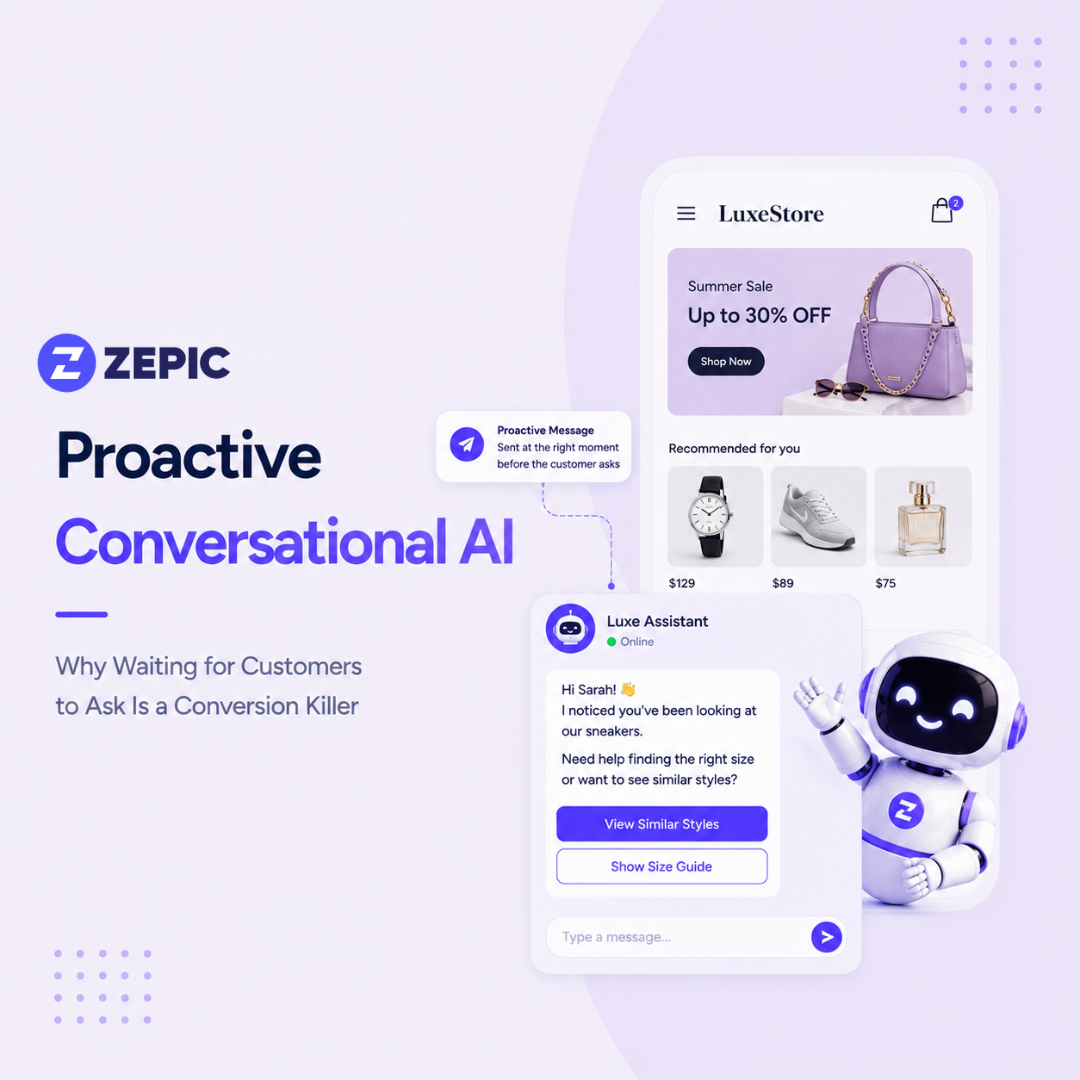
Real proactive conversational AI monitors live context, tracking behavioral signals, active session data, historical interactions, and stated intent. It then launches a highly contextual conversation at the precise millisecond it will achieve maximum impact.
Three specific conditions transform an AI-initiated conversation from an annoying interruption into a helpful interaction:
- The Signal: A definitive behavioral trigger determines the need for outreach, moving past basic timers.
- The Relevance: The generated text addresses exactly what the behavioral signal indicates the customer needs.
- The Timing: The interaction occurs early enough to assist the user, avoiding the trap of chasing an already closed browser tab.
The Signal Taxonomy
Proactive digital agents track and evaluate specific user behaviors across your digital properties:
| Signal Type |
Example Trigger |
| Dwell + scroll depth |
A user spends 3+ minutes on a pricing matrix with no CTA clicks. |
| Exit intent |
The user cursor accelerates rapidly toward the browser close button. |
| Repeat visit |
A profile logs its 3rd distinct visit to the same technical product page. |
| Search pattern |
A user inputs queries containing "vs competitor" twice within one session. |
| Drop-off point |
An account abandons an application or order at step 3 of a 4-step process. |
| Support history |
A user opened a critical support ticket 48 hours ago that remains unresolved. |
| Purchase recency |
An account reaches 45 days since their last order, where their baseline cadence is 30 days. |
| Sentiment shift |
Customer satisfaction scores drop after the last interaction, with no follow-up. |
The Five Moments Where Waiting Is Most Expensive
Waiting for your customer to take the first step creates a revenue leak. Here are five distinct business moments where a reactive posture directly hurts your bottom line and how proactive customer engagement AI alters the outcome.
The Pricing Page Stall
- The Signal: High user dwell time combined with deep scrolling, no call-to-action clicks, and multiple mouse movements over specific plan tiers.
- The Reactive Approach: The system does nothing, allowing the user to experience choice paralysis and leave.
- The Proactive Approach: A dedicated Sales AI Agent triggers a precise message: "I see you are exploring our team tiers. Would it help if I broke down which plan fits your exact team size?"
The Cart Abandonment Window
- The Signal: A high-value item is added to the cart, and the checkout process begins, but the user stops entering text on the shipping details screen.
- The Reactive Approach: The system waits to send a generic cart abandonment recovery email four hours later.
- The Proactive Approach: The Sales AI Agent initiates a chat window within 90 seconds of inactivity: "Still finalized your choice? I can confirm if this specific size is currently in stock and reserve it for you for the next ten minutes."
The Pre-Churn Silence
- The Signal: Platform usage metrics drop significantly, a technical support ticket was recently closed, and no organic re-engagement has occurred for days.
- The Reactive Approach: The company waits silently until the user clicks the "cancel subscription" button inside their dashboard.
- The Proactive Approach: A specialized Retention Manager Agent launches an outreach interaction: "We noticed your team has not deployed our reporting feature this week. Many operators find our automated scheduling tool saves a few hours during setup. Would you like a quick walkthrough?"
The Post-Purchase Upsell Window
- The Signal: An order confirmation page loads, and the customer profile history shows a clear gap that a complementary accessory or add-on solves.
- The Reactive Approach: A standard post-purchase recommendation email goes out three days later, long after buying momentum has faded.
- The Proactive Approach: The agent presents a contextual add-on offer directly inside the active order confirmation chat window while the user's intent remains fully engaged.
The Support-to-Sales Handoff Gap
- The Signal: A complex technical support ticket is marked as resolved, during which the customer asked about a feature restricted to a higher product tier.
- The Reactive Approach: The customer support representative closes the ticket, leaving the sales opportunity completely unaddressed.
- The Proactive Approach: The support agent flags the data signal directly to a sales agent, who follows up within an hour: "I saw your question regarding our advanced security features. That framework is available on our scale tier. Would you like to see a live demonstration of how it protects data?"
Why Most Enterprise AI Can't Do This: The Architecture Problem
Executing an enterprise-grade proactive AI engagement strategy requires specific software capabilities. Most standalone chatbot applications or single-point tools lack the foundational data architecture to support proactive actions. True proactive AI requires three pillars to succeed.
1. Connected Intelligence
The digital agent that engages a user on a pricing page must instantly know historical purchase records, open support histories, current subscription tiers, and prior sales conversations. Without shared context across all customer touchpoints, a proactive message functions as an unwanted interruption rather than a helpful interaction.
2. Real-Time Signal Processing
Schedule-based triggers that fire hours after an event do not qualify as proactive conversational tools. True proactive execution requires parsing live session context and moving within a window of intent measured in minutes and seconds. Because traditional marketing automation platforms rely on slow batch data logic, their outreach constantly lags behind user behavior.
3. Agent Orchestration
A complex digital journey cannot rely on a single, isolated bot. A pricing page signal demands a sales specialist, and a support expansion opportunity requires a coordinated handoff between support and sales systems. Managing these interactions successfully requires moving past single bots to an integrated AI agent workforce governed by in-built orchestration capabilities.
Deploying proactive systems without these architectural layers creates significant operational risks. It leads to repetitive, spam-like messages and situations where customers receive disconnected questions from multiple tools in a single week. Systems lacking proper architecture make helpful interventions feel like unwanted tracking.
What Proactive AI Looks Like When It Works: Three End-to-End Scenarios
Enterprise SaaS — Pricing Page to Demo
- The Trigger: A known decision-maker from a target account lands on the pricing page for the fourth time in a week. They stay for three minutes and hover their mouse over the custom enterprise tier.
- The AI Interaction: A Sales Agent initiates a chat: "You have spent some time looking over our enterprise structure this week. Most organizations at your operating scale have specific questions about our custom API rate limits. Would you like to pick a 20-minute slot on our engineer's calendar to review those specs?"
- The Outcome: The user chooses a time slot directly inside the chat interface. The system books the meeting without requiring a multi-field contact form, a generic demo landing page, or a two-day manual sales development follow-up cycle.
eCommerce — Real-Time Cart Recovery
- The Trigger: A customer places three items into their shopping cart, starts the standard checkout sequence, and stops moving on the final payment selection screen.
- The AI Interaction: A Sales Agent reaches out within 90 seconds: "Still finishing up your order? I have securely saved your cart selection. The medium jacket you selected is currently running low on inventory. Would you like me to reserve it for you for the next 15 minutes?"
- The User Response: "Does this order qualify for free shipping?"
- The AI Interaction: "It does. All domestic orders over $75 receive free shipping, and your current cart total is $89. Here is a direct link to complete your checkout with the shipping discount applied: [Checkout URL]."
- The Outcome: The agent resolves the product objection, clears up checkout friction, and helps the customer complete the purchase entirely inside the active session.
B2B — Retention Agent Catching Churn
- The Trigger: An enterprise platform account shows a sharp drop-off in user logins over 14 days. Their data history shows a technical integration ticket was resolved five days ago, but no team members have logged back in since.
- The AI Interaction: A Retention Agent reaches out to the account administrator: "Hi Sarah, I wanted to reach out following our integration update last week. Is the data syncing smoothly across your team's dashboard now? A few operations teams noted a similar configuration loop and found that adjusting their webhook permissions resolved it permanently. Would you like me to verify your settings?"
- The Outcome: The proactive contact reactivates an unhappy user, uncovers a lingering configuration issue, and allows a human account manager to step in before the customer decides to cancel.
Let us revisit our opening digital scenario with a proactive system in place.
The customer spending four minutes on your pricing page does not close the browser tab in frustration. Instead, an intelligent sales agent reads their behavioral signals and initiates a helpful conversation before they can move toward the exit button.
That specific conversation turns into a live demonstration. That demonstration turns into a closed enterprise contract.
The digital agent that drove this outcome did not sit idly by waiting for an explicit command. It was architected to read data signals and take action.
The enterprise brands building a structural advantage in 2026 are not simply collecting isolated AI tools. They are deploying integrated agent networks that share context, process live user signals, and take the first step. They function as a coordinated workforce instead of simple, isolated tools.
Transform Your Customer Engagement Strategy
Neura HQ allows you to deploy a fully connected AI agent workforce spanning sales, support, and more. Talk to us today!
Frequently Asked Questions
What is the difference between proactive and reactive conversational AI?
Reactive conversational AI waits for a customer to initiate an interaction by clicking a chat widget, sending a message, or asking a question. Proactive conversational AI actively monitors behavioral signals, session activity, and contextual data to identify opportunities where assistance may be needed and initiates the conversation automatically.
How does proactive AI engagement increase conversion rates?
Proactive AI engagement helps increase conversions by addressing customer concerns in real time. By detecting signals such as extended page visits, hesitation during checkout, or repeated product comparisons, the AI can provide timely assistance, clarify questions, offer recommendations, or resolve objections before the customer leaves the site.
What behavioral signals trigger proactive AI conversations?
Common triggers include extended dwell time on key pages, deep scrolling without taking action, exit intent behavior, multiple visits to the same product or pricing page, repeated visits across sessions, and abandonment during a checkout or signup process. These signals indicate uncertainty or interest and create opportunities for proactive engagement.
Can AI agents initiate conversations without feeling intrusive?
Yes. Effective AI agents initiate conversations only when customer behavior suggests assistance would be valuable. By referencing the user's current activity and providing relevant help rather than generic promotions, proactive engagement feels helpful and personalized instead of disruptive or intrusive.
How does proactive AI reduce cart abandonment?
Proactive AI detects when shoppers become inactive or encounter friction during checkout. It can initiate a conversation to answer shipping questions, clarify pricing, provide product information, resolve technical issues, or guide users back to checkout. By addressing obstacles in real time, the system helps recover purchases that might otherwise be abandoned.
What is the ROI of proactive conversational AI vs reactive support?
Reactive support primarily focuses on reducing operational costs by handling customer inquiries efficiently. Proactive conversational AI contributes directly to revenue generation by increasing conversions, reducing abandonment, and improving customer engagement. Organizations often see both operational savings and measurable improvements in sales performance.
How do AI agents decide when to proactively reach out to a customer?
AI agents evaluate real-time behavioral data, customer history, browsing patterns, purchase activity, and predefined business rules. By combining these signals, the system identifies the most appropriate moment to engage, ensuring the interaction supports the customer journey rather than interrupting it.
How is proactive AI different from push notifications or email automation?
Push notifications and email automation typically operate on fixed schedules or predefined triggers after an interaction has occurred. Proactive conversational AI engages customers during active sessions, adapts to real-time behavior, and supports two-way conversations that can immediately address concerns, answer questions, and guide decision-making.





%201.png)


.png)