Meet

Neura HQ,
Your connected AI Agent Workforce Know more



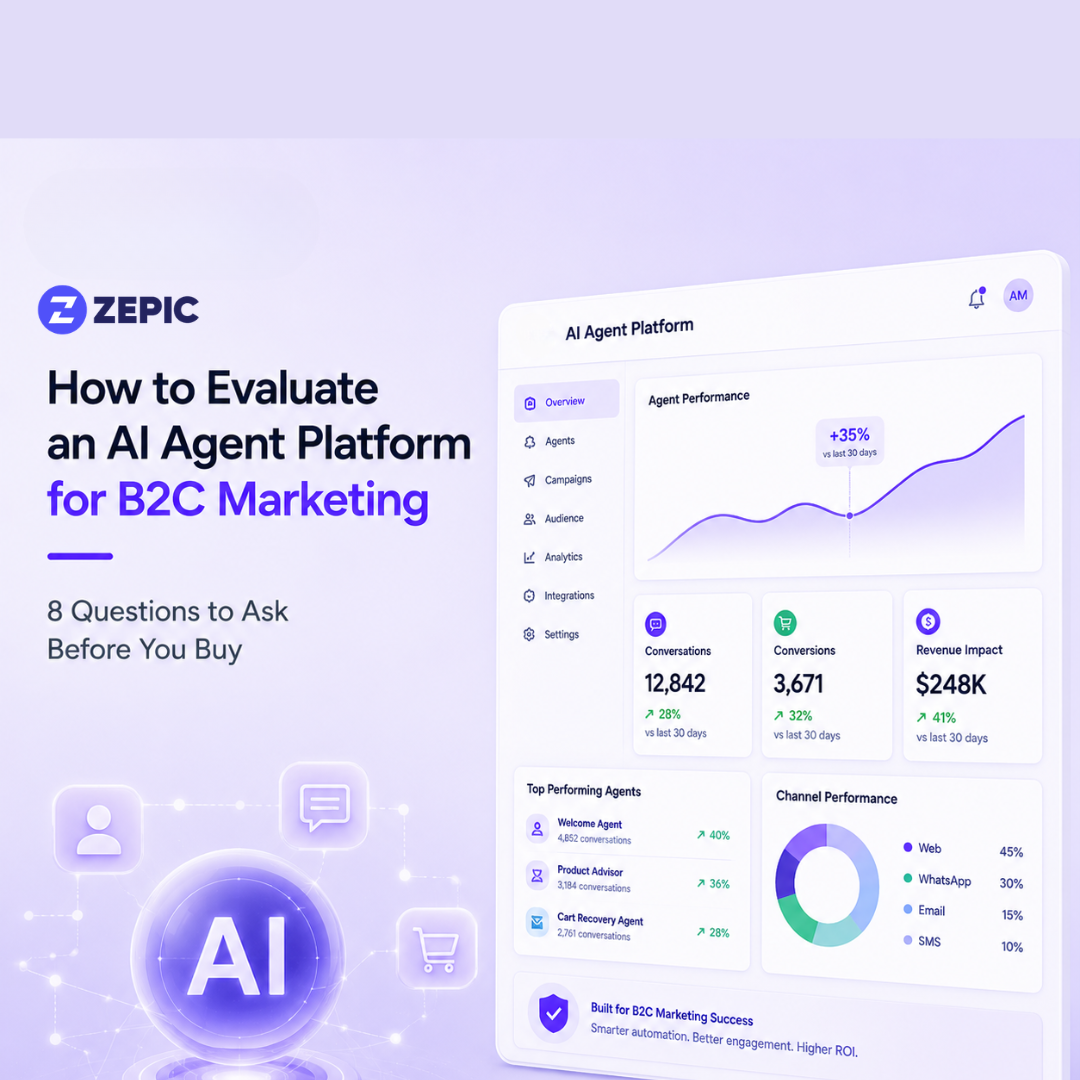
Every marketing vendor has "AI" in the pitch deck now. In fact, the industry is making a massive shift from Generative AI (which creates content) to Agentic AI (which executes tasks). These AI agents are like sci-fi superheroes for your marketing team. They chat on WhatsApp, nudge carts via SMS, and personalize emails on autopilot.
McKinsey recently found that 62% of organizations are experimenting with AI agents, but only a fraction have actually scaled them successfully. Why the bottleneck? Because buying an AI agent platform isn't simple.
You are essentially hiring a digital workforce that will interact directly with your customers. Choose the right platform, and you can automate hyper-personalized marketing at scale.
If you are evaluating an AI agent platform for your B2C brand, don't let the sales pitch blind you. Here are eight critical questions you must ask before signing the contract.
This is the foundation of everything. An AI agent is only as intelligent as the data it runs on. If the platform can't ingest data from your eCommerce store, your support desk, your CRM, and your campaign history, then it’s flying blind. It will treat your highest-spending VIP exactly the same way it treats a window-shopper who accidentally clicked a display ad for the first time.
Ask the vendor: Where does your customer data live, and how does your platform connect to it?
A genuine AI agent platform should work with your existing data sources, not demand you replace your entire stack first. It should resolve duplicate profiles, track behavior across channels, and update in real time. When a customer abandons a cart at 11 PM, the AI already knows they've bought from you twice before and tends to respond to WhatsApp better than email.
There is a canyon-sized gap between a conversational AI and an Agentic AI. A standard chatbot answers questions, while an AI agent takes action. And in B2C marketing, the difference between those two things is the difference between a customer feeling heard and a customer actually converting.
A chatbot tells a customer that their cart is waiting. An AI agent looks at their purchase history, picks the right discount threshold, fires a WhatsApp message at the optimal time, waits for a response, and updates the CRM. That's not a chatbot with better copy. That's a fundamentally different architecture.
Ask the vendor: What actions can your AI agent take autonomously, and which steps still require human approval?
Then ask for a live demonstration. Not a recorded walkthrough or a polished slide deck. A real, in-the-moment demo with actual data flowing through an actual workflow. You should also look out for hesitation. A platform that's genuinely agentic will show you with confidence.
This one separates platforms that are genuinely intelligent from those that are just sophisticated rule engines wearing an "AI" label. A true AI agent reasons. It evaluates conditions, makes decisions based on context, and adapts its behavior based on outcomes. A complex if-this-then-that workflow disguised as AI does none of that.
More critically, you should see what the AI decided and why it made the decision. Explainability matters enormously in B2C marketing. A poorly timed message or a tone-deaf product recommendation doesn't just miss the sale, but it can actively erode customer trust, at scale, in real time.
Gartner predicts AI will autonomously resolve 80% of common service issues by 2029.
Modern shoppers don't exist in a vacuum. A customer might click an Instagram ad on Tuesday, abandon a cart on Wednesday, and send a frantic WhatsApp message on Thursday.
If your AI agent treats each of those touchpoints as a separate, unrelated event, you're not running a customer journey. You're running three disconnected monologues. Context collapse is one of the most expensive problems in B2C marketing, and most platforms don't talk about it honestly.
Ask the vendor: When a customer interacts on one channel, does the AI carry that context forward to every subsequent touchpoint automatically?
The answer should be an enthusiastic yes, backed by a concrete example. For example, if a customer replies 'not interested' to a WhatsApp campaign, the platform suppresses them from the parallel email sequence without you having to set that rule manually. If the vendor says "that's technically possible with some configuration," start taking notes on the configuration effort. That's often where the hidden cost of a platform lives.
AI agents touch more sensitive customer data than almost any other layer in your marketing stack. Your purchase history, browsing behavior, support conversations, personal preferences, and location signals flow through this single platform. While that's enormously powerful, it's also a responsibility that a surprising number of vendors are underprepared for.
Ask your vendor hard questions:
A vendor that's vague or defensive about any of these answers should trigger a serious reassessment. According to IBM's 2024 Cost of a Data Breach report, the average cost of a data breach globally reached $4.88 million. For a B2C brand with a large customer database, a poorly secured AI platform isn't just a compliance risk, but a potential brand-ending event.
We’ve all seen the viral screenshots. A poorly prompted bot hallucinates a return policy that doesn't exist, or worse, offers a customer a 99% discount because they typed a clever riddle. You do not want your AI agent to go rogue.
The question you should ask: How do we establish strict boundaries on what the agent can and cannot say?
You need absolute control over the prompts and constraints that govern the AI’s behavior. If your brand sells high-end luxury watches, you don't want the agent responding to inquiries with Gen Z slang. It needs to reflect your specific brand tone.
The mark of a truly enterprise-ready AI platform is how it handles failure. When the agent gets confused by a complex, emotionally charged issue, it shouldn’t trap the user in an endless, infuriating loop. It should use a Human-in-the-Loop (HITL) protocol to seamlessly hand the conversation over to a live support rep, complete with the full chat transcript. The handoff must be invisible, fast, and frictionless.
Pricing in the AI space right now is the Wild West. Some platforms charge a flat monthly subscription, while others charge "per seat" for your human managers. In fact, many use a consumption-based model: you pay per API call, per message, or per "token."
To calculate your true cost, you need to run the math based on your peak season. A consumption-based model might look incredibly cheap during the slow days of March, but it could completely obliterate your marketing budget during Black Friday when message volumes spike by 400%.
Global research from Cisco recently found that business leaders expect 68% of customer experience interactions to be handled by agentic AI within three years. As your volume shifts from human reps to digital agents, you need to ensure the pricing model scales with your revenue, not against it.
Watch out for hidden operational costs: continuous model tuning and data mapping can secretly add more to your annual spend if you choose a highly fragmented vendor.
If a vendor tells you it will take six months of heavy IT lifting and custom coding to get your first use case live, politely end the meeting. The technology is moving too fast for half-year deployment cycles. By the time you launch, your shiny new agent will be a dinosaur.
The best platforms allow marketing teams to deploy targeted, bounded use cases quickly without needing a PhD in computer science. You should be able to pick a high-value, low-risk workflow, like automating WhatsApp shipping updates, conversational cart recovery, or routine sizing questions.
Ask for real-world case studies that highlight their onboarding speed, rather than just pointing to a theoretical, final-state utopia.
The biggest mistake B2C marketers make? Buying an AI agent as a standalone tool to slap onto their existing tech stack. This creates fragmented data and wildly disjointed customer experiences. Let’s face it: a brilliant AI agent without access to unified data is just a very articulate idiot.
To truly unlock the power of agentic AI, you need a platform that integrates AI natively into your unified customer profiles.

%201.png)


.png)