TLDR:
- WhatsApp helps fintech apps reduce payment drop-offs and improve collections by providing a highly visible, two-way communication channel.
- Traditional channels like SMS, email, and phone calls often fail due to low engagement, delayed responses, and high operational costs.
- Fintechs can use WhatsApp to address both incomplete transactions and overdue payments through automated, timely reminders.
- Payment recovery starts with detecting drop-off events such as failed payments, incomplete OTP verification, or abandoned KYC processes.
- Automated WhatsApp reminders with retry links and alternative payment options can recover a significant share of abandoned transactions.
- EMI collection works best through a structured reminder sequence starting before the due date and escalating gradually if payment remains outstanding.
- Payment reminders, confirmations, and due notifications should be sent as utility messages, not marketing communications.
- Compliance requires official WhatsApp Business API usage, explicit customer opt-ins, and adherence to regulations such as RBI guidelines and the DPDP Act.
- Two-way conversations allow customers to request extensions, check balances, resolve payment issues, and get support without calling agents.
- Chatbots integrated with loan and payment systems can automate common repayment and account-related queries in real time.
Imagine a borrower's EMI is due in three days, and your system fired an SMS, but they did not open it. Then it fired an email, which landed straight in the Promotions tab. On Day 4, the EMI bounces, and a penalty gets added. So, obviously, the borrower is frustrated, and your collections team is stuck making manual phone calls.
This entire chain of failure is a communication problem.
According to global fintech consumer reports, 68% of users abandon financial transactions due to security concerns, lack of confirmation, or unclear processes. Conversely, financial platforms adopting the official WhatsApp Business API report a 60% reduction in transaction abandonment alongside a 45% increase in customer trust. The gap between a bounced EMI and an on-time payment is often down to a single well-timed, well-worded WhatsApp message.
Using WhatsApp for fintech payment collection helps you address two distinct operational challenges:
- Problem 1: Payment Drop-Offs: Transactions initiated but left incomplete, including checkout abandonment, KYC stalls, and payment gateway exits.
- Problem 2: Due Collection: EMIs, loan repayments, and subscription dues that arrive late or fail entirely.
This comprehensive playbook covers the strategic implementation steps for both scenarios.
Why SMS and Email Fall Short
Relying on traditional communication channels creates predictable bottlenecks for modern lending apps and NBFCs.
- SMS Open Rates: Average only 20% to 30%, while WhatsApp messages have a 98% open rate.
- Email for Financial Alerts: Frequently lands in Promotions or Spam folders, offering no real-time engagement or resolution.
- Cold Calling: Involves high operational costs, suffers from low consumer trust, and offers zero scalability when managing volume.
The real cost of this communication gap is steep. Every bounced EMI triggers an automatic penalty, strains the customer relationship, risks Non-Performing Asset (NPA) classification, and burns valuable agent hours on repetitive follow-up calls.
Channel Comparison for Fintech Payment Communication
| Channel |
Open Rate |
Response Rate |
Two-Way Capability? |
Operational Cost |
| SMS |
20–30% |
~5% |
No |
Low |
| Email |
15–25% |
~3% |
No |
Low |
| Push Notification |
10–15% |
~2% |
No |
Very Low |
| Phone Call |
~40% answer rate |
— |
Yes |
High |
| WhatsApp |
98% |
40–60% |
Yes |
Medium |
The Compliance Foundation—Setting Up Safely
Before sending your first message, establishing a compliant, secure infrastructure ensures your communication remains uninterrupted and secure.
- Step 1: Use Official Infrastructure Only: Deploy your workflows exclusively through the official Meta partner ecosystem. Avoid unofficial bulk-messaging tools, as these lead to immediate phone number bans and regulatory violations. Utilizing the official API allows your business to safely scale WhatsApp outreach beyond broadcast limits.
- Step 2: Categorize Messages Accurately: Meta enforces strict rules regarding message templates.
- Utility Messages: Covers EMI reminders, payment confirmations, and transaction alerts. This is the most cost-effective tier with the highest delivery priority.
- Authentication Messages: Covers OTPs and login validation codes.
- Marketing Messages: Covers promotional offers and upsell/cross-sell campaigns. These incur a higher cost and require distinct consent.
- Step 3: Secure Verifiable Opt-Ins: Capture explicit user consent during core application milestones, such as loan application submission, account creation, or initial app onboarding. Maintain clear, time-stamped documentation of this consent.
- Step 4: Align with Regulatory Guardrails: Ensure your messaging flows respect local financial guidelines, including the RBI guidelines on digital lending communication, the DPDP Act for secure data handling, and TRAI DLT registration rules.
Rule of Thumb: Payment reminders, EMI alerts, and transaction confirmations belong strictly under utility messaging. Never send them as marketing templates. Misclassification increases your messaging costs and reduces delivery speeds.
Reducing Payment Drop-Offs (Mid-Transaction Exits)
Financial applications experience three primary drop-off moments:
- Payment gateway timeouts or error pages, where a user exits without retrying.
- OTP delivery failures where a user abandons the screen.
- KYC document upload stalls where a user exits mid-flow.
Step-by-Step: The Payment Recovery Flow
Step 1: Detect the Drop-Off Signal
Integrate your payment gateway or app backend directly into your messaging layer to trigger automated responses based on technical webhooks:
- A payment session is initiated, but no success callback fires within 5 to 10 minutes.
- An OTP is requested, but verification remains incomplete after 3 minutes.
- A document upload is started, but no final submission is recorded within 24 hours.
Step 2: Send the First Recovery Message (T+10 Minutes Post-Drop)
Keep the tone supportive and conversational. Position the alert as a helpful system nudge rather than a formal collection warning. This approach helps resolve fintech app payment drop-off recovery using WhatsApp Business API pipelines immediately. Here’s an example of a message you can send out:
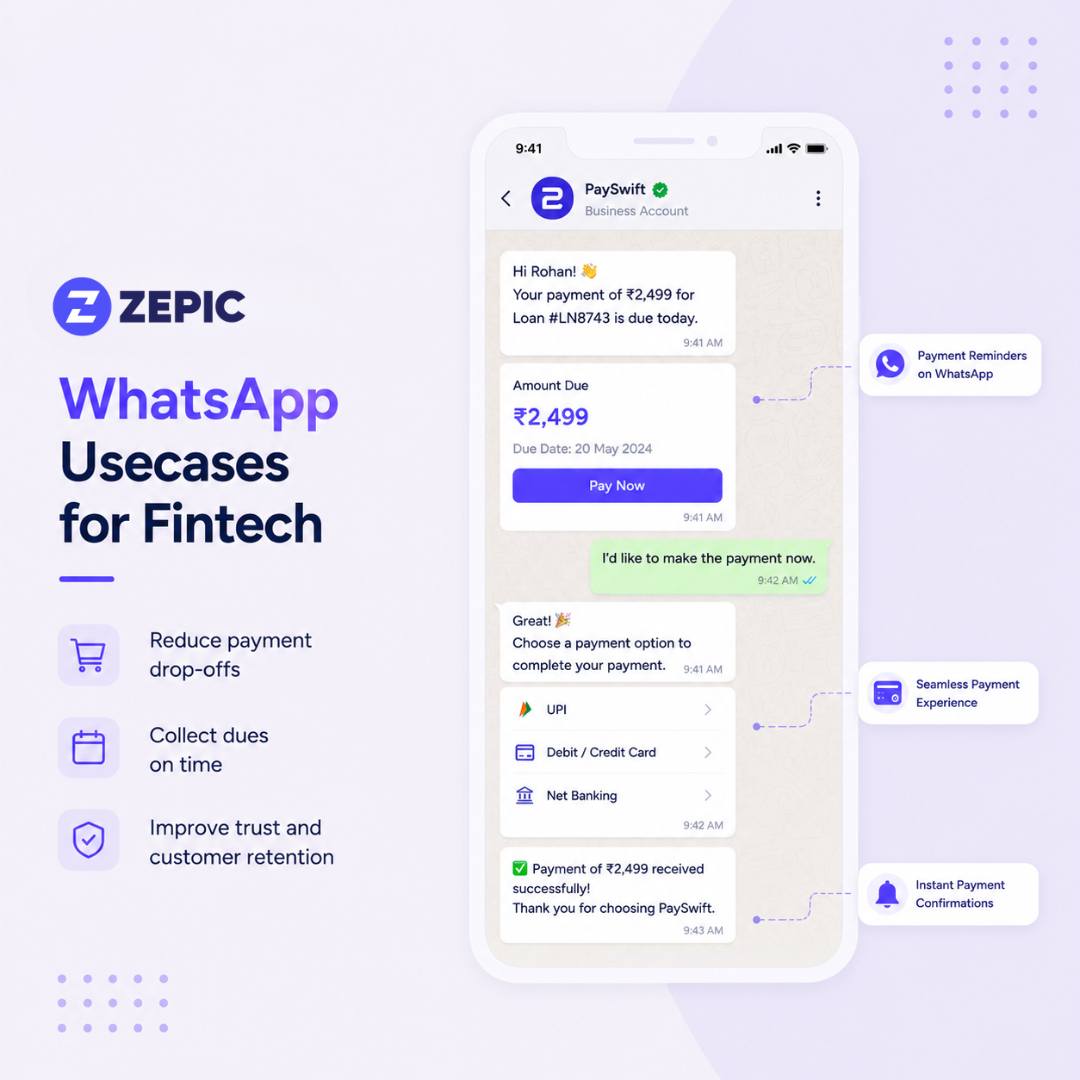
Hi [Name], it looks like your payment of ₹[Amount] didn't go through. This can happen due to a brief network issue. Tap below to retry — your details are saved.
[Retry Payment]
Need help? Reply here, and we'll sort it out.
Step 3: Send the Second Recovery Message (T+4 Hours, if Unresolved)
Introduce alternative payment alternatives to bypass potential gateway friction, focusing on WhatsApp payment drop-off recovery fintech strategies.
Example:
Hi [Name], your ₹[Amount] payment is still pending. You can also complete it via UPI, net banking, or debit card.
[Pay Now] | [Need Help?]
Step 4: Escalate to Agent Hand-off (T+24 Hours, if Unresolved)
Route the customer to a live support representative or offer an automated callback option to resolve technical issues.
Step 5: Close the Loop with Instant Confirmation
The moment a transaction succeeds, send an immediate confirmation receipt via WhatsApp. Establishing this reliable cadence prevents common administrative friction and clarifies why your payment reminders aren't reaching customers on legacy channels.
The 5-Message EMI & Due Collection Sequence
Implementing an automated WhatsApp automated payment reminder sequence helps lending apps and NBFCs recover dues predictably without straining customer relationships.
Message 1: T-7 Days Before the Due Date
Tone: Friendly advance notice. Zero pressure.
Hi [Name], your EMI of ₹[Amount] for [Loan Name] is due on [Date]. Pay early and stay penalty-free.
[Pay Now via UPI] | [View Schedule]
Message 2: T-3 Days Before the Due Date
Tone: Informative. Provide a clear breakdown of the balance due.
Hi [Name], a quick reminder — ₹[Amount] is due in 3 days. Here's what it includes: Principal ₹[X] + Interest ₹[Y].
[Pay via UPI] | [Net Banking] | [Debit Card]
Message 3: Due Date (Morning Alert)
Tone: Direct, clear, and actionable.
Hi [Name], today is the last day to pay your EMI without a penalty. ₹[Amount] is due today.
[Pay Now]
Message 4: T+1 Day Post-Due Date (If Unpaid)
Tone: Transparent regarding late fees, yet collaborative.
Hi [Name], your EMI of ₹[Amount] was due yesterday. A late fee of ₹[X] has been added. Pay before [Date + 3] to avoid further impacts to your credit score
[Pay Now] | [Talk to Us]
Message 5: T+3 Days Post-Due Date (Final Automated Attempt)
Tone: Empathetic, problem-solving assistance.
Hi [Name], we noticed you may be having trouble with this payment. We're here to help. Reply 'DEFER' to request a due date extension, or 'AGENT' to speak with our support team.
[Pay Now] | [Request Help]
Important Compliance Note: Following Message 5, pause automated programmatic delivery and transition the account to human-assisted collections teams. Continuing automated sequences beyond this window increases regulatory friction and customer dissatisfaction.
Two-Way Conversations That Prevent Defaults Before They Happen
When businesses transition to interactive messaging, WhatsApp shifts from a basic notification broadcast into an active repayment-safeguard channel. Utilizing a due payment collection WhatsApp chatbot changes how companies interact with borrowers.
Scenario A: The Borrower Asks for Payment Flexibility
- Trigger: The borrower replies "DEFER" or "HELP" to an automated text.
- Automated Action: Your system qualifies the customer's intent, distinguishing temporary cash-flow mismatches from longer-term financial challenges.
- Resolution: The bot presents pre-approved automated structural options, such as a 7-day payment extension, partial payment collection, or a formal restructuring review request, writing the outcome directly back to your loan management system (LMS).
Scenario B: Pre-Due Date Ledger Inquiries
- Trigger: The customer texts, "How much is my EMI this month?"
- Automated Action: The chatbot instantly syncs with your core backend database to retrieve current loan data.
- Resolution: The customer receives a precise balance statement alongside instant payment links, saving your call center from manual account searches.
Scenario C: Handling Real-Time Payment Failures
- Trigger: A customer encounters a bank error and texts, "Payment failed but money was deducted."
- Automated Action: The chatbot scans recent transactional webhooks, confirms the transaction state, and provides bank reference details.
- Resolution: Providing this transparency solves stressful payment events instantly, demonstrating why conversational WhatsApp outperforms one-way alerts by replacing frustration with immediate answers.
Deploying an interactive WhatsApp chatbot that does more than reply to FAQs requires true bidirectional API integration. Your automated architecture must parse incoming text variations and dynamically route users to appropriate self-service resolution trees.
Metrics to Track for Your WhatsApp Collection System
To evaluate the return on investment of your WhatsApp Business API for NBFC and lending workflows, monitor these key operational indicators:
| Metric Name |
Area of Measurement |
Performance Target |
| EMI Reminder Open Rate |
Overall delivery and customer reach |
> 90% |
| On-Time Payment Rate |
Effective collection performance |
15–25% lift compared to traditional SMS |
| Drop-Off Recovery Rate |
Percentage of incomplete transactions saved |
20–35% recovery rate |
| Bounce/NPA Reduction Rate |
Long-term loan default prevention |
30–50% overall reduction |
| Support Call Deflection |
Incoming user queries managed entirely by automation |
> 60% of common tier-1 questions |
| Cost per Collection |
Operational efficiency gains |
40–60% reduction in manual collection costs |
Building a Resilient Collections Infrastructure
Traditional communication channels often create unnecessary friction for growing financial platforms. When your collections team relies on unanswered phone calls or emails that get buried in spam folders, operational efficiency suffers. Moving your communication strategy to a responsive, interactive channel solves these visibility issues entirely.
Deploying an automated messaging system helps your platform achieve several critical business goals:
- Guaranteed Visibility: The 98% open rate ensures that your critical billing updates and loan disclosures are seen by borrowers instantly.
- Lower Operational Costs: Shifting up to 60% of basic transactional queries to automated conversational workflows reduces the burden on manual call centers.
- Improved Portfolio Health: Reaching borrowers early through a preferred channel protects your platform from rising Non-Performing Asset (NPA) rates.
The financial platforms that invest in interactive communication infrastructure today will secure lower collection costs and higher customer lifetime value over the next two years.
See ZEPIC in Action
Managing payment drop-offs and complex loan recovery timelines requires an intelligent approach to communication. ZEPIC provides the advanced two-way WhatsApp orchestration your business needs to automate reminders, ingest real-time payment webhooks, and seamlessly escalate complex cases to live agents.
Ready to optimize your repayment workflows?
Book a Personalized ZEPIC Demo Today
Frequently Asked Questions
How can fintech apps use WhatsApp to reduce payment drop-offs?
Fintech apps can reduce payment abandonment by connecting checkout and transaction events to automated WhatsApp workflows. When a user exits during a payment attempt or verification process, the system can trigger a timely reminder containing a direct retry link, helping users complete their transaction before they abandon the process.
What is the best WhatsApp reminder sequence for EMI collection?
A structured reminder sequence typically includes an advance reminder before the due date, a payment summary closer to the deadline, a due-date notification, a follow-up alert if payment is missed, and a support message offering assistance or repayment options. This approach improves repayment rates while maintaining a positive customer experience.
Is it compliant to send payment reminders and loan recovery messages on WhatsApp?
Yes, provided businesses use the official WhatsApp Business API, maintain documented customer consent, utilize approved utility message templates, and comply with applicable financial and data privacy regulations. Organizations should also follow all local regulatory requirements governing customer communications.
How does WhatsApp reduce transaction abandonment in financial services?
WhatsApp provides a highly interactive communication channel that allows businesses to send real-time transaction updates, answer customer questions, and provide direct payment links. This reduces friction in the payment process and enables customers to resolve issues immediately, increasing transaction completion rates.
What are the differences between utility and marketing messages for fintech on WhatsApp?
Utility messages are transactional and service-oriented communications such as payment reminders, account notifications, fraud alerts, and transaction confirmations. Marketing messages are promotional in nature and may include product offers, loan upgrades, or cross-sell campaigns. Each message category follows different compliance, consent, and pricing requirements.
How do NBFCs use WhatsApp Business API to recover overdue loans?
NBFCs use WhatsApp Business API to automate repayment reminders, account notifications, and customer support interactions. Automated workflows can answer common questions, provide payment links, collect repayment confirmations, and route complex situations to collections specialists. This reduces manual effort while improving communication efficiency and customer engagement.





%201.png)


.png)