Click-to-WhatsApp Ads: The Fastest Way to Build a Compliant Subscriber List in 2026
Anandhi Moorthy
Senior Content Marketer
May 14, 2026
TLDR:
Click-to-WhatsApp (CTWA) ads are one of the fastest and most effective ways to build a compliant WhatsApp subscriber list in 2026.
They outperform traditional landing pages and forms by removing friction and opening a WhatsApp conversation instantly after an ad click.
CTWA ads can deliver higher conversion rates, lower cost per lead, and faster purchase cycles than standard lead-generation channels.
Compliance is built into the user journey because subscribers actively initiate the conversation and provide explicit consent.
Meta provides a 72-hour free conversation window after an ad-driven chat starts, allowing brands to qualify leads and secure subscriptions at no messaging cost.
Fast response times matter, with automated replies ideally delivered within 10 seconds to maintain engagement and ad performance.
Effective welcome flows should deliver the promised offer, request explicit consent, and collect customer preference data.
The most important metrics are cost per conversation, conversation-to-subscriber rate, qualified lead rate, and revenue per conversation.
Common mistakes include slow responses, poor lead qualification, excessive promotional messaging, weak attribution tracking, and missing consent records.
Long-term success depends on nurturing subscribers through onboarding flows, segmented broadcasts, and regular list hygiene.
Today’s growth teams have two major problems: skyrocketing customer acquisition costs and increasingly strict global privacy regulations. Traditional lead generation funnels are losing a majority of their traffic through slow-loading landing pages and complex forms. At the same time, shifting compliance standards under GDPR, CCPA, and DPDP Act mean that legacy tactics like pre-checked boxes or implied consent can lead to immediate account suspensions.
Marketers need an acquisition channel that lowers friction while protecting data compliance. WhatsApp could be that channel if you play your cards right.
In 2026, Click-to-WhatsApp ads are the single fastest, lowest-friction, and most legally defensible way to build a WhatsApp subscriber list. QR codes, website forms, and traditional pop-ups cannot match the scale or velocity of this format.
The performance data from global market studies highlights why this format dominates modern growth playbooks:
94% Higher Conversion Rate: Click-to-WhatsApp (CTWA) ads deliver a 94% higher conversion rate compared to standard click-to-website ads, according to a 2026 Forrester and Meta joint study.
92% Lower Cost Per Lead: A 2026 Meta and BCG retail study revealed that CTWA ads achieve up to a 92% reduction in cost per lead when compared to traditional lead-generation ad formats.
High Engagement Velocity: Meta Conversations data shows that 35% to 55% of all click-to-WhatsApp ad clicks result in an immediate, active brand conversation.
Elevated Click-Through Rates: CTWA ads maintain a 3% to 6% average click-through rate, which represents a 2x to 3x improvement over standard Meta ad formats.
Surging Enterprise Adoption: Meta investor briefings note an 82% year-over-year growth in CTWA ad spend globally from Q1 2025 to Q1 2026.
Rapid Purchase Cycles: The median time-to-purchase for users acquired via CTWA ads is 47 minutes from the initial message receipt, compared to 14.8 hours for email marketing.
This dramatic shift in performance stems from structural design. When a user clicks your ad, Meta opens a WhatsApp conversation instantly. The user encounters no page redirects or no browser tab switches.
After removing these friction points, brands recover conversions that are normally lost during website transitions. This makes click-to-WhatsApp ads in 2026 the definitive anchor for conversation-driven growth.
Let’s look at how you can build a compliant subscriber list with Click-to-WhatsApp-Ads.
Comparison of Acquisition Channels for List Building
Acquisition Channel
Average Click-to-Subscriber Conversion
Audience Reach Target
Scalability Mechanism
Click-to-WhatsApp Ads
10% – 20%
Cold & Warm Audiences
Paid Budget Scaling
Forms / Landing Pages
0.2% – 1%
Cold & Warm Audiences
Paid Budget Scaling
QR Codes
Dependent on Foot Traffic
Existing Customers Only
Physical Distribution
Website Pop-ups
1% – 3% of Site Visitors
Active Site Visitors
Web Traffic Growth
Organic Social Comments
Dependent on Viral Reach
Engaged Followers
Content Velocity
Each alternative method maintains a specific place within a balanced marketing mix. However, none can be targeted and scaled with the mathematical precision of a paid Meta campaign. Click-to-WhatsApp ads represent the only list-building mechanism that accelerates linearly as you optimize your ad spend.
Why CTWA is Built-In Consent
Data privacy regulations require clear documentation of user permission. A compliant WhatsApp marketing list is a legal requirement across global jurisdictions.
Click-to-WhatsApp ads are your best shot because compliance is baked directly into the user experience framework.
Meta's WhatsApp Business Policy requires active consent from consumers. Users must perform a clear, affirmative action to opt into receiving ongoing marketing communications.
Pre-checked boxes, buried terms of service agreements, and implied consent via a standard product purchase do not satisfy these regulatory definitions.
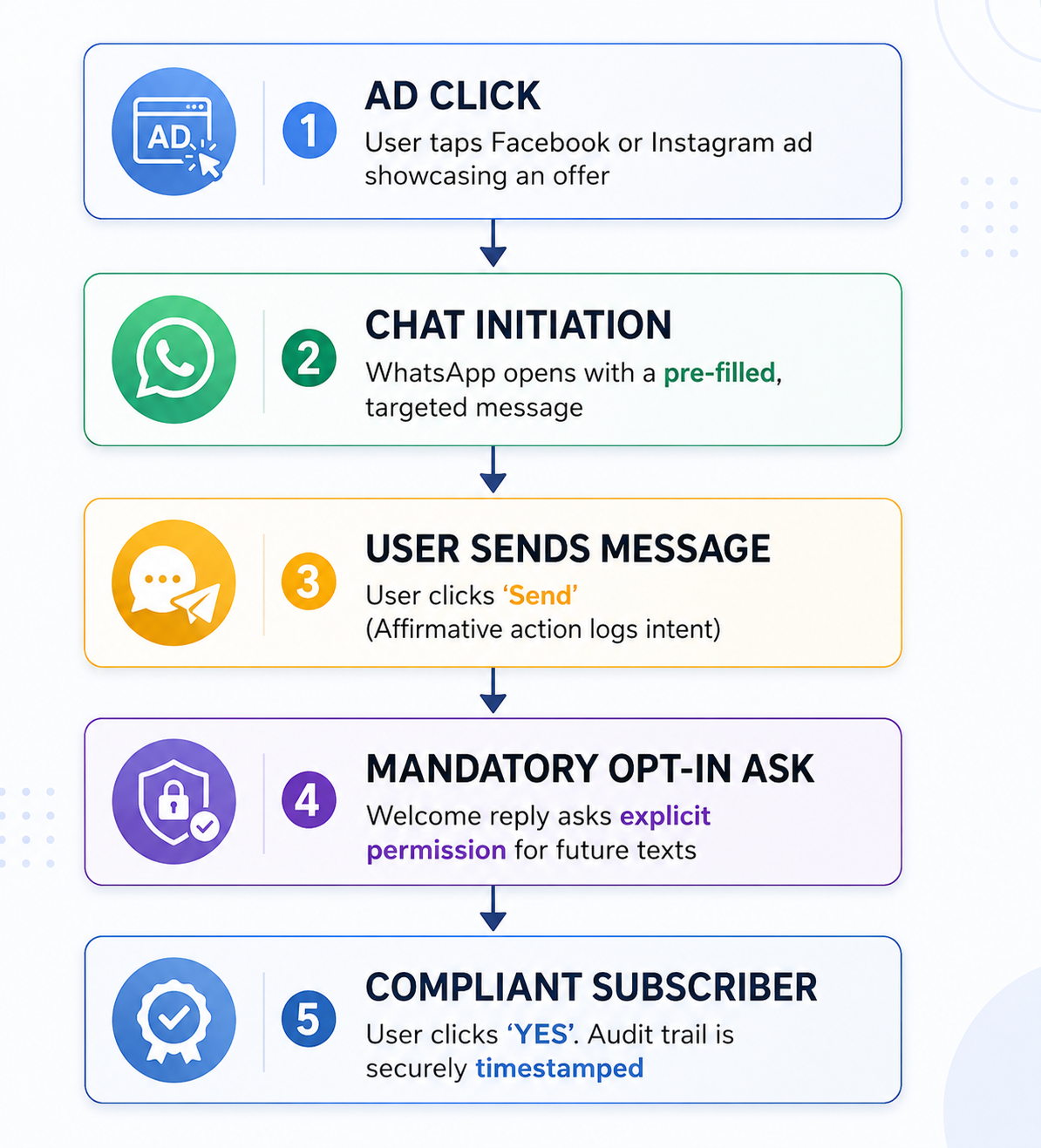
CTWA ads satisfy these standards by structurally logging the user's journey. The customer clicks the ad, transitions into WhatsApp, and manually sends an initial message. This sequence provides a transparent, user-initiated action that forms the basis of digital consent.
Failing to secure and document explicit consent is the primary reason for WhatsApp Business Account (WABA) restrictions and phone number blocks by Meta's compliance systems. A structured WhatsApp opt-in compliance 2026 workflow follows a clear, programmatic progression:
This clear architecture ensures adherence to stringent compliance frameworks worldwide:
GDPR (Europe): Provides a fully traceable, verifiable audit trail of user-initiated communication without pre-selected checkboxes.
CCPA/CPRA (California): Delivers immediate transparency regarding data collection purposes directly inside the chat screen.
DPDP Act (India): Ensures an unambiguous, affirmative choice through distinct message opt-in buttons before any promotional broadcasts are delivered.
A critical nuance that many brands overlook is that a click on a CTWA ad alone does not grant permission for perpetual marketing. The initial click simply opens a conversation. To turn that interaction into a permanent asset on your WhatsApp Business subscriber list, you must capture an explicit opt-in confirmation within your opening message sequence. Brands that bypass this step risk compliance flags and account suspensions.
The Mechanic Most Brands Don't Know About: The 72-Hour Free Window
The financial engine behind a high-performing Meta click-to-WhatsApp campaign setup is a specific pricing exception built into Meta’s network architecture: the 72-hour free conversation window.
When a user initiates a conversation with a business by clicking on a click-to-WhatsApp ad deployed on Facebook or Instagram, Meta waives all conversation fees for the next 72 hours. During these three days, your business can send multiple qualifying marketing, utility, or authentication messages without incurring per-conversation charges.
Because messaging incurs zero template fees during this time, you can execute a highly responsive onboarding flow:
Immediate Fulfillment: Instantly deliver the discount code, PDF guide, or consultation link promised in the advertisement.
Automated Qualification: Deploy interactive buttons to determine the user's specific budget, product preferences, or purchase timelines.
Tailored Product Showcasing: Automatically present specific inventory packages matched directly to the user's responses.
Objection Resolution: Address common concerns regarding shipping, warranties, or platform integrations through automated FAQ buttons.
Subscription Locking: Secure the explicit opt-in necessary to continue messaging the consumer once the 72-hour window expires.
Once this 72-hour window closes, standard Meta conversational rules resume. You can only re-engage the customer using pre-approved, structured WhatsApp templates. If you secured their explicit opt-in during the free window, they become a permanent subscriber on your marketing list. If you failed to lock in their consent, you must stop messaging them to prevent user spam reports.
Meta’s delivery algorithm uses response velocity as an important quality signal for your ad account. If your system takes more than 30 seconds to reply to an ad-driven inbound message, Meta's system may flag the interaction as poor quality and shift your ad delivery toward lower-value placements.
To maintain optimal ad delivery pricing, your first response must execute in under 10 seconds via a WhatsApp chatbot.
Setting Up Your CTWA Campaign
Prerequisite Checklist
WhatsApp Business API Account: You must use the enterprise-grade WhatsApp Business API rather than the free legacy business application. The API is required to manage concurrent chat volumes, store digital compliance audit trails, and run automated data workflows.
Linked Meta Business Manager: Your Meta Ads Manager account must be formally linked to your verified WhatsApp Business Account (WABA) within your business settings.
Pre-Approved Welcome Templates: Your introductory opt-in messages must be submitted and approved by Meta's compliance team prior to activating your ads to ensure instant message delivery.
API Automation Integration: Ensure your customer data platform or WhatsApp automation solution is active and configured to execute responses in under 10 seconds.
Campaign Setup in Meta Ads Manager
Objective Selection: Choose the engagement objective within Meta Ads Manager, then select Messaging Apps. As your system logs conversion data, you can transition to sales objectives optimized via the Conversions API once you hit a baseline of roughly 50 monthly conversions.
Destination Configuration: Uncheck Facebook Messenger and Instagram Direct. Set your exclusive destination path directly to your connected WhatsApp phone number.
Pre-Filled Message Architecture: Create a clear, high-intent pre-filled message string for the user to send. Avoid vague greetings like "Hi" because they pass weak optimization signals to Meta’s algorithm. Use explicit, action-oriented text strings instead.
Audience Targeting Optimization: Start your campaign by targeting warm custom audiences, including recent website visitors, Instagram profile engagers, and video viewers. These segments deliver strong conversion efficiency during early testing. Once your automated greeting sequences are optimized, expand your reach to broader lookalike and cold audiences to scale acquisition.
The Welcome Message: Where Subscribers Are Made or Lost
The moment an ad click brings a prospect into your chat, your automated welcome message must perform three distinct functions: deliver your promised lead asset, secure explicit marketing consent, and gather qualifying data.
An optimal welcome flow uses a sequential two-message structure to systematically register users while maintaining a clean user experience.
Message 1: Delivered within 10 seconds of user initiation
"Hi {{1}}! 🙌 Your exclusive product catalog is ready for download right here: [link] Would you like to receive our weekly product drops and private inventory sales directly on WhatsApp? Tap YES below to stay updated. You can opt out at any time by texting STOP."
(Provide two distinct interactive quick-reply buttons labeled YES and NO)
Message 2: Triggered instantly upon the user clicking "YES"
"You are officially in! ✅ Welcome to our private WhatsApp update channel. We only send updates once a week with our best offers. To help tailor your experience, which product category are you most interested in today?"
(Provide contextual interactive options based on your product inventory.)
Mistakes to Avoid in Your Welcome Messages
Dense Text Walls: Keep your copy concise. Messages exceeding three sentences generally see a steep drop-off in user response rates.
Multiple External Links: Including more than one URL can trigger automated spam filters and lower engagement.
Overloaded Conversational Demands: Do not try to collect an opt-in, ask a multi-part qualifying question, and push a direct checkout link all within the same text window.
Generic Contextless Greetings: Avoid open-ended phrases like "Hi, how can we help you today?" Your welcome message should match the specific offer presented in the ad that the user clicked.
Primary Operational Performance Metrics
Acquisition Channel
Average Click-to-Subscriber Conversion
Audience Reach Target
Scalability Mechanism
Click-to-WhatsApp Ads
10% – 20%
Cold & Warm Audiences
Paid Budget Scaling
Forms / Landing Pages
0.2% – 1%
Cold & Warm Audiences
Paid Budget Scaling
QR Codes
Dependent on Foot Traffic
Existing Customers Only
Physical Distribution
Website Pop-ups
1% – 3% of Site Visitors
Active Site Visitors
Web Traffic Growth
Organic Social Comments
Dependent on Viral Reach
Engaged Followers
Content Velocity
The 5 Ways CTWA Campaigns Fail
Even with a healthy advertising budget, click-to-WhatsApp campaigns can falter if their technical and operational frameworks are misaligned. Understanding these failure points helps teams protect their performance margins.
1: High Chat Volume with No Resulting Sales
Root Cause: The welcome workflow delivers the lead magnet but lacks automated qualification pathways. The system treats all users as immediate buyers, which can overwhelm sales teams with low-intent leads.
Correction: Implement clear, button-based routing in your second automated message to separate immediate purchasers from users who need automated nurture flows.
2: Slow Response Times
Root Cause: A brand launches a WhatsApp lead generation meta campaign without active API integrations, relying instead on manual responses from live support agents.
Correction: Deploy a chatbot to guarantee sub-10-second response times. Human agents should only join the conversation after a lead meets your qualification criteria.
3: High Unsubscribe Rates After Early Broadcasts
Root Cause: Marketing teams treat WhatsApp like an email list, sending generic daily promotions that ignore user preferences. This approach can trigger high spam reports and damage your sender reputation.
Correction: Limit broadcast frequency to 1 or 2 high-value messages per week, and segment your audience using preference data captured during onboarding.
4: Inability to Prove Campaign ROI to Leadership
Root Cause: The technical team omits CAPI integration. Because Meta Ads Manager only displays total conversation counts rather than revenue data, leadership cannot verify the program's financial return.
Correction: Implement end-to-end mapping using the ctwa_clid parameter to attribute web and offline sales directly back to your ad groups.
Failure 5: Sudden Account Restrictions and Suspension
Root Cause: The brand broadcasts marketing templates to users who clicked an ad but never clicked a clear opt-in confirmation button.
Correction: Use a gated conversational layout where promotional messages are sent exclusively to users who have a documented opt-in status logged in your database.
What Comes After the List: Making the Subscriber Valuable Long-Term
Building an audience list is simply the first phase of conversation-based commerce. The long-term value of your audience depends entirely on how you engage subscribers after they opt in.
A balanced lifecycle marketing program should deploy three primary automated flows from day one:
The Welcome Trilogy (Days 1–3): Use this sequence to introduce your core brand narrative, share customer case studies, and offer a first-time purchase incentive.
Segmented Broadcast Sequences: Send highly relevant updates up to twice a week, filtering your audience based on interest signals captured during their initial conversation.
Automated List Hygiene: Run an automated check for subscribers who haven't interacted with your messages in over 30 days. Request a fresh opt-in confirmation before removing inactive contacts to preserve your account's quality score.
Click-to-WhatsApp ads achieve rapid list growth because they complement the underlying product design. When you bring users directly from an ad into a pre-filled WhatsApp conversation, the format removes the friction points that often cause traditional landing pages and web forms to lose customers.
The brands building the highest-quality subscriber lists in 2026 do not rely on intrusive pop-ups or complex forms. Instead, they use CTWA ads to drive immediate engagement, confirm compliance within the initial chat sequence, and use Meta's Conversions API to optimize their ad spend based on real revenue data.





%201.png)


.png)