Meet

Neura HQ,
Your connected AI Agent Workforce Know more



TLDR:
Imagine a customer reaching out to a premium airline because their flight was canceled. They spend twenty minutes chatting with a booking agent that gathers their preferences, loyalty number, and dietary restrictions. The booking agent realizes it cannot process a refund directly and hands the session over to a billing agent.
The billing agent opens the chat and asks, "Hello! How can I help you today? What is your ticket number?"
The customer is instantly frustrated. The information they provided seconds ago hasn’t been passed on to the other agent. This is a classic example of an AI agent handoff failure in production. While the individual models are intelligent, the system as a whole is forgetful. This lack of continuity is the silent killer of modern automation.
As businesses move from simple chatbots to complex multi-agent AI systems, the challenge shifts from model intelligence to system coordination. AI agents are incredibly powerful when working in isolation. However, they become brittle and unreliable when they have to collaborate.
This article explores why shared context is the essential connective tissue for reliable AI and how to build systems where agents actually talk to each other.
To understand why agents fail, we must first define what they are supposed to remember. In the world of Large Language Models (LLMs), context is the information the model can see and use to generate a response at any given moment.
In professional AI agent architecture, we categorize information into three distinct buckets:
LLMs use token windows to process information.
Short-term context is often referred to as episodic memory. It covers the immediate back-and-forth of a single session. Long-term context, or semantic memory, involves pulling relevant facts from a massive database using a RAG pipeline (Retrieval-Augmented Generation).
While a model might have a huge context window, it still faces the lost in the middle phenomenon. Research shows that LLMs are great at recalling information from the very beginning or the very end of a prompt but struggle with details buried in the center. This is a primary reason why AI agents fail when prompts become too bloated with unnecessary data.
Even with context windows expanding to millions of tokens, they are not a substitute for true communication. Loading every single piece of data into a prompt is expensive, slow, and increases the risk of hallucinations. When multi-agent LLM communication relies solely on dumping huge amounts of text into a shared window, the agents lose the signal in the "noise."
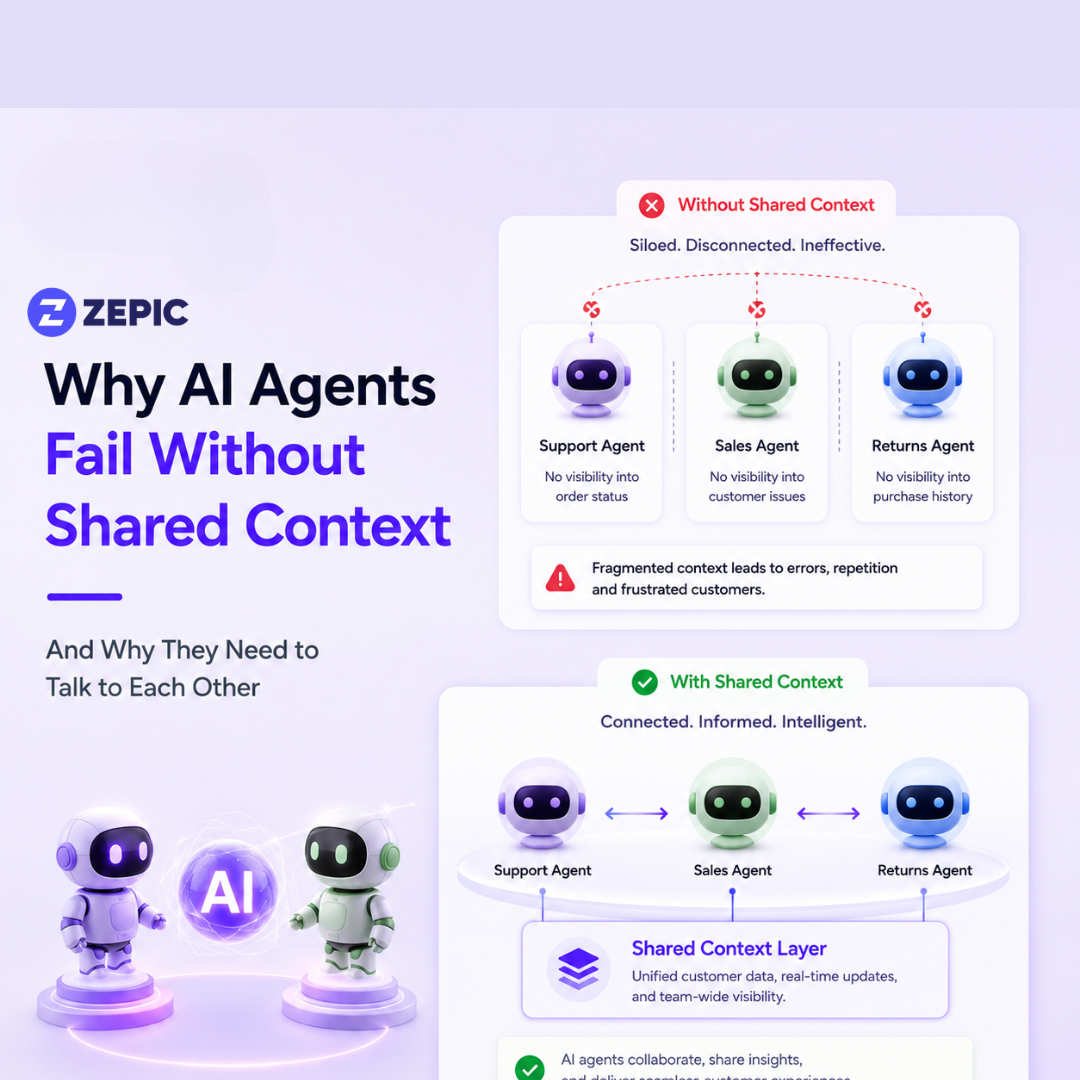
In many current agentic AI workflows, agents operate like coworkers who are forbidden from speaking to each other. They only communicate through a manager who passes strictly defined files. This isolation leads to several predictable failure patterns.
Every time an isolated agent is triggered, it starts from zero. Without a mechanism for AI agents to share context, the agent has no idea what its predecessor did. If an analysis agent spends ten minutes cleaning a dataset and then passes it to a Reporting Agent, the second agent may attempt to clean the data again because it does not know the work is already done. This redundancy wastes compute tokens and increases latency.
A handoff occurs when Task A is finished, and Task B begins. In many autonomous AI agent problems, the handoff is just a raw data transfer. If the first agent fails to summarize its findings or explain the why behind its actions, the second agent lacks the intent.
For instance, a research agent might find three sources for a blog post. If it hands those sources to a writing agent without explaining that Source #2 is the most reliable, the writing agent might prioritize Source #3, leading to a lower-quality output.
When multiple agents work on the same project without a shared state, they can work at cross-purposes. Consider an AI-driven marketing system:
This lack of inter-agent communication creates a fragmented brand voice and technical errors that require human intervention to fix.
The solution to these failures is a shift in philosophy. We must move from building agents that "do tasks" to agents that "share understanding."
Data passing is the act of sending a JSON object from Agent A to Agent B. Communication is the act of sharing context, goals, and constraints. When agents communicate, they don't just send the final answer. They send the status of their work and any obstacles they encountered.
In multi-agent AI systems, shared context acts as a whiteboard that all agents can see. Instead of passing notes back and forth, they all refer to a central source of truth. This allows for better AI agent orchestration because every agent knows the current progress of the entire workflow, not just their individual slice.
Think of a professional kitchen. The head chef, the line cooks, and the servers do not just pass plates. They shout "Order in!" and "Behind!" to maintain a shared understanding of the environment. If a server simply dropped a plate in front of a cook without context, the kitchen would collapse. AI agent collaboration requires the same level of environmental awareness.
Building a system where agents talk requires specific infrastructure. Here are the most effective patterns for agentic AI workflows.
Instead of keeping memory inside the LLM prompt, developers use external databases.
Some modern frameworks have popularized the orchestrator model. In this setup, a manager agent maintains the global context. It delegates tasks to worker agents and then integrates their findings back into the central state. This ensures that the worker agents stay focused while the manager handles the big picture.
In more advanced systems, agents use an agent-to-agent protocol. This is similar to how microservices communicate in traditional software. When Agent A finishes a task, it emits an "event." Other agents "subscribe" to that event and update their internal context accordingly. This allows for building AI agents that work together in real-time rather than in a rigid, linear sequence.
If you are designing an AI agent architecture for enterprise use, follow these four guiding principles to ensure reliability.
Never assume an agent knows why it is performing a task. Every prompt should include a "Context Block" that defines the current state of the project. If an agent is joining a workflow midstream, the system should provide a concise summary of all previous steps.
A common reason why AI agents fail is that they receive the wrong type of data. In a well-designed system, Agent A declares: "I produce a formatted CSV." Agent B declares: "I require a CSV to generate a chart." This explicit mapping prevents handoff errors and ensures the agent-to-agent protocol remains functional.
Context should live outside the chat session. By using persistent state management, you allow agents to "pick up where they left off" even if the system restarts. This is vital for long-running tasks like market research or software development that might take hours or days to complete.
If an agent loses context or receives a corrupted handoff, it should not guess. It should be programmed to "ask for clarification" from the orchestrator or a human. Building agents that recognize when they are missing information is a key step in multi-agent LLM communication best practices.
Many companies find that their AI Proof of Concepts (PoCs) work beautifully, but their production deployments fail. This is often because a PoC uses a single agent for a simple task, while production requires a chain of agents for a complex business process.
In a controlled demo, context is easy to manage. In the real world, data is messy. Users change their minds, APIs return errors, and tasks are interrupted. Without a robust system for how to share context between multiple AI agents, these real-world "edge cases" cause the entire system to break.
Enterprises must stop viewing AI as a series of isolated prompts. Instead, shared context should be viewed as a layer of infrastructure, similar to a database or a cloud server. Investing in a centralized context layer allows companies to scale from 2 agents to 200 without a linear increase in errors. This is the foundation of agentic AI system design for enterprises.
The next stage of the AI revolution is not about making models "smarter" in terms of raw facts. It is about making them more collaborative. We are moving away from the era of the solitary genius AI toward the era of the "high-performing AI team."
When agents can share context, they stop being tools and start being digital coworkers. They can anticipate needs, correct each other's mistakes, and maintain a seamless experience for the end user. Intelligence alone is no longer the bottleneck for automation. The real challenge is coordination.
By implementing structured memory, clear communication protocols, and a shared state, you can transform brittle, isolated bots into a reliable multi-agent system. The future of AI belongs to the agents that know how to listen to one another.
Building a context-aware system is the difference between an AI that works in a demo and an AI that works in the real world. Ensure your agents have the "connective tissue" they need to succeed.
Isolated agents are the biggest hurdle to scaling AI in the enterprise. NeuraHQ helps bridge this gap with persistent state management and intelligent orchestration.
Build AI agents that actually work together. Explore NeuraHQ today to see how shared context can transform your automation strategy.

%201.png)


.png)