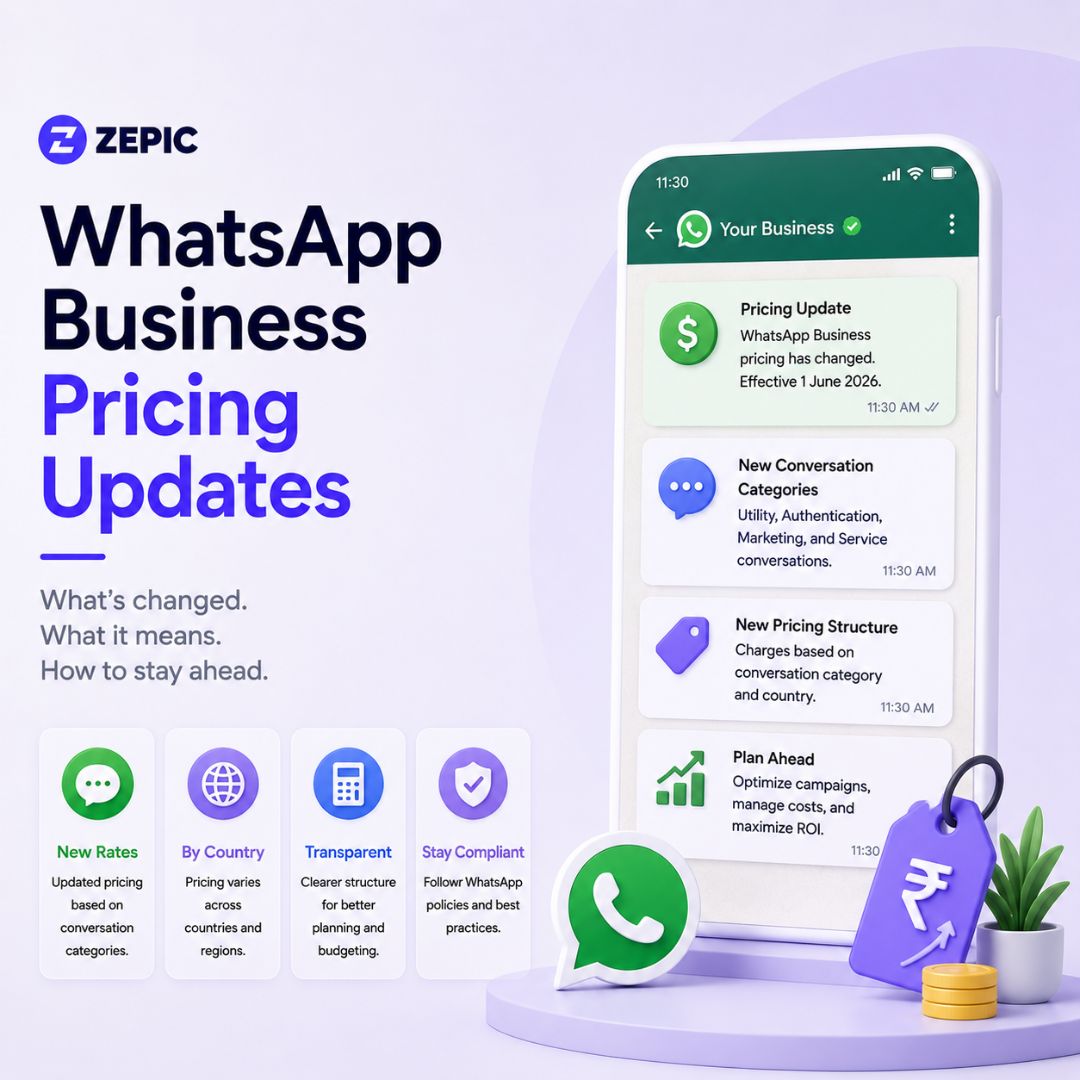
WhatsApp Business Pricing Updates: What’s Changing in 2026
Anandhi Moorthy
Senior Content Marketer
July 6, 2026
TL;DR: WhatsApp Pricing Changes
The End of Free Windows (Oct 1, 2026): Meta is officially eliminating free replies within the 24-hour Customer Service Window. All standard service messages (handled by human reps or third-party AI chatbots) will incur a per-message fee matching local Utility rates.
New Meta AI Token Billing (Aug 1, 2026): Automated responses powered natively by the new Meta Business Agent Platform will be billed on a per-token basis ($2.00 USD per 1M tokens), averaging out to roughly 4–5 cents per message depending on complexity.
Utility Templates Lose Free Status (Oct 1, 2026): Utility templates triggered inside an active 24-hour customer conversation window will no longer be free and will revert to standard utility template charges.
The Impact: Instead of paying for just a single template to initiate a chat session, businesses will now be billed for every individual message sent across a customer journey, significantly increasing conversational costs.
Are you a brand that relies on WhatsApp marketing, or are you exploring using WhatsApp to break through the noise?
You might want to grab a coffee and read carefully because Meta is going to shake things up with their WhatsApp Business Pricing Updates this year.
We understand how overwhelming this can be.
Just when you thought you’d got WhatsApp marketing figured out, Meta decides to switch things up again. But it’s not all bad news. Knowing what’s changing and refining your strategy can help you make the most of the new pricing changes.
Without further ado, let’s get right into it.
2026 WhatsApp Pricing Updates
Meta Introduces Charges for WhatsApp Service Messages (Effective Oct 1, 2026)
If your business relies on WhatsApp for conversational commerce, support, or automation, brace yourself for a fundamental shift in Meta's monetization strategy. Moving into the second half of 2026, Meta is ending the era of the completely "free" 24-hour Customer Service Window (CSW).
Historically, any free-form, non-template message sent by a business in response to a customer within that 24-hour window incurred zero delivery charges. As of October 1, 2026, that policy is changing. Here is exactly how the new pricing structure breaks down, how message categories are splitting, and what it means for your bottom line.
1. The Timeline: Rolling Out the Charges
Meta is staging this rollout across the latter half of 2026 to introduce their first-party AI framework while simultaneously re-monetizing standard communication lines.
July 1, 2026: Meta officially launches the Meta Business Agent Platform, opening up APIs for native agent integration.
August 1, 2026: Meta begins charging for all messages sent via the native Meta Business Agent on a per-token basis.
October 1, 2026: Meta reinstates per-message charges for standard service messages (which had been free since November 2024).
October 1, 2026: Meta terminates the free status of utility templates sent within an active 24-hour customer service window (which had been free since July 1, 2025).
2. The Split: Service Messages vs. Meta Business Agent
Previously, all non-template responses sent to a user fell under a single blanket category: service. Meta is now splitting non-template responses into two distinct tracks based on who or what generates the message:
Service Messages (category: service): This applies to any conversational response powered by a human customer service representative or a third-party AI solution (such as an external chatbot or custom LLM integration).
Meta Business Agent Messages (category: meta_business_agent): This is a brand-new category applying strictly to automated, conversational responses powered natively by Meta’s own Agent Platform.
3. How the Pricing Works
The billing mechanisms for these two conversational tracks are fundamentally different:
A. Standard Service Messages (Human / 3rd-Party AI)
Meter: Per-message delivered.
The Rate: Service messages will not have a unique rate card. Instead, Meta will match service message rates exactly to the existing local market rates for Utility and Authentication template messages.
Volume Tiers: Warning for high-volume enterprise users—Meta will not offer volume tiers or discounts for service messages, though they will continue to maintain volume tiers for utility and authentication templates.
Rate Transparency: Exact market-by-market rate cards will be published by September 1, 2026, giving businesses a 30-day window to recalculate their overhead.
B. Meta Business Agent Messages
Meter: Per-token consumed (measuring both the inbound prompt ingestion and the outbound agent response generation).
The Rate: A flat global rate of $2.00 USD per 1 Million tokens.
The Real-World Cost: Meta estimates that a standard message consumes roughly 20,000 to 25,000 tokens. This maps out to roughly 4 to 5 cents (USD) per message. Simple inquiries (e.g., "What are your hours?") will consume fewer tokens and cost less, while rich, multi-turn technical troubleshooting will consume more tokens and cost more.
4. The "One Charge Per Message" & Promo Rules
To prevent double-billing friction, Meta has established clear guardrails around how these categories overlap:
No Double Dipping: A message can only ever have one category and incur one charge. If an AI or human agent sends a non-template message containing promotional copy, Meta will only bill it as a service or Meta Business Agent message. It will not trigger an additional premium marketing template charge.
The Free Entry Point Exemption: The 72-hour free entry point window for conversations starting via Click-to-WhatsApp Ads or Facebook Page Call-to-Action buttons is preserved for delivery. However, there is a catch: if you use a native Meta Business Agent inside that 72-hour free window, you will still be billed for token consumption starting August 1, 2026.
What Else is New with WhatsApp in 2026?
Secure Your Brand: WhatsApp Global Rollout of Username Reservations
In what is being hailed as one of the platform's biggest privacy updates, WhatsApp has officially kicked off global username reservations ahead of a full public launch later this year.
Chat Without Phone Numbers: Much like Instagram or X (Twitter), users and businesses can now claim a unique identifier starting with the @ symbol (e.g., @YourBrandName). Once the feature goes completely live, you can connect with customers, vendors, or communities by sharing your username, keeping your personal mobile number completely private.
Why Reserve Early? With over 3 billion users, highly sought-after handles will go quickly. WhatsApp opened reservations early so businesses could secure their intellectual property. To minimize identity theft, usernames linked to recognized public figures, governments, and established brands are heavily protected. You can also claim the exact same handle you use on Instagram or Facebook by linking your WhatsApp to the same Meta Accounts Center.
The "Username Key" Security Layer: To prevent spam bots from guessing your handle, WhatsApp is introducing an optional Username Key (a 4-digit security PIN). If enabled, a person messaging your username for the first time must know this code to successfully initiate a chat.
How to Claim Yours: Update your app to the latest version and navigate to Settings > Account > Username to see if the reservation rollout has arrived in your account dashboard.
2025 WhatsApp Pricing Updates
WhatsApp Business is Switching to Per-Message Pricing
WhatsApp has been known for its per-conversation pricing model. However, from July 1st, 2025, they are switching to per-message pricing, aligning with how most other messaging platforms charge.
The charge only applies when a message is successfully delivered, and the price varies based on
The country code of the person you’re messaging
The type of message you're sending (marketing, utility, or authentication)
What This Means For Your Business
Currently, you're paying for 24-hour conversation windows regardless of how many messages you send within that timeframe. But with the new pricing model, you’ll be charged for each template message you send a user.
Does that sound confusing? Here’s an example of how it’ll work.
Say your customer is in Brazil; you send them a marketing template and a utility template. WhatsApp will charge you separately for each message.
Source: WhatsApp Pricing updates document
Let’s look at the price breakdown
You send a marketing template message → You pay the marketing message rate for Brazil.
You send a utility template message → You pay the utility message rate for Brazil.
So, even if both messages go to the same customer, you’ll be billed for each one individually based on their message type and the customer’s country.
This means your costs will depend on
How many template messages you send, and
The category of each message (marketing, utility, or authentication), and
The country where your customer is located.
The bottom line is that if you've been bundling multiple messages into single conversations to save costs, you'll need a new approach.
Is WhatsApp Marketing About to Get More Expensive?
Before you panic, take a deep breath; here’s the good news: WhatsApp is also introducing ways to help you keep costs down.
Respond to customers at no charge with free-form messages and utility template messages
Source: WhatsApp Pricing updates document
You can respond to customers through free-form messages in the 24-hour customer service window for FREE!
Want to know something more exciting? You can also send utility template messages for free if it’s within the customer service window.
P.S. The 24-hour customer service window resets with each user message, creating ongoing opportunities for free communication.
What does this mean for your business?
You have the flexibility to choose between a free-form or utility template without worrying about the extra cost (as long as you keep the conversation within that 24-hour window.)
You can stay available and chat with your customers on WhatsApp—even using AI-powered conversations—without spending a penny. Yep, it’s free.
Wait, there’s more exciting news.
The Higher Your Tier, The Higher the Discounts
If you send a lot of messages, you're going to love this update.
Starting July 2025, WhatsApp is introducing volume tiers for utility and authentication messages. As you reach higher volume thresholds, you automatically unlock better rates.
Here are some sample rates. WhatsApp will publish the new thresholds on their website and documentation.
Source: WhatsApp Pricing updates document
How Volume Tiers Work
It’s more like a bulk discount at your favorite wholesale shop. The more messages you send in each category and country, the cheaper each message becomes. Here's the catch, though: these discounts are calculated separately for each combination of
Message type (utility vs. authentication)
Country where your customer is located
For example, the threshold to reach Tier 2 for utility messages in India might differ from the utility messages in Brazil or even the authentication messages in India.
What Does This Mean for Your Business?
If you're a high-volume marketer, these tier discounts help balance out the shift to per-message pricing. But here’s what you need to keep in mind:
Only utility and authentication messages get volume discounts (not marketing messages)
Your tier resets each billing period (no carrying over last month's volume)
You need to hit the volume thresholds within each specific country-category combo
Free Entry Points: Turn Your Ads into Free Messaging Opportunities within a 72-Hour Window
When a prospect messages you from a WhatsApp ad or Facebook Page button, and you respond within 24 hours, you unlock a 72-hour window where template messages to that user are completely free.
Source: WhatsApp Pricing updates document
Think about it: three full days of free template messaging triggered by your ads. This creates a powerful incentive to drive user-initiated conversations through your advertising.
How can you use this?
Coordinate your WhatsApp campaigns with your ad schedule to maximize these free messaging periods.
WhatsApp is Redefining Utility Template Category
Back in April, Meta started carefully reviewing and penalizing businesses that misuse templates.
Now that utility messages sent within the customer service window are going to be free, WhatsApp is refining what qualifies as a "utility" message based on user engagement and sentiment.
This feature will show you detailed breakdowns of per-message pricing, helping you understand exactly which messages are charged versus free. You'll be able to track costs across different markets, message categories, and campaigns.
For marketing teams, this means more precise budget allocation and ROI calculations. You'll have the data you need to optimize your WhatsApp strategy for maximum impact at minimum cost.
WhatsApp Template Categories
Every WhatsApp template you send fits into one of three categories: Utility, Marketing, or Authentication. These categories determine how your message is priced, and how Meta expects you to use them.
Here’s a quick breakdown of them:
Marketing Templates
As the name suggests, all promotional messages fall into the marketing template category. These are campaigns that intend to,
Create awareness of your product or service (feature announcements, new product announcements, app promotion, event marketing)
Drive sales or renewals (promos, coupons, invite to sales events)
Build customer relationships (birthday wishes, loyalty points, chats that prompt new conversations)
P.S. If your template is a mix of utility and marketing message, it will be categorized as marketing. If the content is unclear (e.g., contents are only “{{1}}” or “Congratulations!”), it is also categorized as marketing.
Utility Templates
Utility templates must be strictly non-promotional, meaning they should not have any promotional or persuasive intent. They also hav to be either specific or requested by the Customer or critical to them.
Utility messages include,
Opt-in and opt-out to receive messages on WhatsApp. It should be a follow-up to opt-ins collected through other channels (e.g., website, email).
Important or time-sensitive updates or alerts about a purchased or subscribed products/services (account balance, profile completion alerts, payment reminders)
Feedback surveys about a specific product or order, generic survey don’t fall under the utility category
Conversations that were requested by the user through other channels. It could be something like, “Hi! I see you requested support via our online chat. I am the virtual assistant on WhatsApp. How can I help?”
P.S. Public safety, public service, account protection, public disruption, and legal/regulatory compliance messages are also considered as utility messages.
Authentication Templates
Source: WhatsApp Template Guidelines
Authentication templates are used to verify a customer’s identity during account creation, account recovery, or OTPs for new or existing orders. These are WhatsApp’s most restricted templates.
So, to be classified as an authentication template, you must
Use WhatsApp’s preset authentication message templates, including optional add-ons like security disclaimers and expiry warnings.
Configure a one-time password button (copy-code or one-tap).
Follow content restrictions: URLs, media, and emojis are not allowed for authentication template content or parameters.
Additional length restrictions of 15 characters also apply to parameters.
Navigating the Shift: Your WhatsApp Game Plan for 2025
The July 2025 implementation date will be here before you know it. While it changes how you’ll be charged, it also opens doors to get more strategic (and efficient) with how you message.
Let’s look at some steps you can take to revise your WhatsApp marketing strategy.
Rethink Your Campaign Structure
With per-message pricing, the structure of your campaigns might need a refresh.
Design interactions that encourage user responses, as these reset the 24-hour customer service window and create more free messaging opportunities.
Tip: Interactive messages like quizzes, polls, feedback requests, or mini-rewards can be engagement boosters while saving costs.
Leverage Volume-Based Pricing
WhatsApp’s volume-based pricing tiers reward brands that send a high volume of messages in specific countries and categories. Audit your current messaging patterns and find opportunities to:
Consolidate messaging across similar cohorts
Adjust campaign timing to batch sends more efficiently
Prioritize markets where you're close to reaching the next tier threshold.
Optimize Template Usage
Utility templates and free-form messages sent within the 24-hour service window are free. But templates offer more structure, testing options, and auditability. So review your existing message mix to:
Convert eligible free-form messages to utility templates
Ensure they’re personalized and non-promotional to stay within WhatsApp’s rules
Encourage good user sentiment to maintain their utility status
Maximize Free Entry Points
The 72-hour free window triggered by user messages from ads is a great opportunity. Increase your investment in WhatsApp-integrated advertising to drive more user-initiated conversations.
Integrating your WhatsApp campaigns with your broader advertising strategy will give you strategic advantages. It will improve user engagement and unlock extended free messaging periods through user-initiated conversations.
Change Doesn’t Have to be Scary
The July 2025 pricing updates might seem overwhelming, but if you adapt quickly, you’ll be able to gain an edge over the competition. While others scramble to understand per-message pricing, you'll be maximizing free messaging windows, hitting volume discounts, and turning every customer interaction into a cost-effective opportunity.
The key is having the right strategy and the right tools to execute it.
Don't let these changes catch you off guard. WhatsApp marketing automation tools can help you navigate these kinds of shifts.
Ready to turn WhatsApp Business’s pricing changes into your competitive advantage? Get started with ZEPIC today and see how the right WhatsApp marketing automation software can help you not just survive these changes, but thrive because of them.
Keep your sender reputation clean (avoid spam reports)
Follow WhatsApp's template guidelines exactly
Remove inactive numbers from your lists
Don't overwhelm users with too many messages
Can I message users who haven’t subscribed to receive messages on WhatsApp?
No, WhatsApp requires explicit opt-in consent before you can send template messages. You need documented permission from users, and they must be able to opt out easily.
Exception: If someone messages you first (through ads or your website), you get a 24-hour free response window.
How can I use WhatsApp Business effectively?
With the new pricing, be strategic:
Prioritize utility messages (free in 24-hour windows + volume discounts)
Encourage user responses to reset free messaging windows
Use interactive elements to keep conversations going
Will my existing templates need to be recategorized?
With WhatsApp refining its definition of utility messages, some existing templates might need recategorization starting July 1, 2025.
WhatsApp hasn't provided an exhaustive list of affected use cases, but they've emphasized that changes will be based on user engagement metrics and sentiment analysis.
What are free-form messages?
These are your regular, conversational messages (not templates). They're completely free within the 24-hour customer service window but can only be sent within 24 hours of the customer's last message to you.






%201.png)


.png)