The Missing Context: Why Most Brands Collect Data But Still Send Irrelevant Messages

Anandhi Moorthy

Senior Content Marketer
April 16, 2026

Imagine you just spent three hundred dollars on a high-end coffee machine after weeks of researching boiler types and pressure bars. Ten minutes after the confirmation email arrives, you receive a promotional blast from the same retailer offering you 15% off that exact coffee machine.

This is the current state of personalization. Brands have access to more information than at any point in history. They track every click and past purchase. Despite this wealth of information, the messages reaching consumers often feel misplaced. The industry calls this personalization, but for the customer, it feels irrelevant.

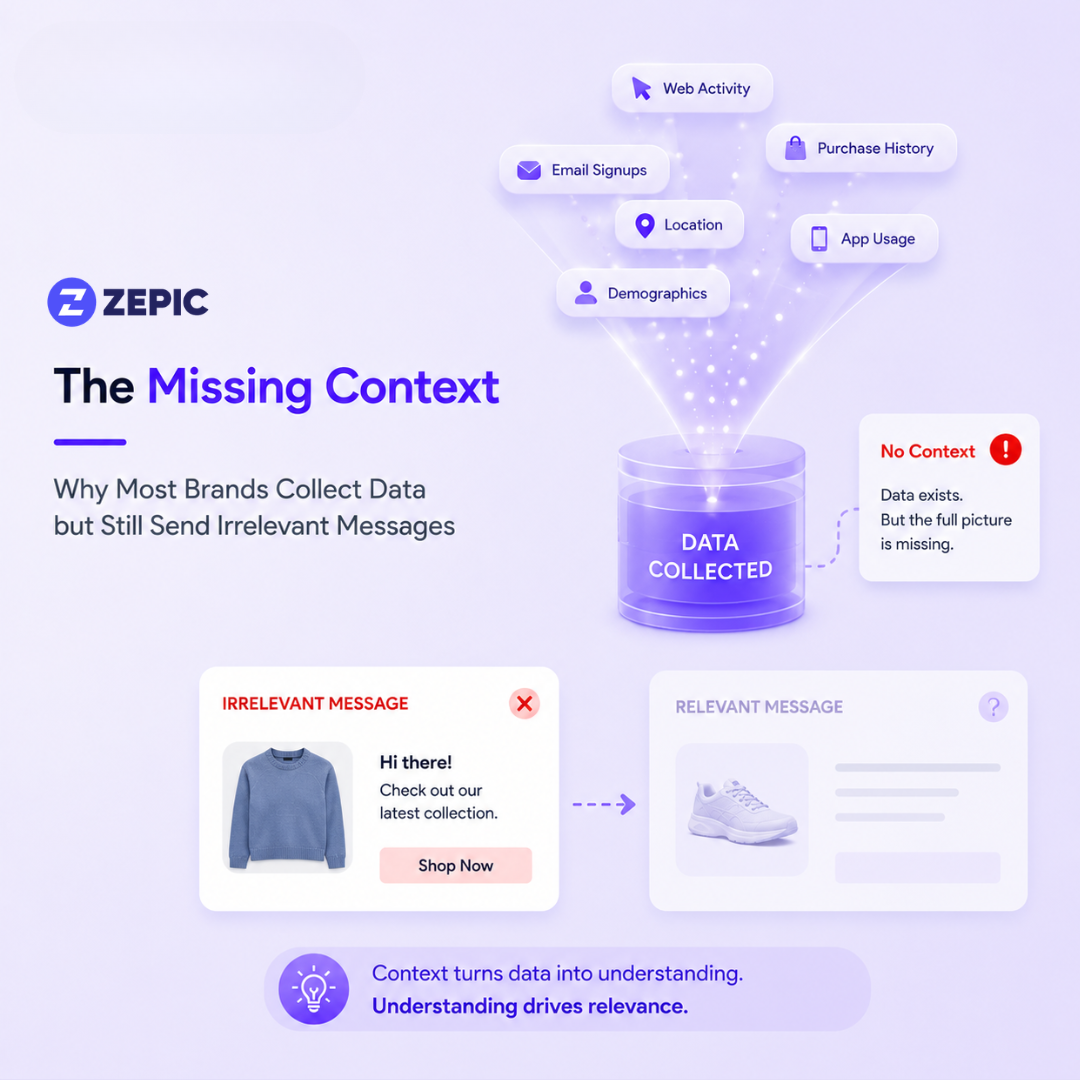
The problem is rarely a lack of data because most companies are drowning in data. The problem is a lack of context. Data tells you who a person is and what they did in the past. Context tells you what they are doing right now and why it matters. Let’s explore why the gap between data collection and relevance exists and how your brand can close it.

The Data Collection Illusion

Many marketing teams operate under the assumption that more data automatically means better experiences. This is the data collection illusion. Organizations invest millions of dollars into data lakes and analytics tools. They collect thousands of data points per customer, ranging from geographic location to device type.

Recent industry reports indicate that the average enterprise uses over 90 different marketing tools. Each of these tools collects its own set of facts. However, a collection of facts is not the same as a deep understanding of a customer.

Why More Data Often Fails
  • Data points are static: A person's birthdate or home address does not change, but their needs change by the hour.
  • Volume creates noise: When you have too much information, it becomes difficult to identify which signal actually indicates a desire to buy.
  • Information lacks intent: Knowing that someone looked at a pair of hiking boots three times tells you they are interested. It does not tell you if they already bought them at a physical store or if they decided the price was too high.

The Difference Between Data and Meaning

Many brands are often data-rich but context-poor. Data tells you that a customer is a 35-year-old woman living in Seattle who likes outdoor gear. Context tells you that she is currently at the airport in sunny Phoenix and needs a lightweight hat, not a heavy raincoat. Using the first piece of information leads to an irrelevant message, but the second can lead to a sale.

Why Personalization Still Fails

If brands have the data, why is the output still so poor? Most marketing personalization failures stem from four specific gaps. These gaps prevent data from becoming a useful tool for the customer.

Gap 1: Siloed Data Systems

Data silos are the biggest enemy of relevance. In many companies, the team running Facebook ads has no idea what the email marketing team is sending. The customer service department has no record of the coupons the customer received.

When systems do not talk to each other, the brand appears disorganized. A customer might be in the middle of a heated support ticket regarding a broken product while simultaneously receiving a "We miss you! Come shop our new collection" email. This happens because the CRM, the support desk, and the email platform are not unified.

Gap 2: Stale Data and Latency

Data has a shelf life because the interests a customer had six months ago may not apply today. Many brands build segments based on historical purchases and then fail to update those segments in real time.

If a customer buys a crib, they are likely expecting a baby. However, if you are still sending them advertisements for cribs two years later, you are using stale data. You have failed to account for the passage of time and the family’s changing needs.

Gap 3: No Behavioral Triggers

Many brands still rely on bulk campaigns. They send emails on Tuesday mornings because that is when they have always sent them. This approach ignores the customer's own schedule.

Relevant messages are triggered by actions. A browse abandonment email sent an hour after a customer leaves a site is contextual. A random newsletter sent while the customer is asleep is not. Without behavioral triggers, even the most personalized content feels like an interruption.

Gap 4: The Missing Intent Layer

Demographic data is a poor substitute for intent. Knowing someone's income level or job title does not explain their current motivation. People buy products to solve specific problems.

A customer might visit a luxury travel site because they are planning a once-in-a-lifetime honeymoon. They might also visit because they are doing research for a blog post. If the brand treats both visitors the same based on their high-income demographic, they will miss the mark for at least one of them.

Data vs. Context: What is the Difference?

Understanding the difference between data and context is essential for any modern marketer. Data consists of the raw facts you have stored in your database. Context is the set of circumstances that surround those facts.

Defining the Terms

Data: Name, email, last purchase date, total spend, city, and device type.

Context: Current location, local weather, time of day, current page being viewed, and the path taken to get there.

Comparison: Data-Driven vs. Context-Driven
Feature Data-Driven Message Context-Driven Message
Trigger Scheduled for 10:00 AM. Triggered by a price drop on a watched item.
Greeting Uses the customer's first name. References the specific item they just viewed.
Offer A general 10% discount for everyone. Free shipping because the customer is 2 miles from a store.
Channel Sent via email because that is what is on file. Sent via SMS because the customer is currently mobile.
Outcome Often ignored or marked as spam. High engagement and helpfulness.
The Travel Brand Example

Consider a travel agency that has data showing a customer frequently flies from New York to London.

A data-driven approach would be to send an email every time there is a sale on flights to London. This seems smart, but it lacks context.

A context-driven approach would look at the customer's recent behavior. If the customer just booked a flight to London yesterday, sending a "Sale to London" email today is frustrating. Instead, the brand should send a list of the best coffee shops near the specific hotel the customer booked. That is context. It moves from "selling" to "serving."

The Role of First-Party Data and Behavioral Signals

In a world where third-party cookies are disappearing, first-party data is the most valuable asset a brand owns. First-party data is information collected directly from your own channels. It is more accurate and more compliant with privacy laws than purchased data.

Behavioral Signals that Reveal Context

Context is found in the digital body language of the customer. You can learn a lot by observing how someone interacts with your website or app.

  • Recency and Frequency: How often does the user visit? If they visit three times in one day, their intent is high.
  • Category Affinity: What types of content are they consuming? If they are reading "how-to" guides, they are in the research phase. If they are looking at the shipping policy, they are in the buying phase.
  • Purchase Velocity: How much time passes between their purchases? This helps you predict when they will need a refill or an upgrade.
  • Active Windows: When is this specific user most likely to engage? Sending a message during their active window increases the chance of a positive response.
Real-Time Data Activation

The real challenge is not just having this data, but activating it. Batch processing data once a week is no longer sufficient. If a customer abandons a cart, the follow-up needs to happen while the item is still on their mind. Real-time activation requires a technical setup where your data platform can send instructions to your messaging platform instantly.

What Missing Context Costs Brands

Sending irrelevant messages is not a neutral act. It has a real, measurable cost. When customers receive content that does not apply to them, they do not just ignore it; they begin to resent the brand.

The High Price of Irrelevance
  • Increased Churn: Research shows that over 50% of consumers will unsubscribe from a list if they receive too many irrelevant messages.
  • Wasted Ad Spend: Showing ads for products a customer has already purchased is a direct waste of marketing budget.
  • Brand Erosion: Trust is built on understanding. When a brand sends irrelevant messages, it signals to the customer that the brand does not actually know who they are.
  • The "Ignore" Reflex: Customers are fast learners. If your last three emails were irrelevant, they will stop opening your fourth, even if it contains a great offer. This ruins your sender reputation and decreases the effectiveness of all future campaigns.

72% of consumers say they only engage with marketing messages that are tailored to their interests. If you miss the context, you are effectively cutting your potential audience by nearly three-quarters.

How to Close the Context Gap

Moving from a data-heavy strategy to a context-heavy strategy requires a shift in both technology and mindset. You must stop thinking about "what can we sell" and start thinking about "what does this person need right now."

Step 1: Unify Your Data Sources

The first step is creating a unified customer view. You need a system, often called a Customer Data Platform (CDP), that pulls information from every touchpoint. This includes your website, mobile app, email results, and point-of-sale systems. When your data is in one place, you can see the full picture of the customer journey.

Step 2: Define Context Signals per Channel

Not every signal is relevant for every channel. You need to map out which behaviors should trigger which messages.

  • Email: Best for detailed information, follow-ups, and long-term nurturing.
  • WhatsApp: Best for time-sensitive alerts, like a flash sale or a delivery update.
  • Push Notifications: Best for immediate actions within an app.
  • On-Site Personalization: Best for showing relevant products while the customer is actively shopping.
Step 3: Map Messages to Journey Stages

Stop sending the same message to everyone. A first-time visitor should see a "Welcome" message that introduces the brand values. A returning customer should see "Recommended for You" based on their history. A loyal customer should receive "Early Access" to new products. Mapping your content to these stages ensures the message fits the customer's current relationship with your brand.

Step 4: Use Behavioral Triggers Over Time-Based Campaigns

Shift your focus from the calendar to the customer. Instead of a "Monthly Newsletter," consider a series of automated emails triggered by specific actions.

Example:

  • Trigger: Customer looks at the pricing page twice in 24 hours.
  • Action: Send an email offering a 1-on-1 demo or a specific FAQ regarding costs.
  • Why it works: It addresses a specific hurdle at the exact moment the customer is facing it.
Step 5: Test for Relevance, Not Just Open Rates

Many marketers focus on open rates and click-through rates. While these are important, they do not tell the whole story. You should also track "Negative Engagement." Are people unsubscribing? Are they marking messages as spam? Use these metrics to identify which campaigns are lacking context. If a campaign has a high open rate but a high unsubscribe rate, the subject line was likely misleading, or the content inside did not match the recipient's expectations.

Wrapping Up

Data is the foundation of modern marketing, but context is the architecture that makes it useful. Collecting thousands of data points does nothing for your brand if you cannot use them to improve the customer's life. When brands ignore context, they treat their customers like entries in a spreadsheet rather than people with changing needs and emotions.

The goal of personalization is not to show the customer how much you know about them. The goal is to make their experience easier. By unifying your data, focusing on real-time behavioral signals, and closing the gap between information and intent, you can stop sending noise and start sending value.

Take a moment to audit your current marketing automation. Are you sending messages based on what you want to say, or based on where your customer is in their journey? The shift from data-driven to context-driven marketing is the difference between being a brand that interrupts and a brand that helps.

Try ZEPIC for context-rich marketing!

Frequently Asked Questions

Why do customers receive irrelevant marketing messages?

Customers receive irrelevant messages when brands rely on static or outdated data instead of real-time signals. Even if basic details like name or location are known, failing to account for recent actions—such as a completed purchase—results in messaging that feels disconnected from the current customer journey.

What is the difference between personalization and contextualization?

Personalization uses historical data to tailor content, such as addressing a customer by name or referencing past purchases. Contextualization uses real-time data to make messages relevant to the present moment. In simple terms, personalization focuses on who the customer is, while contextualization focuses on what they are doing right now.

How do brands collect customer data for marketing?

Brands collect data through multiple channels, including website tracking using cookies and pixels, direct user inputs during signups, purchase history, email engagement metrics, and mobile app interactions such as location and in-app behavior.

Why is data-driven marketing not always effective?

Data-driven marketing fails when data is siloed, outdated, or incomplete. Without a unified view of the customer, brands may send conflicting or irrelevant messages. Additionally, data alone cannot fully capture a customer’s intent or emotional state, limiting its effectiveness without contextual understanding.

What is contextual marketing and how does it work?

Contextual marketing delivers messages based on a user’s current situation. It uses real-time signals such as location, weather, device type, and on-site behavior to trigger relevant interactions. For example, showing nearby store offers, sending weather-based promotions, or offering discounts when a user is about to leave a checkout page.

How can brands improve email marketing relevance?

Brands can improve relevance by replacing scheduled batch campaigns with behavior-triggered messaging. Emails should be sent based on actions such as browsing activity or cart abandonment. Segmentation based on recent behavior, rather than static demographics, ensures content aligns with current customer intent.

What is the role of first-party data in personalization?

First-party data is collected directly from a brand’s own audience, making it accurate and consent-based. It includes interactions such as website visits, app usage, and purchase history. This data provides a reliable foundation for meaningful personalization compared to third-party data sources.

Why does marketing personalization fail?

Personalization fails when it is poorly timed, based on outdated data, or lacks true understanding of user intent. Common issues include using stale information, disconnected systems that do not share data, over-reliance on automation, and messaging that feels robotic rather than human.

Desperate times call for desperate Google/Chat GPT searches, right? "Best Shopify apps for sales." "How to increase online sales fast." "AI tools for ecommerce growth."

Been there. Done that. Installed way too many apps.


But here's what nobody tells you while you're doom-scrolling through Shopify app reviews at 2 AM—that magical online sales-boosting app you're searching for? It doesn't exist. Because if it did, Jeff Bezos would've bought (or built!) it yesterday, and we (fellow eCommerce store owners) would all be retired in Bali by now.


Growing a Shopify store and increasing online sales isn’t easy—we get it. While everyone’s out chasing the next “revolutionary” tool/trend (looking at you, DeepSeek), the real revenue drivers are probably hiding in plain sight—right there inside your customer data.
After working with Shopify stores like yours (shoutout to Cybele, who recovered almost 25% of their abandoned carts with WhatsApp automation), we’ve cracked the code on what actually moves the needle.


Ready to stop app-hopping and start actually growing your sales by using what you already have? Here are four fixes that will get you there!

Fix #1: Convert abandoned carts instantly (Like, actually instantly)

The Painful Truth: You're probably losing about 70% of your potential sales to cart abandonment. That's not just a statistic—it's real money walking out of your digital door. And looking for yet another Shopify app for abandoned cart recovery isn't going to fix it if you're not getting the fundamentals right.

The Quick Fix: Everyone knows you need multi-channel recovery that hits the sweet spot between "Hey, did you forget something?" and "PLEASE COME BACK!" But here's the reality—most recovery apps are a one-trick pony. They either do email OR WhatsApp, not both. And don't even get us started on personalizing offers based on cart value—that usually means toggling between three different dashboards while praying your apps talk to each other.

Enter ZEPIC: This is where we come in. With ZEPIC's automated Flows, you can:
Launch WhatsApp recovery messages (with 95% open rates!)
Set up perfectly timed email sequences (or vice versa)
Create personalized recovery offers not just on cart value but based on your customer’s behavior/preferences
Track and optimize everything from one dashboard

Fix #2: Reactivate past customers today

The Painful Truth: You're probably losing about 70% of your potential sales to cart abandonment. That's not just a statistic—it's real money walking out of your digital door. And looking for yet another Shopify app for abandoned cart recovery isn't going to fix it if you're not getting the fundamentals right.

The Quick Fix: Everyone knows you need multi-channel recovery that hits the sweet spot between "Hey, did you forget something?" and "PLEASE COME BACK!" But here's the reality—most recovery apps are a one-trick pony. They either do email OR WhatsApp, not both. And don't even get us started on personalizing offers based on cart value—that usually means toggling between three different dashboards while praying your apps talk to each other.

Enter ZEPIC: This is where we come in. With ZEPIC's automated Flows, you can:
Launch WhatsApp recovery messages (with 95% open rates!)
Set up perfectly timed email sequences (or vice versa)
Create personalized recovery offers not just on cart value but based on your customer’s behavior/preferences
Track and optimize everything from one dashboard

Offering light at the end of the tunnel is Google’s Privacy Sandbox which seeks to ‘create a thriving web ecosystem that is respectful of users and private by default’. Like the name suggests, your Chrome browser will take the role of a ‘privacy sandbox’ that holds all your data (visits, interests, actions etc) disclosing these to other websites and platforms only with your explicit permission. If not yet, we recommend testing your websites, audience relevance and advertising attribution with Chrome’s trial of the Privacy Sandbox.

Top 3 impacts of the third-party cookie phase-out

Who’s impacted

How

What next

Digital advertising and
acquisition teams
Lack of cookie data results in drastic fall in website traffic and conversion rate
Review all cookie-based audience acquisition. Sign up for Chrome’s trial of the Privacy Sandbox
Digital Customer Experience
Customers are not served relevant, personalised experiences: on the web, over social channels and communication media
Multiply efforts to collect first-party customer data. Implement a Customer Data Platform
Security, Privacy and Compliance teams
Increased scrutiny from regulators and questions from customers about data storage and usage
Review current cookie and communication consent management, ensure to align with latest privacy regulations

Recent blog post

No items found.