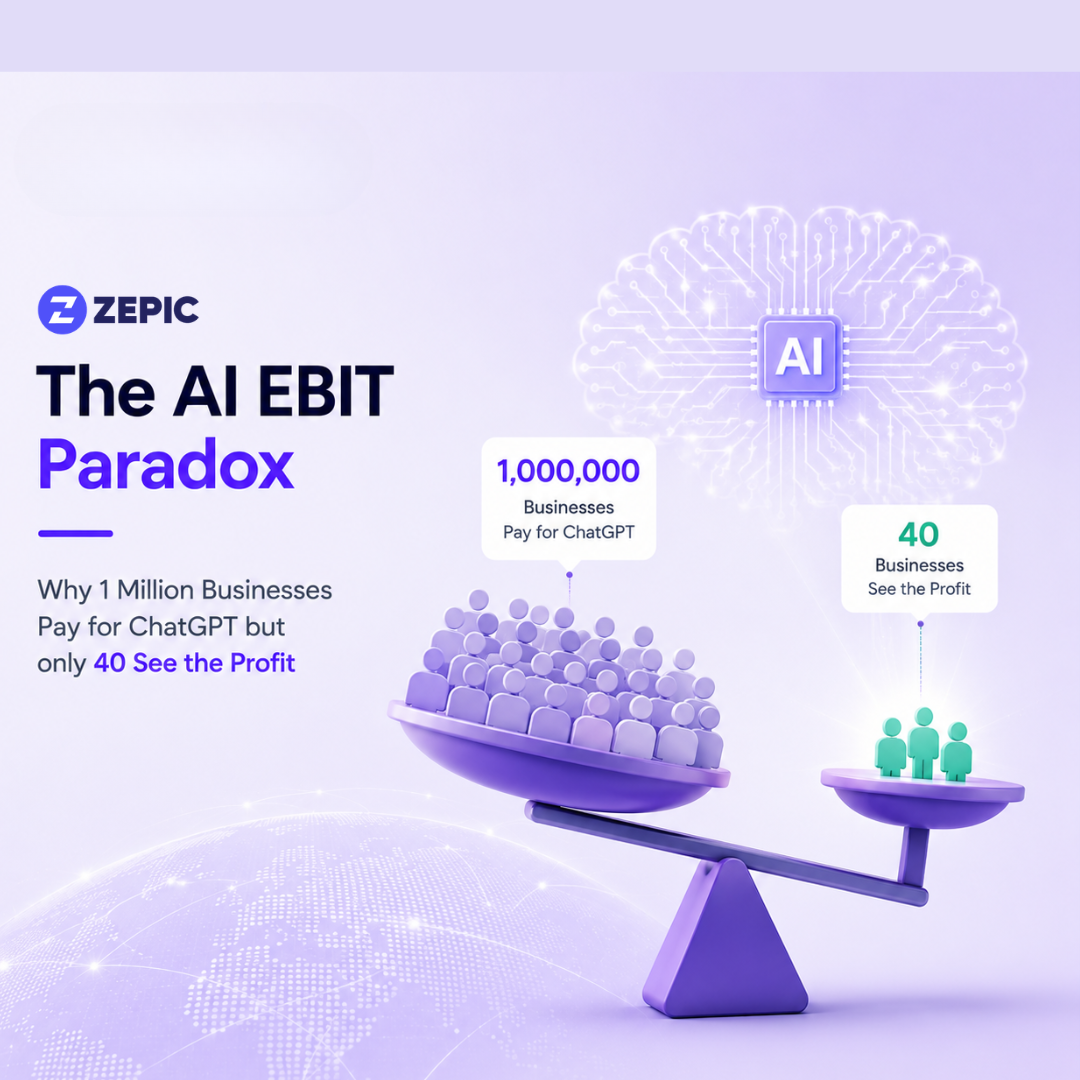
The AI EBIT Paradox: Why 1 Million Businesses Pay for ChatGPT, but Only 40% See the Profit

Anandhi Moorthy

Senior Content Marketer
April 6, 2026

TLDR:

  • Enterprise AI adoption is growing rapidly, with over 1 million businesses paying for AI tools, and ChatGPT Enterprise usage increasing significantly, but most companies still see little measurable financial return.
  • The “AI EBIT Paradox” refers to the gap between high AI spending and low impact on actual profitability, despite strong usage and enthusiasm across enterprises.
  • Many companies use AI as a separate tool instead of embedding it into workflows, creating manual handoffs that reduce productivity gains and limit EBIT impact.
  • Only around 10–15% of employees become active AI adopters, while the majority rarely use enterprise AI tools unless AI is integrated into their existing workflows.
  • Employees often avoid using AI for high-value business tasks because they are uncomfortable sharing sensitive company or customer data in AI chat interfaces.
  • Low seat utilization makes enterprise AI expensive, increasing the effective cost per active user and causing finance teams to question ROI.
  • Most enterprise AI tools lack shared memory or institutional learning, forcing employees to recreate prompts, workflows, and context repeatedly instead of building on previous knowledge.
  • Isolated AI agents that do not share context across departments create inefficiencies, duplicate work, inconsistent customer experiences, and more manual intervention.

There's something strange happening in finance decks across the world right now.

AI budgets and adoption are up. "AI transformation" is in the quarterly plan deck of every enterprise under the sun. And yet, when the CFO pulls up the EBIT (Earnings Before Interest and Taxes) data, there's barely any momentum.

Over one million businesses now actively pay for enterprise AI tools. OpenAI's own data shows ChatGPT Enterprise message volume grew 8x year-over-year, with business seats increasing 9x. So it is clear that the usage and the enthusiasm are real.

But according to MIT's GenAI Divide report, 95% of organizations that deployed generative AI saw no measurable financial return. This is the AI EBIT Paradox: businesses are spending more on AI than ever before, and employees are using it, but that barely moves the needle in terms of numbers

Here's why that gap exists and how you can close it.

The Scoreboard Nobody Wants to Read

In the past year, 78% of enterprises have adopted AI, and models like ChatGPT Enterprise save 40 to 60 minutes per day on average. 

You might be thinking those numbers look great; what’s the problem? Let’s look at some numbers most AI vendor decks quietly skip past.

42% of companies scrapped most of their AI initiatives in 2025, up sharply from just 17% the year before. Only 5% of integrated enterprise AI pilots produce measurable profit and lose impact. 

Those two sets of numbers shouldn't coexist. But they do, and they do for very specific structural reasons. Let’s find out what they are.

Five Reasons AI Isn't Moving Your EBIT

1. AI Lives Beside Your Work, Not Inside It

Open a Chat Tab➡️ Paste in Some Context,➡️Get a Response ➡️Copy-paste it ➡️Close the tab➡️Repeat 50 times a day

This is an AI enterprise workflow that’s as old as time (Well, at least old as AI itself)

But every manual handoff between an AI output and the system where work actually happens is an extra step that can cost you. It seems small in isolation, almost negligible, but at scale, across teams and days, those tiny frictions compound into a dent on time, efficiency, and ultimately revenue.

A sales rep generating a follow-up email in ChatGPT and then manually copying it into the CRM has saved time on the writing but lost time on the transfer. The net productivity gain shrinks, and the EBIT impact shrinks with it.

So if you want to see real financial returns, you have to move away from using AI as a drafting assistant and embed AI into how work gets done, so outputs land directly in the systems that matter.

2. Only 15% Employees are Early Adopters 

Every organization has a group of early adopters who pick up new tools quickly and integrate AI into their daily routines. In most companies, this group is roughly 10 to 15% of employees.

The remaining 85% isn't exploring AI tools. They’re busy closing tickets, shipping campaigns, and hitting targets. If AI doesn't appear naturally in their process, they won't go hunting for it.

This is why seat utilization data from enterprise AI deployments is quietly damning. A company buys 1,000 seats. After 90 days:

  • 150 people use it regularly
  • 200 more open it occasionally
  • 650 have barely logged in
  • The budget is fully spent

Paying for unused seats doesn't just waste money. It inflates the cost-per-active-user, which makes AI look expensive when the real problem is distribution.

3. Nobody Pastes Sensitive Data into a Chat Window

Here's the uncomfortable truth about enterprise AI usage patterns: the tasks that would generate the most business value are exactly the ones employees avoid doing with AI.

Drafting a generic blog post? Fine. Summarizing a public competitor's press release? Sure.

But when it comes to analyzing a customer's financial profile to personalize an offer or running a scenario on next quarter's EBIT forecast? They don’t rely on AI.

Not because employees don't want help. Because pasting sensitive business data into a third-party chat interface feels like a compliance violation waiting to happen, even when enterprise data agreements technically cover it. The perception of risk is enough to change behavior.

The result of this is that AI gets deployed for the lowest-stakes, lowest-value tasks. The work that could actually move margins stays manual.

4. The Cost Math Gets Uncomfortable Fast

Enterprise AI licenses are not cheap at scale. When utilization is low, the effective per-active-user cost balloons up fast.

A company paying for 500 ChatGPT Enterprise seats at approximately $30/user/month but seeing only 100 active users has an effective cost of $150 per active user per month. At that point, a finance team doing a straightforward cost-benefit analysis is going to raise flags.

IBM Institute for Business Value research found that enterprise-wide AI initiatives achieved an average ROI of just 5.9% despite incurring a 10% capital investment. That gap between spend and return is precisely why 42% of companies scrapped most of their AI projects in 2025.

The math only works when adoption is broad, and outputs connect to revenue or cost lines the business actually tracks.

5. Every Session Starts from Zero

Most enterprise AI tools have no memory across sessions. They don’t have institutional learning or compounding improvement.

For instance, say a marketing manager spends two hours developing the perfect competitive analysis prompt. It lives in their browser history, maybe a personal notes doc, and is not shared with the team. Six colleagues each spend two hours building the same thing from scratch.

Meanwhile, the AI model itself doesn't get better at understanding your business. It doesn't learn your customer segments, your pricing logic, your tone, or your definitions. This means the productivity gains are linear at best, and they stay individual. They don't scale across the organization, and they definitely don't show up in EBIT.

AI Agents That Don't Share Context

Here's a problem that's becoming more expensive as AI use scales: most AI agents operate in isolation.

A company might deploy a customer-facing AI agent to handle support queries and a separate agent to assist the sales team. Each one was built, trained, and maintained in its own silo.

On paper, each agent is doing its job. But none of them are talking to each other.

Why this matters for margins:

  • The support agent handles a customer complaint about a delayed order. That context never reaches the sales agent, which the same customer encounters when they call back three days later about renewing their contract. The sales agent has zero context. The rep has to start from scratch, and the customer is annoyed. This ultimately results in the deal being at risk.

  • The HR agent onboards a new hire and collects their role, skills, and preferences. None of that context flows to the IT provisioning workflow or the L&D recommendation engine. Manual follow-up fills the gap. Human hours fill the gap.

  • Every handoff between isolated agents is a place where context resets, and a person has to step in.

McKinsey's research on AI implementation found that organizations treating AI as integrated systems rather than standalone tools see 3 to 15% revenue uplift and 10 to 20% ROI improvement. The delta between those two modes is almost entirely explained by context sharing.

The margin math of context loss:

When agents don't share context, the hidden costs stack up:

  • Duplicate data entry across systems
  • Longer handle times because agents (and reps) have to re-establish context manually
  • Inconsistent customer experiences that increase churn
  • Human escalations for queries that should be resolved automatically
  • Compliance risk when decisions are made without full information

A BCG study found that 74% of companies report they haven't demonstrated tangible value from their AI deployments yet. Context fragmentation is one of the leading structural reasons for that failure. When each agent operates in its own bubble, the organization is just building AI overhead.

The companies seeing compounding AI returns have solved this. Their agents share a unified knowledge layer. Customer interactions inform the sales context. Sales context informs success workflows. Operational data flows back into the agents that need it. The system gets smarter as it processes more data, rather than staying static.

Productivity Versus Profit: Why They're Not the Same Thing

Workers saving 40 to 60 minutes per day is a real productivity gain. It's also not automatically a profit gain.

Saved time only converts to EBIT when one of two things happens:

  1. The saved time gets redirected to higher-value work (more deals closed, more customers served, faster shipping)
  2. The saved time reduces headcount cost without reducing output

If saved time gets absorbed by slightly longer lunch breaks, extra Slack scrolling, or the same amount of output with marginally less stress, it improves employee experience but doesn't touch the income statement.

This is the core of the EBIT paradox. Businesses measure AI adoption in activity metrics (messages sent, queries processed, seats activated) and assume productivity will follow. Productivity does follow, often. But productivity and profit are not the same variable, and the journey from one to the other requires deliberate workflow redesign, not just tool deployment.

The MIT report found that the biggest ROI in enterprise AI consistently comes from back-office automation: eliminating outsourced business process work, cutting external agency costs, and removing process steps that previously required human coordination. These are structural changes to cost lines, not productivity improvements that may or may not translate.

A Quick Self-Audit: Is Your AI Investment EBIT-Ready?

Before adding more seats or switching tools, answer these five questions honestly:

  • Does AI connect to your core systems, or does every useful output require a manual transfer step?
  • Can your average employee use it, without a prompt library and without training, in the tools they already use daily?
  • Does institutional knowledge accumulate, or does every session start from scratch?
  • Do your agents share context, or do each one operate in isolation from the others?
  • Are you measuring financial outcomes (cost per process, revenue per employee, cycle time reduction) rather than usage metrics?

If most of the answers are "no," the issue isn't the AI model. It's the architecture around it.

What the 5% Are Doing Differently

The MIT study of 300+ enterprise AI implementations found a consistent pattern among the small group actually seeing financial returns. They're not using better models. They're using better infrastructure. Specifically:

  • AI is embedded inside the tools employees already use, not added as a separate tab
  • Agents share a common knowledge layer, so context travels across the customer journey
  • Outputs feed directly into downstream systems rather than requiring manual entry
  • Governance and data controls are built in from the start, which means finance, legal, and compliance teams approve a broader rollout instead of blocking it
  • ROI is measured at the process level (cost per ticket, revenue per rep, cycle time), not at the tool level (seat utilization, messages sent)

Purchasing AI from specialized vendors with workflow integration beats internal builds by a 2:1 ratio on success rates. Companies building their own tools from scratch are three times more likely to end up in the 95% that see no financial return.

The Bottom Line

The AI EBIT paradox is real, but it's solvable.

The gap between what businesses spend on AI and what shows up in earnings isn't a technology problem. The models are capable, but there is a structural gap. AI agents that don't share context, productivity gains that never get redirected to revenue or cost lines, and measurement frameworks that track activity instead of outcomes—these are the architecture problems that keep AI off the income statement.

The companies closing that gap are building systems where AI is woven into how work actually flows, where context travels with the customer, and where every output connects to a metric that matters financially.

That shift is available to any business willing to look past seat count and toward the workflow.

Ready to Move from AI Activity to AI Impact?

ZEPIC Neura is built for exactly this. Neura connects your customer data, your workflows, and your AI interactions into a unified layer, so context travels, agents collaborate, and every AI interaction connects to a business outcome you can measure.

If your AI investments aren't showing up in your margins yet, start with Neura.

Frequently Asked Questions

Why are so many enterprise AI projects failing to deliver ROI?

Many AI projects fail because they are deployed as standalone tools instead of being embedded into real business workflows. Employees use them manually, outputs require extra steps to integrate into systems, and critical data often remains disconnected. As a result, individual productivity gains do not translate into measurable business outcomes such as cost savings or revenue growth.

Does ChatGPT Enterprise actually improve business profitability?

In some cases, yes. AI tools can significantly improve individual productivity and output quality. However, these gains only translate into profitability when organizations intentionally redirect saved time toward higher-value work or reduce operational costs. Without that alignment, productivity improvements alone do not impact the bottom line.

What percentage of employees actually use enterprise AI tools regularly?

Adoption rates are often lower than expected. In many enterprise deployments, only a minority of employees consistently use AI tools after rollout. Usage tends to concentrate among early adopters unless AI capabilities are embedded directly into existing workflows and tools that employees already rely on daily.

How long does it take for enterprise AI to show financial returns?

Enterprise AI typically takes longer than traditional technology investments to deliver financial returns. Many organizations see meaningful ROI over a multi-year period, especially when AI is deployed in complex or cross-functional use cases. Faster returns are often achieved when AI is applied to specific operational processes where automation can directly reduce costs.

What is the difference between an AI tool and an AI agent?

An AI tool responds to prompts and generates outputs that require human action to be useful. An AI agent, on the other hand, can take action directly by connecting to systems, using live data, executing tasks, and coordinating workflows. This distinction is critical because agents reduce manual effort and process costs, while tools primarily improve the speed of individual tasks.

Desperate times call for desperate Google/Chat GPT searches, right? "Best Shopify apps for sales." "How to increase online sales fast." "AI tools for ecommerce growth."

Been there. Done that. Installed way too many apps.


But here's what nobody tells you while you're doom-scrolling through Shopify app reviews at 2 AM—that magical online sales-boosting app you're searching for? It doesn't exist. Because if it did, Jeff Bezos would've bought (or built!) it yesterday, and we (fellow eCommerce store owners) would all be retired in Bali by now.


Growing a Shopify store and increasing online sales isn’t easy—we get it. While everyone’s out chasing the next “revolutionary” tool/trend (looking at you, DeepSeek), the real revenue drivers are probably hiding in plain sight—right there inside your customer data.
After working with Shopify stores like yours (shoutout to Cybele, who recovered almost 25% of their abandoned carts with WhatsApp automation), we’ve cracked the code on what actually moves the needle.


Ready to stop app-hopping and start actually growing your sales by using what you already have? Here are four fixes that will get you there!

Fix #1: Convert abandoned carts instantly (Like, actually instantly)

The Painful Truth: You're probably losing about 70% of your potential sales to cart abandonment. That's not just a statistic—it's real money walking out of your digital door. And looking for yet another Shopify app for abandoned cart recovery isn't going to fix it if you're not getting the fundamentals right.

The Quick Fix: Everyone knows you need multi-channel recovery that hits the sweet spot between "Hey, did you forget something?" and "PLEASE COME BACK!" But here's the reality—most recovery apps are a one-trick pony. They either do email OR WhatsApp, not both. And don't even get us started on personalizing offers based on cart value—that usually means toggling between three different dashboards while praying your apps talk to each other.

Enter ZEPIC: This is where we come in. With ZEPIC's automated Flows, you can:
Launch WhatsApp recovery messages (with 95% open rates!)
Set up perfectly timed email sequences (or vice versa)
Create personalized recovery offers not just on cart value but based on your customer’s behavior/preferences
Track and optimize everything from one dashboard

Fix #2: Reactivate past customers today

The Painful Truth: You're probably losing about 70% of your potential sales to cart abandonment. That's not just a statistic—it's real money walking out of your digital door. And looking for yet another Shopify app for abandoned cart recovery isn't going to fix it if you're not getting the fundamentals right.

The Quick Fix: Everyone knows you need multi-channel recovery that hits the sweet spot between "Hey, did you forget something?" and "PLEASE COME BACK!" But here's the reality—most recovery apps are a one-trick pony. They either do email OR WhatsApp, not both. And don't even get us started on personalizing offers based on cart value—that usually means toggling between three different dashboards while praying your apps talk to each other.

Enter ZEPIC: This is where we come in. With ZEPIC's automated Flows, you can:
Launch WhatsApp recovery messages (with 95% open rates!)
Set up perfectly timed email sequences (or vice versa)
Create personalized recovery offers not just on cart value but based on your customer’s behavior/preferences
Track and optimize everything from one dashboard

Offering light at the end of the tunnel is Google’s Privacy Sandbox which seeks to ‘create a thriving web ecosystem that is respectful of users and private by default’. Like the name suggests, your Chrome browser will take the role of a ‘privacy sandbox’ that holds all your data (visits, interests, actions etc) disclosing these to other websites and platforms only with your explicit permission. If not yet, we recommend testing your websites, audience relevance and advertising attribution with Chrome’s trial of the Privacy Sandbox.

Top 3 impacts of the third-party cookie phase-out

Who’s impacted

How

What next

Digital advertising and
acquisition teams
Lack of cookie data results in drastic fall in website traffic and conversion rate
Review all cookie-based audience acquisition. Sign up for Chrome’s trial of the Privacy Sandbox
Digital Customer Experience
Customers are not served relevant, personalised experiences: on the web, over social channels and communication media
Multiply efforts to collect first-party customer data. Implement a Customer Data Platform
Security, Privacy and Compliance teams
Increased scrutiny from regulators and questions from customers about data storage and usage
Review current cookie and communication consent management, ensure to align with latest privacy regulations

Recent blog post

No items found.