TLDR
- Zero-party data is information customers willingly share, making it more accurate, privacy-friendly, and valuable than inferred tracking data.
- Web chat is an ideal channel for collecting zero-party data because conversations feel natural and less intrusive than forms or surveys.
- A single chat interaction can reveal multiple insights, including intent, preferences, urgency, budget, and pain points.
- Brands should collect only the data they can actively use for personalization, recommendations, or segmentation.
- Conversational questions with quick-reply buttons outperform traditional survey-style forms by reducing friction and improving completion rates.
- Progressive profiling helps gather customer information gradually across multiple interactions instead of overwhelming users with too many questions at once.
- Chat responses should be converted into structured customer attributes and stored in a centralized profile rather than remaining in chat transcripts.
- The data collected should be activated immediately to personalize recommendations, content, offers, and communication channels.
- Zero-party data can improve every stage of the customer journey, from product discovery and conversion to retention and re-engagement.
- Different industries can use conversational data differently, such as skincare recommendations, fashion styling, travel itineraries, or gift suggestions.
- Because customers voluntarily provide the information, zero-party data aligns well with privacy regulations such as GDPR, CCPA, and the DPDP Act.
- The biggest mistakes are collecting unused data, asking too many questions, storing data only in chat logs, and failing to personalize experiences based on the information gathered.
Many companies today face a major problem that affects their marketing: They have more data tools than ever before, yet they still send irrelevant marketing messages to their audiences.
But with the end of the cookie era, third-party tracking is dying across platforms like Safari and Firefox, and global regulations like GDPR and India's Digital Personal Data Protection (DPDP) Act have limited traditional data tracking.
This makes it tricky to collect customer data; however, 73% of consumers are willing to share personal data when they get clear value in return. Furthermore, a report by Gartner highlights that 48% of buyers feel more comfortable when brands ask for information directly instead of tracking their online behavior.
Web chat has emerged as the most natural channel for zero-party data collection. A sentence shared in a chat conversation can carry five distinct data points that a traditional website quiz would need five separate screens to capture.
Let’s dive into the fundamentals of zero-party data and understand why conversational chat outperforms alternative collection methods
Why Web Chat Is the Best Zero-Party Data Collection Channel
Traditional website quizzes and multi-step forms often feel like data extraction to the consumer. They require effort and interrupt the shopping experience. A zero-party data chatbot, on the other hand, feels like a helpful conversation with a store associate.
Web chat provides natural signal extraction that standard forms can never capture, including urgency, uncertainty, and emotional framing.
When a user types, "I need a dress for a summer wedding next week, but I am worried about the heat," they provide three crucial data points: an occasion, a timeline, and a specific pain point.
Using a web chat data collection strategy also lowers friction, leading to higher completion rates. When you are integrating tappable response buttons directly inside the chat window, users can reply with a single click without typing on their mobile devices.
Most importantly, web chat enables real-time activation. The answers provided feed directly into the customer profile, allowing the system to update the onsite experience immediately.
Web Chat Compared to Other Zero-Party Data Channels
| Feature |
Traditional Chatbots |
Conversational AI |
Autonomous AI Agents |
| Core Function |
Delivers canned, scripted responses |
Interprets language and diagnoses intent |
Executes full workflows and takes autonomous actions |
| Technology Stack |
Keyword matching and conditional logic |
Large Language Models (LLMs) and NLP |
Large Action Models (LAMs) and system APIs |
| Autonomy Level |
Zero autonomy; follows rigid pathways |
Moderate autonomy in conducting dialogue |
High autonomy; makes decisions to reach complex goals |
| System Integration |
Isolated from the main business databases |
Basic read-only links to knowledge bases |
Deep read and write access across enterprise software |
| Contextual Memory |
Forgotten as soon as the session ends |
Temporary memory limited to the current chat |
Persistent memory across channels and timelines |
| Primary Value |
Basic deflection of simple FAQs |
Improved conversational customer experience |
Full end-to-end task resolution at scale |
How to Collect Zero-Party Data Through Web Chat: Step-by-Step
Implementing successful zero-party data collection strategies requires a structured approach. Follow this six-step process to design, gather, and utilize customer information effectively.
Step 1: Decide What Data Points You Actually Need
Before launching a chat workflow, identify your top three data points for personalization. Avoid gathering excess information that does not serve a clear purpose. Map every single data point to a specific downstream action.
Data Mapping Example: Collecting a customer's skin type should automatically trigger a personalized product recommendation flow for skincare routines.
A foundational rule of data collection is to never collect information you will not actively use. Gathering data without applying it erodes customer trust and lowers engagement.
Step 2: Design Conversational Questions (Not Survey Questions)
Write your chat prompts using simple, friendly language. Avoid rigid survey formats. Present one question at a time to prevent user overload and minimize drop-offs.
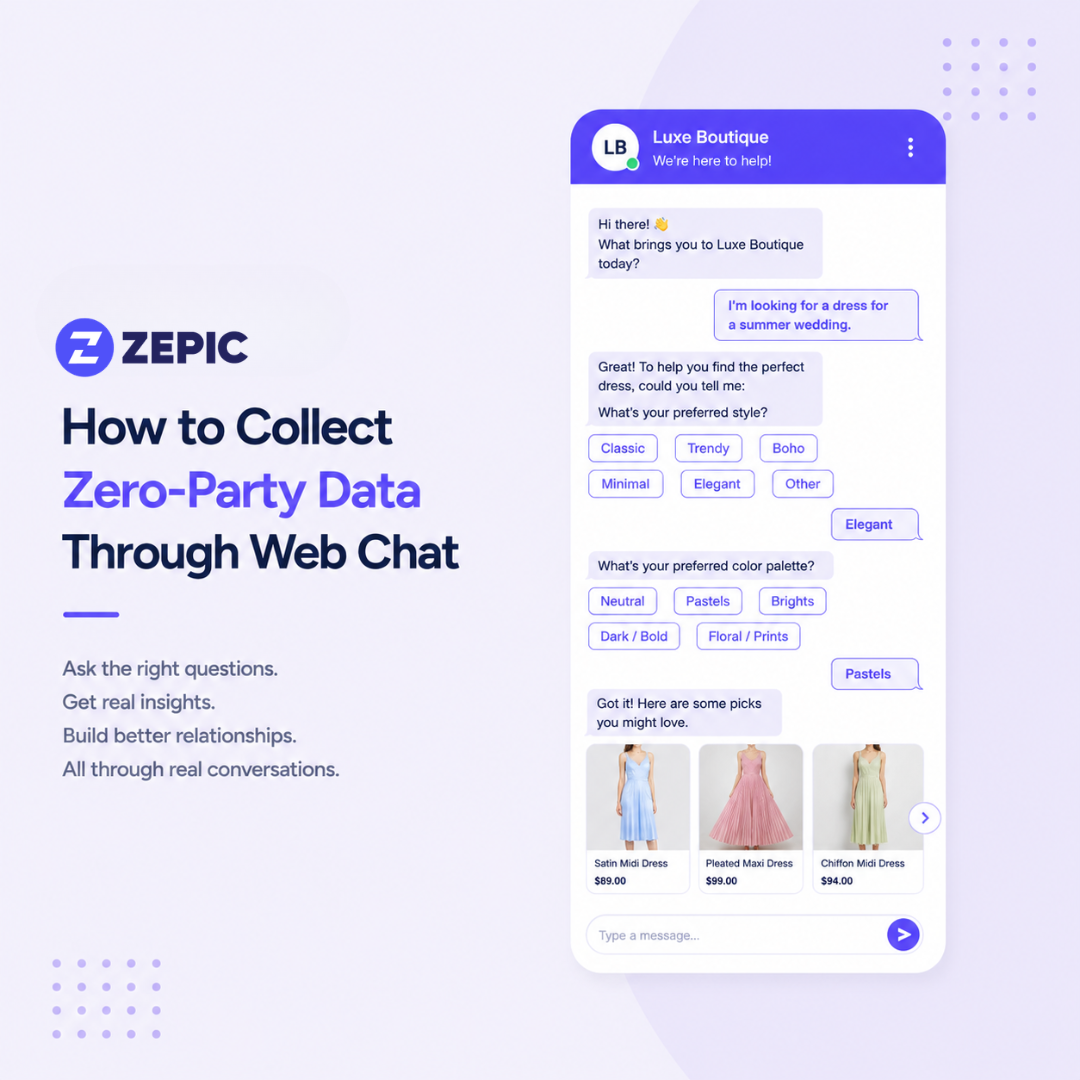
- Use tappable multiple-choice buttons inside the chat window to enable zero-typing responses. For example, present the question, "What is your primary skin concern?" alongside four clear buttons: Hydration, Anti-aging, Acne, or Sensitivity.
- Add visual options, such as images of different product styles, to make the process engaging.
High-Performing Zero-Party Data Chat Questions
- Intent: "What brings you to our site today?"
- Purchase Signal: "What is your ideal budget range for this item?"
- Gifting Context: "Are you shopping for yourself or looking for a gift?"
- Channel Preference: "How do you prefer to receive order updates from us?"
- Pain Point: "What is your biggest challenge with your current workout gear?"
Step 3: Layer Questions Progressively Across the Journey
Do not present all your questions in a single chat session. Implement progressive profiling web chat strategies to gather details naturally over time.
- First Session: Focus on immediate intent and the visitor's primary goal.
- Second Session: Deepen the profile by asking about specific preferences or budget constraints.
- Subsequent Sessions: Refine the profile using post-purchase feedback and usage context.
Ensure that every question connects to a visible, immediate benefit for the customer so they experience the value of sharing their data.
Step 4: Tag and Store Answers as Structured Profile Data
Raw chat transcripts are highly unstructured and difficult to use for marketing segmentation. To collect zero-party data without cookies effectively, your chat system must translate text and button clicks into structured profile attributes in real time.
- Tag answers immediately as fixed data fields on the individual's profile (e.g., preference: email, budget: $50-$100, goal: hydration).
- Store these attributes in a centralized Customer Vault that holds verified, consented truths rather than assumed behaviors.
- Sync this data across your marketing platform, customer data platform (CDP), and CRM systems.
Step 5: Activate Zero-Party Data Immediately in the Same Conversation
Do not wait to use the information provided. Apply the stated preference to customize the very next response, product recommendation, or promotion within the ongoing chat session.
- Skin Type Stated: Instantly display a curated carousel of matching skincare products.
- Budget Shared: Automatically filter the recommended items to fit the specified price range.
- Channel Preference Declared: Transition the conversation or future notifications to that specific channel.
- Gift Intent Detected: Highlight relevant gift guides, gift-wrapping options, and bundle offers.
Step 6: Use Zero-Party Data to Personalize Downstream Campaigns
Export the structured attributes gathered from web chat to fuel your ongoing marketing initiatives across email, WhatsApp, and social media channels. Replace generic audience segments with precise, preference-driven microsegments.
V. Zero-Party Data Chat Strategies by Customer Journey Stage
A. Pre-Purchase (Discovery & Consideration)
Focus your interactive chat flows on product discovery. Deploy "Find Your Perfect Product" conversational assistants to guide users through your catalog. Use intent detection to separate casual browsers from high-intent researchers, and use multiple-choice options to qualify their budget and specific use cases early on.
B. During Purchase (Conversion)
Use web chat to address common buying hesitation signals. If a user lingers on a checkout page, trigger a supportive chat prompt to capture explicit roadblocks, such as shipping timelines, payment options, or sizing uncertainties. Store these verified preferences to streamline the final conversion.
C. Post-Purchase (Retention & Loyalty)
Capture accurate motivation data at the peak of customer satisfaction, right after a purchase is completed.
Post-Purchase Prompt: "What was the main reason you chose us today?"
Use the response to populate their long-term profile. You can also gather product satisfaction signals to automate future replenishment reminders or loyalty rewards.
D. Re-Engagement (Win-Back)
When long-term customers go quiet, avoid relying on outdated behavioral history. Launch a targeted chat interaction when they return to the site, asking directly, "What would bring you back today?" Use this fresh input to update their profile preferences and trigger relevant, real-time incentives.
VI. Zero-Party Data Chat in Action: Industry Use Cases
Implementing zero-party data e-commerce strategies looks different depending on your specific vertical market. Here is how various industries structure their conversational flows:
Beauty & Skincare
- Data Collected: Skin type, primary skin concerns, routine complexity, and climate.
- Activation Strategy: The chat assistant generates a personalized daily regimen, filtering out products containing ingredients the user wants to avoid.
Fashion & Apparel
- Data Collected: Style preferences, body shape, sizing benchmarks, and primary dressing occasions.
- Activation Strategy: An AI stylist curates specific seasonal outfits, reducing product return rates by utilizing precise customer preference data collection.
Gift & Subscription Retailers
- Data Collected: Recipient age, relationship to the shopper, occasion, and interest categories.
- Activation Strategy: The chat system filters the entire catalog into a tailored gift guide, streamlining the paths to checkout for time-sensitive buyers.
Travel & Hospitality
- Data Collected: Desired destinations, travel styles (e.g., luxury, adventure, family), group sizes, and trip durations.
- Activation Strategy: The website chat assistant creates customized itinerary packages, improving booking conversion rates through personalized marketing assets.
FMCG & Grocery Brands
- Data Collected: Dietary restrictions, flavor preferences, household sizes, and typical reorder frequencies.
- Activation Strategy: The platform sets up automated, conversational replenishment flows over preferred chat apps to secure recurring revenue.
Compliance & Trust: Doing Zero-Party Data Right
Zero-party data is inherently compliant because it relies entirely on voluntary disclosure. It represents the clearest form of explicit consent under modern frameworks like GDPR, CCPA, and India’s DPDP Act.
To maintain this high level of trust, adhere to these fundamental principles:
- Maintain Clear Transparency: Always explain exactly why you are asking for a specific detail. Use context clues like, "Tell us your style preference so we can display the right products for you."
- Provide User Control: Give your customers an easy way to view, modify, or completely delete their stored preference attributes at any time.
- Keep Data in the Relationship: Never use zero-party data for external ad retargeting networks. Keep this data confined to the direct relationship between your brand and the consumer.
- Act on Every Insight: Avoid gathering information that your backend systems cannot process. Asking questions without personalizing the experience damages consumer trust.
Common Mistakes to Avoid
When building out your conversational collection strategies, ensure you avoid these four common pitfalls:
- Storing Answers Only as Chat Logs: Leaving conversational data trapped inside raw text transcripts makes it unusable. Ensure your chat solution extracts every answer into structured profile attributes.
- Overloading the User with Questions: Asking for too many details in a single chat session causes users to abandon the conversation or click random answers just to finish. Stick to progressive profiling.
- Treating Collection as a One-Time Event: Customer preferences change over time. Treat data collection as an ongoing dialogue, regularly giving users the chance to refresh their profiles.
- Using Zero-Party Data for Intrusive Ad Retargeting: Using deeply personal data shared in a private chat to follow users around the web via third-party ad networks violates the trust exchange. Keep the activation native to your direct marketing channels.
Zero-party data collected through web chat is the highest-quality, most actionable, and most privacy-safe information your brand can own. The companies winning the market are those that transform data collection from an act of passive surveillance into an active customer service experience.
Book a demo to see how ZEPIC’s AI-powered web chat and customer data platform can help your brand collect, store, and activate zero-party data seamlessly to drive higher lifetime value.
Frequently Asked Questions
What is zero-party data, and why does it matter?
Zero-party data is information that customers intentionally and proactively share with a brand, such as preferences, purchase intent, budget ranges, and product interests. It is becoming increasingly important because third-party cookies are disappearing due to privacy regulations and browser restrictions. Since the information comes directly from the customer, it provides highly accurate insights that help brands personalize experiences without relying on guesswork.
How is zero-party data different from first-party data?
The difference lies in how the data is collected. First-party data is gathered through observed customer behavior, such as website visits, purchases, clicks, and email engagement. Zero-party data is explicitly provided by the customer through direct interactions, making it more accurate because it reflects stated preferences rather than inferred behavior.
How can web chat be used to collect zero-party data?
Web chat provides a conversational way to collect customer preferences during browsing sessions. Through chatbot workflows and interactive prompts, brands can ask about shopping intent, budget, product preferences, sizing, or use cases. The responses can then be converted into structured customer attributes that support personalization across marketing channels.
What questions should a chatbot ask to collect zero-party data?
Chatbots should ask simple and relevant questions that align with the customer journey. Examples include: "What brings you to our store today?", "Who are you shopping for?", "What is your budget?", and "What style, size, or product category are you interested in?" These questions help brands understand customer intent without creating friction.
How do you use zero-party data to personalize marketing?
Zero-party data can personalize both onsite experiences and outbound campaigns. Brands can use customer-stated preferences to recommend products, filter catalogs, customize website content, and create highly targeted segments for email, WhatsApp, SMS, and other marketing channels.
What is progressive profiling, and how does it work in chat?
Progressive profiling is the process of collecting customer information gradually over multiple interactions rather than requesting everything at once. In a chat experience, brands might capture purchase intent during the first visit, collect preference data during a later interaction, and gather feedback after a purchase. This approach improves data quality while keeping conversations natural and engaging.
Why is zero-party data better than third-party cookies?
Zero-party data is more reliable because it comes directly from customers with their consent. Unlike third-party cookies, which rely on tracking behavior across websites and are increasingly restricted by privacy laws, zero-party data remains accurate, privacy-friendly, and sustainable for long-term personalization strategies.
What are the best tools for zero-party data collection in 2026?
The most effective tools combine conversational interfaces with customer data platforms (CDPs). These solutions capture information from web chat, forms, quizzes, and messaging channels, then automatically convert responses into structured customer profiles that can be used across marketing, sales, and support workflows.





%201.png)


.png)