From Chat to Agent: Why 2026 is the Year Enterprises Swap Public Assistants for Private Agents

Anandhi Moorthy

Senior Content Marketer
April 8, 2026

TLDR

  • 2026 marks the shift from conversational AI assistants to autonomous AI agents that can execute complex business workflows independently.
  • Over half of enterprises have already integrated AI agents into core operations, using them for finance, sales, HR, compliance, and IT workflows.
  • Public AI assistants like ChatGPT are reactive tools, while private enterprise agents are proactive systems connected directly to internal business platforms.
  • Enterprises are moving away from public AI tools due to concerns around data privacy, shadow AI usage, regulatory compliance, and a lack of enterprise control.
  • Regulations like the EU AI Act are pushing organizations toward private AI systems that provide audit trails, explainability, and secure data handling.
  • AI agents now automate tasks such as fraud monitoring, CRM updates, onboarding workflows, security incident response, and lead qualification.
  • Multi-agent systems are becoming common, with different agents collaborating through protocols like MCP to coordinate across departments and workflows.
  • Companies are seeing measurable ROI from AI agents, with some deployments achieving payback within 3–9 months.
  • Successful enterprise AI adoption depends on governance, workflow-focused deployments, human oversight, and strong integration across systems.
  • The competitive gap between AI leaders and laggards is widening, making private AI agents a strategic necessity rather than an experimental technology.

In 2024 and 2025, we marveled at the ability of a Gen AI to summarize an email or draft a blog post. By the middle of 2026, the novelty of conversation has been replaced by the necessity of action. Enterprises are no longer satisfied with AI that talks and are deploying AI that acts.

The shift from passive assistants to autonomous agents is the defining technological trend of this year. As of mid-2026, 54% of enterprises have integrated AI agents into their core operations. These systems can go beyond simply answering questions and do various tasks like executing complex workflows, processing high volumes of legal documents, monitoring real-time compliance, and coordinating decisions across multiple business departments.

This transition marks a departure from the experimentation phase of generative AI. While public tools provided a low-cost entry point for individual productivity, they lack the security and autonomy required for true business transformation. Organizations are now choosing between public AI tools and private enterprise agents. This choice determines their level of capability and their ability to comply with increasingly strict global regulations.

Defining the Divide: Chat Assistants vs. AI Agents

To understand why this shift is happening, we must first define the difference between a public AI assistant and a private enterprise AI agent. Many people use these terms interchangeably, but they represent two different levels of technical maturity.

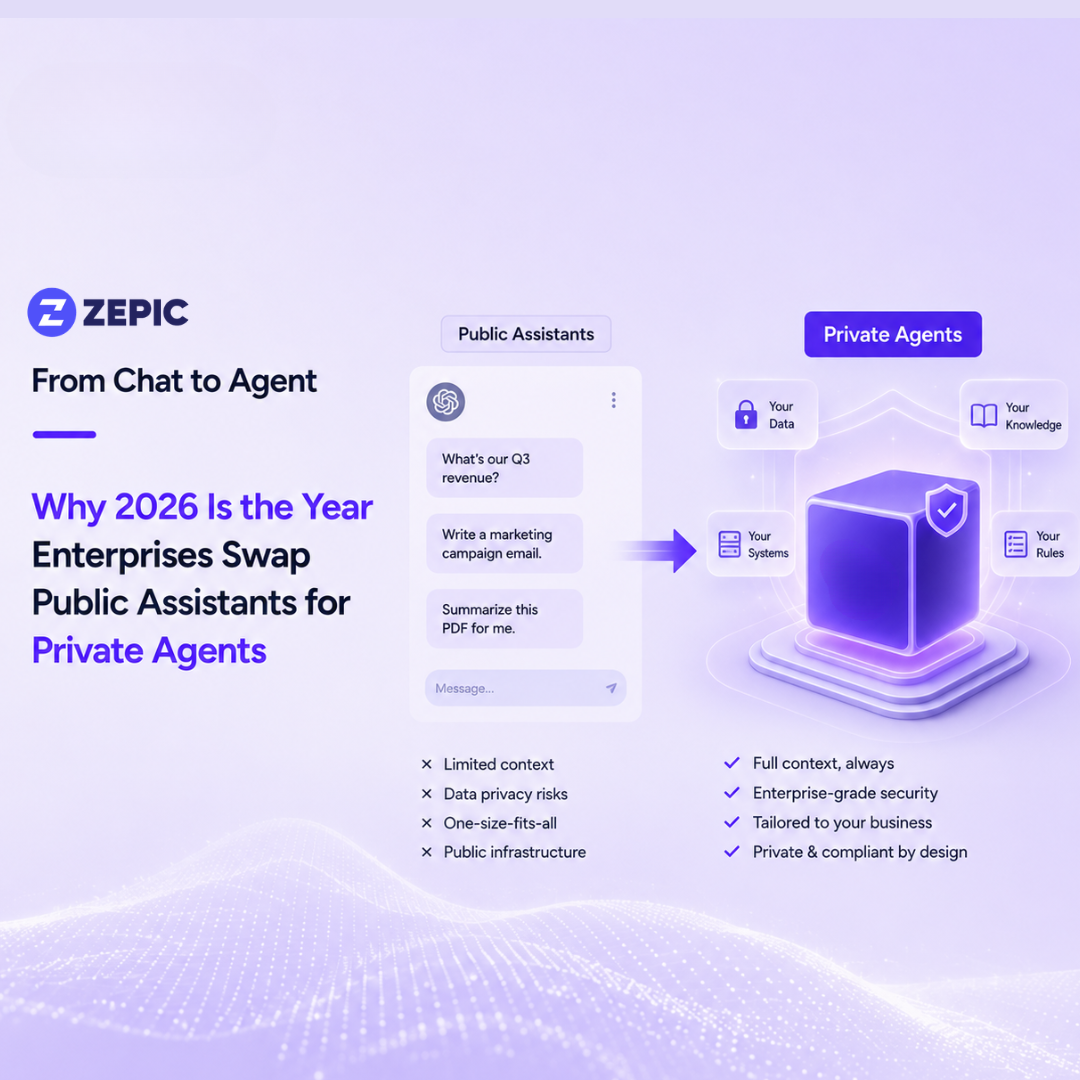
A public AI assistant, like the standard versions of ChatGPT, Gemini, or Copilot, operates on shared infrastructure. Its primary function is conversational. It waits for a user to provide a prompt, processes that prompt based on its training data, and provides a text or image response. The user remains the engine of the process, doing the heavy lifting of connecting the AI's output to a real-world task.

A private enterprise AI agent is goal-driven and autonomous. It is integrated directly into business systems like your CRM, ERP, or internal databases. Instead of waiting for a prompt to summarize a meeting, an agent might be tasked with a goal such as identifying all customers with expiring contracts this month and initiating the renewal process. The agent then reasons through the steps and executes the actions across different platforms.

The following table highlights the core differences:

In 2026, AI is no longer limited to generating content or assisting users through chat interfaces. Organizations are moving toward agentic AI that can reason, act, and adapt across complex enterprise environments. The focus is on results.

Why 2026 Is the Tipping Point

The transition from AI chat to AI agents did not happen overnight. However, 2026 has become the definitive tipping point due to a surge in both technological capability and market demand.

Market data makes a compelling case for this shift:

  • Gartner predicts that up to 40% of enterprise applications will include integrated, task-specific agents by the end of 2026. This is a massive jump from less than 5% in early 2025.
  • The first quarter of 2026 saw 80% of all new or updated enterprise applications embedding at least one AI agent. In 2024, that number was only 33%.

What makes 2026 a turning point is not theoretical progress, but operational readiness. Enterprises now have the architectures, governance models, and orchestration capabilities required to deploy AI agents in production environments. 

We have moved past the magic trick phase, where AI produces a clever poem. Companies are now under immense pressure to move from "AI experiments" to AI doing real, measurable work that impacts the bottom line.

This shift is driven by the realization that chat-based AI has a ceiling. While an assistant can help a single employee write an email faster, an agent can manage the entire outbound sales sequence for a 500-person department. The scalability of agentic AI is what makes it the primary investment for CIOs this year.

The Problem with Public AI Tools in the Enterprise

Decision-makers are rapidly moving away from public AI tools for several critical reasons. While these tools are convenient for individuals, they create significant risks for large organizations.

Data Privacy and Shadow AI Risk

Shadow AI has emerged as a major threat to corporate security. This refers to employees using public AI tools for work tasks without the knowledge or approval of the IT department. These shadow employees often upload sensitive company data into public models to get quick results.

According to the 2026 SaaS Management Index released, 77% of IT leaders found AI-powered features or applications in operation without their knowledge. This has become the number one channel for data exfiltration within the enterprise. We have already seen high-profile incidents, such as the leak at Samsung, where engineers accidentally uploaded proprietary code to a public model. In a private agent environment, that data stays within the company’s secure perimeter.

Regulatory Exposure

The regulatory landscape changed significantly this year. August 2, 2026, is a critical date for every global business. This marks the full application of the EU AI Act for high-risk AI Systems. If your business uses AI for consequential tasks (like hiring, credit scoring, or critical infrastructure), you are now subject to strict legal scrutiny.

Public tools often lack the transparency required to meet these standards. Using a private agent allows a company to maintain a full audit trail of why a certain decision was made. This is essential for compliance with GDPR, HIPAA, and the newer AI-specific regulations that require explainability and data residency.

Lack of Enterprise Control

When you rely on a public tool, you are at the mercy of the vendor's roadmap. If a vendor changes its data terms or discontinues a specific model version, your entire workflow can break. Furthermore, as public models are trained on increasingly broad datasets, the boundary between what the model learned from your proprietary data and what it outputs to other users becomes murky. Private agents give the enterprise total control over the model, the data, and the versioning.

What Private Enterprise AI Agents Actually Do

Private agents have moved beyond the chat box to become digital colleagues that plan, execute, and monitor work. They are currently being deployed across every major business function to handle repetitive, data-heavy processes.

Real-World Use Cases by Function
  • Finance: Agents are used for automated compliance monitoring. They scan thousands of transactions in real-time to detect fraud patterns that human auditors might miss. They also handle complex financial reporting by pulling data from disparate global entities and reconciling them into a single report.
  • Sales: Sales teams are using agents for prospect research and CRM management. For example, OpenAI's own sales team uses an agent that researches inbound leads, scores them against a pre-set rubric, sends a personalized email to qualified leads, and updates the CRM automatically. This allows the human sales reps to focus entirely on closing deals rather than data entry.
  • Human Resources: HR agents manage the entire onboarding workflow. They coordinate with IT to set up accounts, send out policy documents, answer new-hire questions about benefits, and schedule initial training sessions.
  • IT and Security: Threat response agents are now a standard part of the security stack. These agents can classify a security incident, isolate affected systems, and begin the remediation process within seconds of a breach being detected.

Multi-Agent Orchestration

We are also seeing the rise of agent teams. Approximately 22% of production deployments now coordinate three or more agents to work together. This is made possible by the Model Context Protocol (MCP), which provides the technical "rails" for different agents to communicate. There are now over 9,400 public MCP servers, allowing agents from different vendors to work together in a unified ecosystem.

ROI, Speed, and Competitive Moat

For CFOs and CIOs, the shift to private agents is driven by hard numbers. The return on investment (ROI) for these systems is becoming easier to calculate as more companies move them into production.

The median time-to-value for agent deployments is currently 5.1 months. Some specific functions see an even faster return:

  • Sales Development Agents: These typically pay back the initial investment in 3.4 months.
  • Finance and Operations Agents: These take slightly longer due to the complexity of the data, with a median payback of 8.9 months.

The scale of investment is also staggering. Global enterprise AI agent spend is forecast to reach $1.4 trillion by 2027. Most large enterprises have seen their monthly LLM bills grow 7.2x year-over-year as they move from small pilots to enterprise-wide agent deployments.

Beyond immediate cost savings, private agents create a proprietary data moat. By training agents on your company's unique processes and data, you create a system that competitors cannot easily replicate. This is a strategic advantage that goes far beyond simple productivity gains. The goal is to build a business that is faster and more accurate because its core processes are handled by agents that never sleep and never forget a policy.

What Enterprises Need to Get Right

Deploying private agents is not as simple as flipping a switch. To succeed, organizations must focus on three core areas: governance, scoping, and integration.

Governance First

Trust is the foundation for scaling AI. Without clear governance frameworks, auditability, and explainability, an organization cannot safely let an agent take actions. This realization has led to a shift in corporate structure. In 2026, 56% of enterprises have named a dedicated "AI Agent Owner" or an "Agentic Ops" lead. In 2024, only 11% of companies had such a role.

Start Narrow, Scale Smart

One of the biggest mistakes companies make is trying to build a general-purpose agent that does everything. The most successful deployments focus on a single, well-defined workflow. They set binary success criteria and include human-in-the-loop checkpoints where a person must approve an agent's action before it is finalized. Currently, only 38% of production agents have automated evaluations running on every prompt change. This lack of evaluation is the single biggest reason why some AI projects fail to stay in production long-term.

Integration Over Isolation

An agent is only as good as the systems it can talk to. Integration remains the primary challenge for 46% of organizations. The goal is to choose platforms that do not just connect to your systems but can reason across them using relational intelligence. If an agent cannot understand the relationship between a customer's support ticket and their recent billing history, its utility will be limited.

The Competitive Imperative

The gap between AI leaders and laggards is widening rapidly. Worker access to AI tools rose by 50% in 2025, and the number of companies with more than 40% of their AI projects in production is expected to double in the next six months.

Despite this progress, only 34% of enterprises are truly reimagining their business with AI. The rest are merely optimizing incrementally. Incremental optimization is helpful, but it is not a long-term strategy. The leaders in 2026 are the ones who realize that the very nature of work is changing.

The question for leadership is no longer whether to deploy agents. The question is whether your organization can afford to let your competitors deploy them first. If a competitor can handle customer service, financial reporting, and lead generation at ten times your speed and half your cost, your market position is at risk.

Wrapping Up

The shift from 'Chat' to 'Agent' represents a fundamental change in how we think about software. We are moving from a world where we use tools to a world where we manage systems. Private enterprise agents offer the security, autonomy, and measurable ROI that public assistants simply cannot provide.

As we move through 2026, the enterprises that thrive will be those that take control of their AI destiny. This means moving away from shared, public chat tools and investing in private, autonomous agents that are deeply integrated into the fabric of the business.

Are you ready to see where your organization stands in this new landscape?

Use Neura to build AI agents that share context to help you scale. Talk to us today!

Frequently Asked Questions

What is the difference between an AI assistant and an AI agent?

The key difference is autonomy. An AI assistant is reactive—it responds to prompts and generates outputs. An AI agent is proactive—it takes a high-level goal, plans the necessary steps, interacts with tools and systems, and completes tasks independently without requiring continuous human input.

What is "Agentic AI" and how does it work for businesses?

Agentic AI refers to systems designed to act as autonomous digital workers. In a business setting, these systems can plan tasks, execute workflows, and validate outcomes. For example, instead of just summarizing a meeting, an agent can identify action items, schedule follow-ups, and coordinate tasks automatically based on company rules and data.

Why are companies moving away from public AI tools like ChatGPT?

Many enterprises are concerned about data privacy and security. Public AI tools may involve sharing sensitive data with external systems. As a result, companies are increasingly adopting private AI solutions where data remains within secure environments such as internal cloud infrastructure or on-premise systems.

Are private AI agents safer than public assistants?

Yes. Private AI agents operate within an organization’s controlled environment, enabling stronger data governance. They support requirements such as data residency, detailed audit trails for compliance, and custom guardrails that restrict access to sensitive information based on permissions.

What are the top use cases for AI agents in 2026?

AI agents are being widely used across functions such as customer support for resolving issues end-to-end, finance for automating compliance and reconciliation processes, sales for lead research and CRM updates, and IT operations for system monitoring, security, and automated maintenance tasks.

Which industries are leading the adoption of AI agents?

Industries such as telecommunications, retail, and consumer packaged goods are leading in adoption rates, while banking and financial services are investing heavily in AI agents for areas like fraud detection and risk management. These sectors benefit from automation in high-volume, data-intensive workflows.

Desperate times call for desperate Google/Chat GPT searches, right? "Best Shopify apps for sales." "How to increase online sales fast." "AI tools for ecommerce growth."

Been there. Done that. Installed way too many apps.


But here's what nobody tells you while you're doom-scrolling through Shopify app reviews at 2 AM—that magical online sales-boosting app you're searching for? It doesn't exist. Because if it did, Jeff Bezos would've bought (or built!) it yesterday, and we (fellow eCommerce store owners) would all be retired in Bali by now.


Growing a Shopify store and increasing online sales isn’t easy—we get it. While everyone’s out chasing the next “revolutionary” tool/trend (looking at you, DeepSeek), the real revenue drivers are probably hiding in plain sight—right there inside your customer data.
After working with Shopify stores like yours (shoutout to Cybele, who recovered almost 25% of their abandoned carts with WhatsApp automation), we’ve cracked the code on what actually moves the needle.


Ready to stop app-hopping and start actually growing your sales by using what you already have? Here are four fixes that will get you there!

Fix #1: Convert abandoned carts instantly (Like, actually instantly)

The Painful Truth: You're probably losing about 70% of your potential sales to cart abandonment. That's not just a statistic—it's real money walking out of your digital door. And looking for yet another Shopify app for abandoned cart recovery isn't going to fix it if you're not getting the fundamentals right.

The Quick Fix: Everyone knows you need multi-channel recovery that hits the sweet spot between "Hey, did you forget something?" and "PLEASE COME BACK!" But here's the reality—most recovery apps are a one-trick pony. They either do email OR WhatsApp, not both. And don't even get us started on personalizing offers based on cart value—that usually means toggling between three different dashboards while praying your apps talk to each other.

Enter ZEPIC: This is where we come in. With ZEPIC's automated Flows, you can:
Launch WhatsApp recovery messages (with 95% open rates!)
Set up perfectly timed email sequences (or vice versa)
Create personalized recovery offers not just on cart value but based on your customer’s behavior/preferences
Track and optimize everything from one dashboard

Fix #2: Reactivate past customers today

The Painful Truth: You're probably losing about 70% of your potential sales to cart abandonment. That's not just a statistic—it's real money walking out of your digital door. And looking for yet another Shopify app for abandoned cart recovery isn't going to fix it if you're not getting the fundamentals right.

The Quick Fix: Everyone knows you need multi-channel recovery that hits the sweet spot between "Hey, did you forget something?" and "PLEASE COME BACK!" But here's the reality—most recovery apps are a one-trick pony. They either do email OR WhatsApp, not both. And don't even get us started on personalizing offers based on cart value—that usually means toggling between three different dashboards while praying your apps talk to each other.

Enter ZEPIC: This is where we come in. With ZEPIC's automated Flows, you can:
Launch WhatsApp recovery messages (with 95% open rates!)
Set up perfectly timed email sequences (or vice versa)
Create personalized recovery offers not just on cart value but based on your customer’s behavior/preferences
Track and optimize everything from one dashboard

Offering light at the end of the tunnel is Google’s Privacy Sandbox which seeks to ‘create a thriving web ecosystem that is respectful of users and private by default’. Like the name suggests, your Chrome browser will take the role of a ‘privacy sandbox’ that holds all your data (visits, interests, actions etc) disclosing these to other websites and platforms only with your explicit permission. If not yet, we recommend testing your websites, audience relevance and advertising attribution with Chrome’s trial of the Privacy Sandbox.

Top 3 impacts of the third-party cookie phase-out

Who’s impacted

How

What next

Digital advertising and
acquisition teams
Lack of cookie data results in drastic fall in website traffic and conversion rate
Review all cookie-based audience acquisition. Sign up for Chrome’s trial of the Privacy Sandbox
Digital Customer Experience
Customers are not served relevant, personalised experiences: on the web, over social channels and communication media
Multiply efforts to collect first-party customer data. Implement a Customer Data Platform
Security, Privacy and Compliance teams
Increased scrutiny from regulators and questions from customers about data storage and usage
Review current cookie and communication consent management, ensure to align with latest privacy regulations

Recent blog post

No items found.