Meet

Neura HQ,
Your connected AI Agent Workforce Know more



.jpeg)
Hi {first_name}
You’ve seen it. You’ve sent it. And you’ve probably sighed at how impersonal it feels. Because, let’s be honest, no one likes an email that conveys that they’re another name on a list. Studies show that about 72% of consumers exclusively engage with personalized messaging.
To create campaigns that are personal, you need to segment your audience in real time. Easier said than done, right? But here’s why it matters:
Imagine receiving a text that says, "Hey, John! Here’s a 20% discount on baby products!"—except you don’t have kids. Maybe you bought baby essentials for your niece years ago, but now she’s in school, and you’re still getting diaper discounts. That’s poor, outdated segmentation in action, a surefire way to lose customer interest.

For D2C brands, poor segmentation is the difference between converting customers and losing them forever. And that’s exactly where AI segmentation changes the game.
Join us as we explore the importance of AI segmentation for D2C brands and how Zenie can help you!
We all know that customer segmentation is more than a marketing buzzword; it’s the core for creating campaigns that actually resonate. In fact, when you tailor your email or WhatsApp campaigns to your audience, you might be looking at a solid 14.31% boost in open rates and a 101% increase in clicks.
The precision of AI can improve your open rates and even translate into sales. Let’s break down how AI segmentation helps D2C brands.
Traditional segmentation groups customers based on broad factors like age, location, and purchase history. While that’s a good start, it’s also what everyone else is doing. If you want to stay ahead, you need dynamic, behavior-based segmentation.
For instance, say you’re a pet care brand. Sending customers a birthday wish is great, but what if you went a step further and sent a special offer on their pet’s birthday? While that sounds like a great idea, let’s be real: most D2C marketers might not have the time to zero in on minute details. That’s why hyperpersonalization has been a theory and not a reality for a long time.
However, times have changed now; unlike us, AI can process truckloads of data before we get our coffee. With the power of AI segmentation, hyperpersonalization has become a norm in the marketing world. Using it effectively can make your customers feel like you get them.

Advanced marketing automation platforms are powered by AI models that can analyze data from your e-commerce store, email inbox, WhatsApp, and other sources to group your audience based on real-time behavior, purchase history, and engagement trends. This will help you send targeted campaigns to a specific group of customers, like cart abandoners, discount enthusiasts, and high-value shoppers.
A marketing campaign’s success depends on reaching the right people at the right time. You have to remember that people’s interests and buying behavior change over time; a customer who used to shop for wedding decor is probably now looking for baby furniture. Your segmentation has to evolve with them if you want to retain them or even convert them into a loyal customer.
AI continuously analyzes real-time behaviors, preferences, and purchase patterns to update customer segments automatically. So you don’t have to worry about sending out irrelevant campaigns.
On average, a person receives about 121 emails per day. That’s a lot of noise to break through, and it underscores the importance of standing out with every message you send.
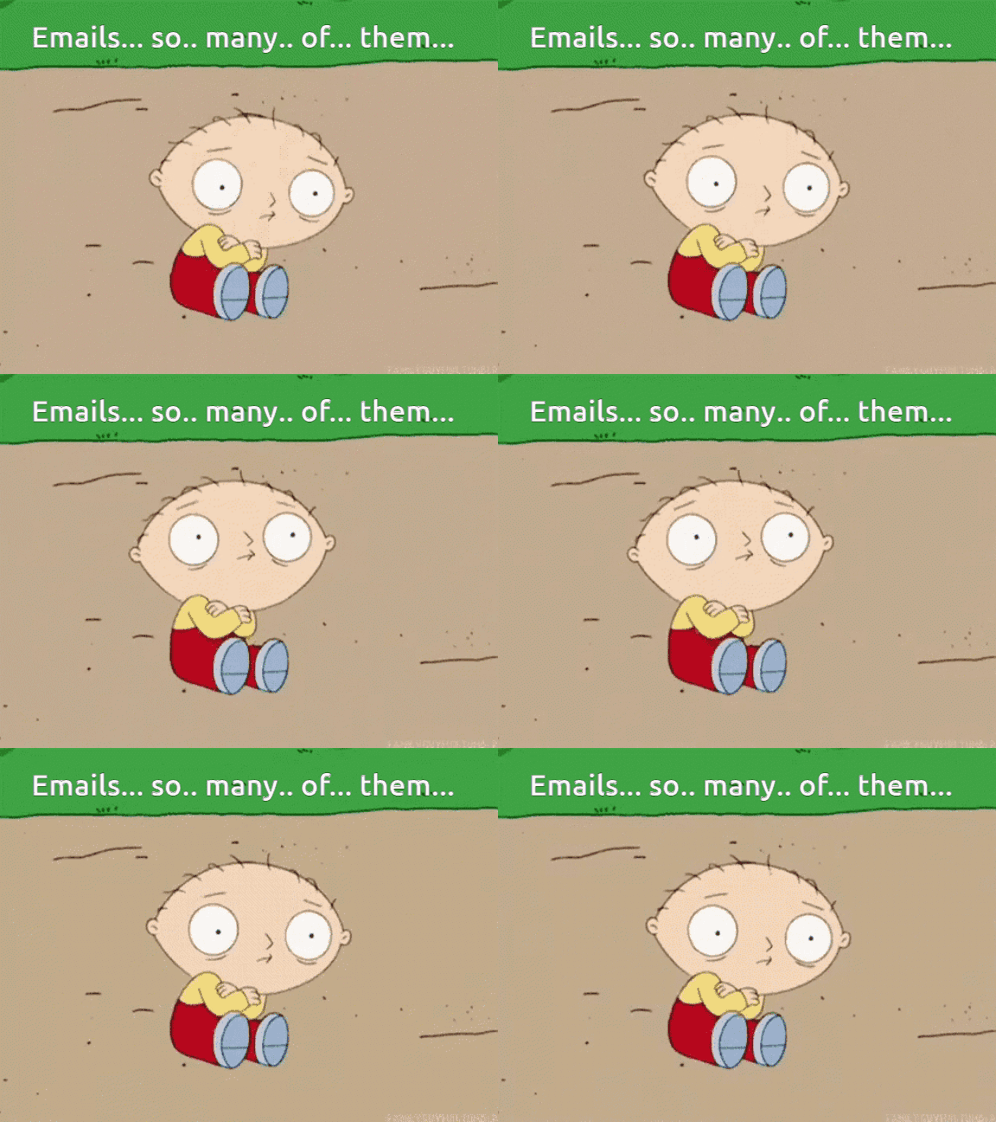
When your emails are tailored to meet the unique interests and your customer’s needs, you’re more than another email in a crowded inbox—you’re a welcome, valuable experience.
Whether it’s recommending products based on recent interactions or predicting when a customer is most likely to engage, AI segmentation ensures you’re delivering messages that add value, not clutter.
With AI-driven personalization, you won’t be lost in the inbox, your message will be the one they actually want to open. Your campaigns can become more than promotions; they become an experience that customers look forward to.
Start with clean and comprehensive data: AI is only as good as the data it processes. Make sure your customer data is accurate and up-to-date. You also could collect data from various touchpoints—your website, emails, WhatsApp interactions, CRM, and purchase history.
Define clear segmentation goals: Before segmenting, identify what you want to achieve. Are you trying to increase conversions, reduce churn, or re-engage inactive users? Having clear objectives will help you create meaningful customer segments.
Leverage predictive analytics: AI tools have powerful predictive capabilities. Use it to identify potential repeat buyers, high-intent shoppers, or customers likely to churn, and target them accordingly.
Continuously optimize segments: AI segmentation isn’t a one-and-done process. Regularly analyze the performance of your segments, adjust criteria based on new insights, and refine targeting strategies to improve engagement and ROI.
Automate but monitor: While AI automation saves time, you should keep an eye on the data. Regularly review AI-generated segments to check their accuracy and make adjustments based on campaign performance.
Test, measure, and iterate: Run A/B tests on different customer segments, track performance metrics, and use AI-driven insights to refine your segmentation strategy. The more you test, the better your results.
Now that we’ve covered why AI segmentation is a game-changer for D2C brands, let’s talk about how Zenie AI makes it effortless.
Zenie AI takes the guesswork out of customer segmentation. You can import data from various touchpoints, including your e-commerce store, emails, WhatsApp, and even CSV files, into ZEPIC. You can ask Zenie to segment your customers based on:

Let us look at an example. Say you want to send out a campaign to unhappy customers. Here’s how you can use Zenie to achieve your goal.
Once you select the segmentation feature in Zenie, you’ll have to choose the object you want to use for the process. Objects are data storage units in ZEPIC.
To classify customers who’ve left you negative reviews, you have to choose the customer reviews object. When you select the object, Zenie will create smart segments or cohorts based on the data.
Going through negative reviews is never fun, but it’s the bitter truth that can make your brand better. As you can see from the image, Zenie automatically assessed the data fields and pointed out that verified poor reviews is a category you might have to pay attention to.

Any rating below 3 is a timebomb that can damage your brand’s reputation forever. But you can always do damage control with a quick email or text. Let’s use Zenie to find out exactly what these reviews are: Enter your prompt and hit the generate button.

Zenie will separate the negative reviews and the details in minutes.

You can now send out campaigns to these customers and turn their experience around.
Why rely on outdated static lists when you have a genie that’s always listening and learning from your data? Use Zenie to create segments based on real-time behavior and make sure your marketing campaigns always reach the right audience at the right time.
Zenie doesn’t just help you with segmentation; it can assist you in creating workflows. You can easily send email and WhatsApp campaigns to your customers at the right time.
Did we mention that you can create WhatsApp campaigns with Zenie? Yes, the AI can generate a message and image for your campaign based on your prompt. Here are some other reasons why you should choose Zenie:
You can use Zenie to track a customer’s actual interactions—like if they’ve visited certain pages multiple times or they’ve been eyeing a specific product for so long but haven’t purchased it yet—and you can automatically move them into a segment for follow-up campaigns.
You don’t need a data science degree to use Zenie AI. It’s built for marketers, meaning you can create and manage smart segments without any complex setup or coding.
Whether you’re running email campaigns or WhatsApp promotions, Zenie AI syncs with your existing marketing tools to ensure smooth execution.
If you’re a veteran D2C marketer, we don’t have to tell you that marketing is evolving at lightning speed. A decade ago, personalization meant “Hi first_name,” and that was enough. But times have changed; marketers have to be mind readers who know what the customers want before they even do.
AI segmentation is the crystal ball that tells you what the future holds. This data-driven process keeps your campaigns relevant and effective since it adapts to real-time customer behavior. And with Zenie AI, you get more than a crystal ball, you get an intelligent assistant that listens, learns, and helps you create hyperpersonalized campaigns in minutes. It can tell you which coffee your customers drink or even how much sugar they add.
Okay, that last bit is an exaggeration—or is it?

Try Zenie today and find out for yourself!

%201.png)


.png)