Why Your Fashion Brand Needs an AI Stylist Agent

Anandhi Moorthy

Senior Content Marketer
March 13, 2026

TLDR:

  • Fashion e-commerce struggles with low conversion (≈2%) and high returns due to poor personalization
  • Shoppers want personalized experiences, but most brands still offer generic product grids
  • AI stylist agents replicate in-store stylists by understanding preferences, context, and intent
  • They provide occasion-based outfit recommendations, not just single product suggestions
  • Agents use purchase history and behavior to deliver real-time personalization
  • Size and fit recommendations reduce uncertainty and cut return rates
  • They drive higher order value through complete look upselling
  • Post-purchase styling keeps customers engaged and improves retention
  • Brands like Ralph Lauren, Stitch Fix, and Zalando are already seeing strong results
  • AI styling improves key metrics: higher conversion, +15–22% AOV, and up to 30% fewer returns
  • Implementation starts small: clean product data, connect CDP, and focus on one use case
  • AI stylists are becoming a competitive necessity, not a nice-to-have, in fashion e-commerce

Fashion is a vertical that has always been personal. The best in-store experience is one where a stylist already knows your taste, remembers what you bought last season, knows your size across every brand, and can pull a complete outfit in minutes.

That experience has been almost impossible to replicate online. Until now.

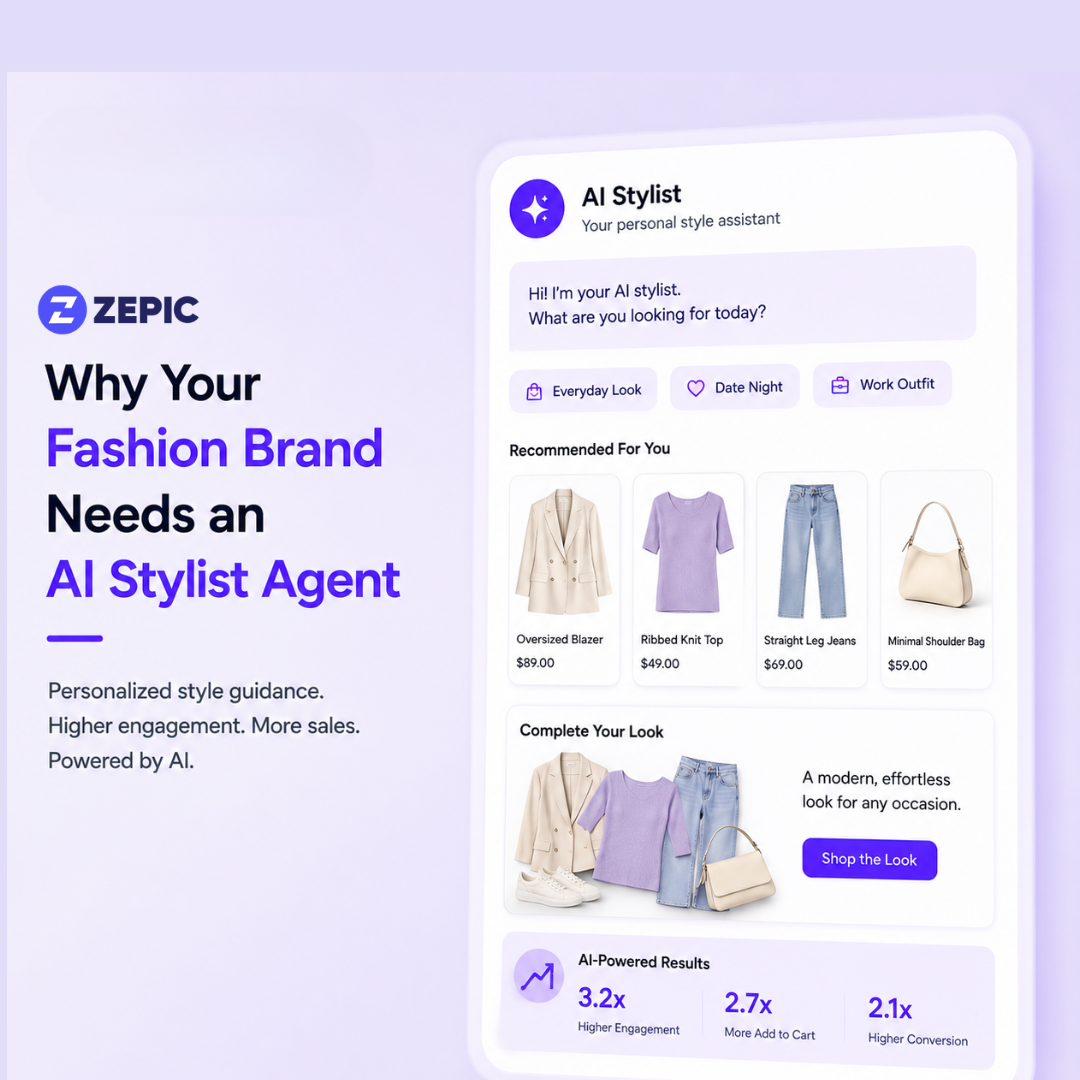
AI stylist agents are changing what fashion e-commerce can actually deliver. These agents understand context, curate complete looks, respond to occasion-based requests, reduce returns, and personalize every interaction based on a shopper's actual behavior and preferences.

If your brand is still relying on a product recommendation widget or a generic chatbot, you need to rethink your strategy. Join us as we explore why your fashion brand needs an AI stylist agent.

The Gap Between What Fashion Shoppers Want and What They Get

The average fashion e-commerce conversion rate sits at just 1.9% to 2.4%, meaning roughly 97 out of every 100 visitors leave without buying. The top 20% of fashion retailers push past 4.3%.

That gap is largely an experience gap.

  • 75% of consumers say they actively prefer brands that offer personalized shopping experiences 
  • 43% of purchases are influenced by personalized recommendations
  • 38% of all fashion returns are caused by sizing and fit issues that better guidance could prevent
  • Fashion return rates average 24 to 26% for apparel and up to 35% for footwear, costing retailers $21 to $46 per returned item 

So based on the numbers, we can understand that all you need to do is improve your experience to increase conversions. We know that’s easier said than done when most mid- to small-sized brands operate with a small team. This is where an AI stylist can help you. 

What an AI Stylist Agent Actually Does

An AI stylist agent goes well beyond "people who bought this also bought." Here is what one actually handles:

Occasion-based styling: A shopper types: "I need something for a rooftop dinner in Miami in July under $200." The agent interprets weather, formality, budget, and context, then returns a complete shoppable outfit.

Wardrobe continuity: The agent connects to purchase history and remembers what the customer already owns. It can suggest new pieces that work with existing items in their wardrobe, increasing the relevance of every recommendation.

Real-time personalization: Rather than showing the same homepage to every visitor, the agent adapts to browsing behavior in the session. A shopper who gravitates toward structured blazers and neutral tones sees those surfaced first, automatically.

Size and fit guidance: The agent draws on body measurement data, brand-specific sizing history, and customer reviews to recommend the right size, reducing the uncertainty that drives returns.

Complete-the-look upselling: Instead of recommending one product, the agent presents a full look and makes it easy to add multiple items in a single interaction, lifting average order value.

Post-purchase styling: After a purchase, the agent can suggest complementary pieces, care instructions, and styling ideas that extend the brand relationship beyond the transaction.
Who Is Already Doing This: Real Brand Examples

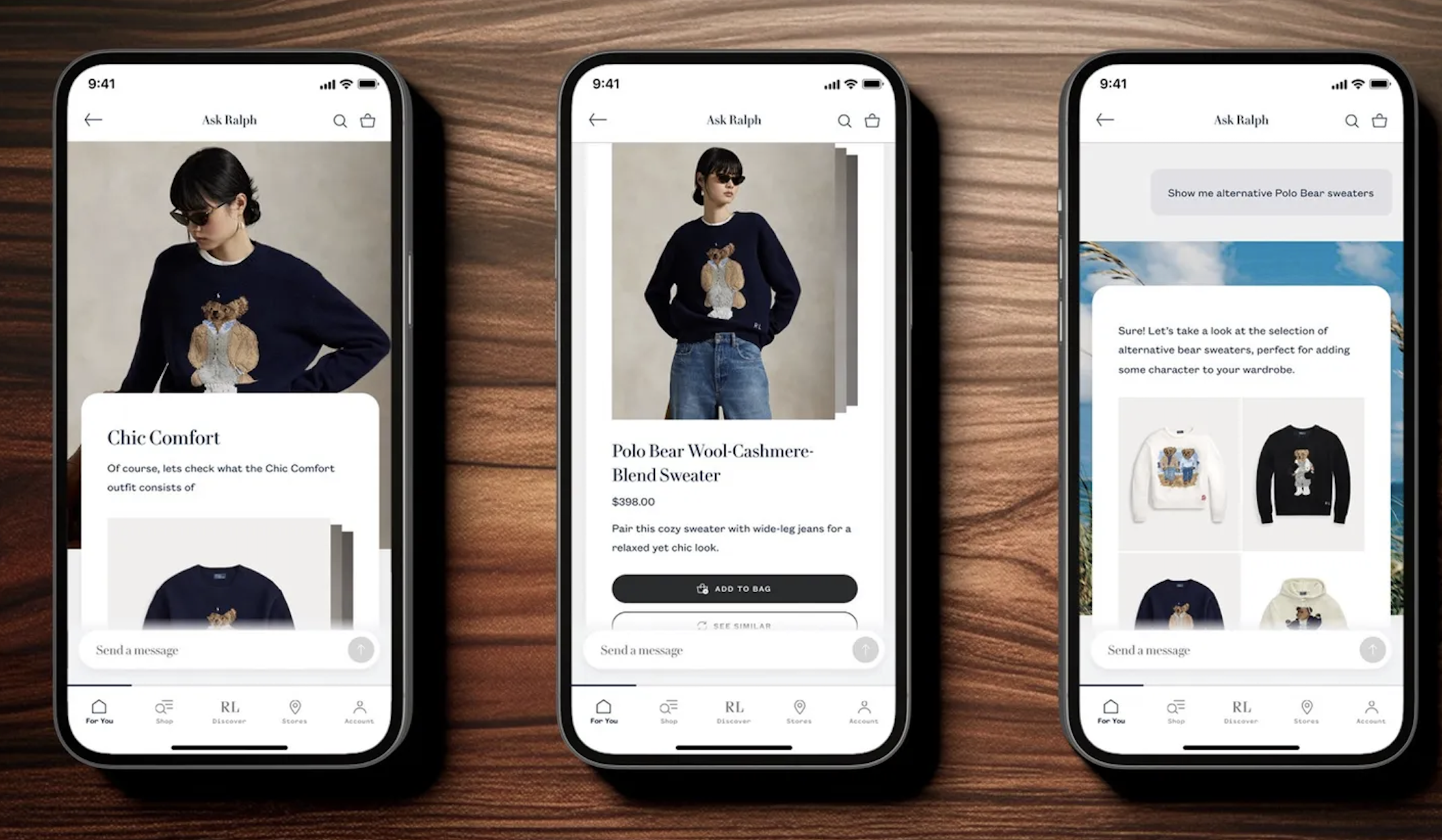
Ralph Lauren: Ask Ralph

Ralph Lauren launched Ask Ralph, an AI-powered shopping tool built with Microsoft on the Azure OpenAI platform. It provides personalized outfit suggestions and styling tips drawn from Polo Ralph Lauren's men's and women's collections. 

Customers can ask questions such as "What should I wear to a concert?" and receive complete, shoppable looks that can be refined and purchased directly.

The agent is designed to replicate the in-store stylist experience. A customer does not browse a grid and guess; they describe what they need, and the agent does the curation. Ralph Lauren has confirmed plans to expand Ask Ralph across more of its brands and markets.

Stitch Fix: AI Style Assistant + Vision

Stitch Fix has built one of the most data-rich AI styling operations in fashion. Their conversational AI Style Assistant is live in the iOS app and engages clients in dialogue, offering AI-generated outfit ideas to help them articulate their preferences, drawing on the company's extensive client data. 

A second tool, personalized AI Style Visualization, lets select shoppers preview how they might look in recommended outfits and trending styles.

Stitch Fix's AI merchandising tool contributed to an average order value 9% higher year over year in Q2 fiscal 2025, driven partly by higher keep rates. Over a longer period, their AI personalization strategy boosted AOV by 40%, increased repeat purchases by 40%, and contributed to a 30% reduction in returns (Chief AI Officer, September 2025).

DressX: Agentic Digital Fashion

DressX launched DressX Agent, an AI-powered digital fashion platform that lets users create personalized avatars from a selfie, virtually try on outfits, and shop from over 200 luxury brands and more than one million products.

This is a strong example of what AI styling looks like when it is built for discovery at scale. A single shopper interaction produces a personalized avatar, a virtual fitting room, and a curated product selection across hundreds of brands, without any manual filtering.

Daydream: Agentic Fashion Discovery

Daydream built a chat-based agentic shopping interface where users fill in a "Style Passport" and interact with AI models specialized in fit, fabric, silhouette, and occasion. These agents return personalized recommendations across 8,000 brands and 200 retail partners and evolve with user behavior over time.

The key differentiator is specialization. Daydream's agents are not general-purpose chatbots; they are purpose-trained on fashion, which means they understand the nuance of drape, silhouette, and occasion in a way a generic AI assistant does not.

Zalando: Personalization at Scale

Zalando uses customer feedback, consumer preferences, and predictive analytics to suggest looks tailored to individual style preferences, with AI systems analyzing social media activity, purchasing patterns, and user behavior to create hyper-relevant suggestions across their entire catalog.

Zalando's approach demonstrates that AI styling is not exclusively for mid-market or DTC brands. A platform with tens of millions of SKUs can use these same systems to surface the right products at the right moment, cutting through catalog noise.

Warby Parker: Virtual Try-On as a Gateway

While primarily an eyewear brand, Warby Parker's virtual try-on story is worth noting because the model translates directly to apparel. Warby Parker introduced virtual try-on technology through its app, allowing customers to virtually try on frames before deciding, with the option to order five frames to try at home with free return shipping. The outcome was a measurable reduction in return rates and a significant improvement in purchase confidence, two problems every fashion brand faces.

What Changes When You Deploy an AI Stylist

Conversion goes up: Brands like Stitch Fix have achieved a 30% increase in conversion rates through AI-driven tailored clothing recommendations. Fashion e-commerce averages 1.9% to 2.4% conversion. Even a modest lift of 1 to 2 percentage points on meaningful traffic volume changes the revenue picture significantly.

Returns come down: Sizing and fit issues drive 38% of fashion returns. When an agent gives accurate size guidance using a shopper's purchase history and brand-specific data, that uncertainty disappears. Stitch Fix cut returns by 30% using AI personalization.

Order values increase: Complete-the-look styling consistently drives multi-item purchases. When a shopper sees a curated outfit rather than a standalone product, they are more likely to add complementary items. AI recommendation engines deliver 15 to 22% higher average order values across fashion deployments (Alhena AI).

Customer retention improves: Stitch Fix reported a 15% boost in customer retention after implementing AI personalization. Shoppers who feel understood come back. Shoppers who received a generic experience do not.

The market is growing fast: The AI in the fashion market is projected to grow from $2.23 billion to $60.57 billion by 2034, representing a 39.12% CAGR. Brands that build AI styling into their stack now will have a compounding advantage over those that wait.

The Practical Build: Where to Start

You do not need to overhaul your entire e-commerce stack to deploy an AI stylist agent. Most brands start with a contained use case and expand from there.

Start with one high-value scenario: The product finder is the most common starting point. A shopper describes what they need by occasion, body type, or budget, and the agent returns a curated outfit. This delivers immediate value and generates data for improvement.

Connect your product data first: The agent is only as good as what it can read. Clean product attributes, detailed descriptions, and accurate sizing data are non-negotiable. Unlike traditional search, AI stylists understand intent. When a shopper describes needing something for "a winter wedding," the AI interprets the event type, setting, weather, and formality and matches against your catalog accordingly. That only works if your catalog can support it.

Feed it behavioral data: An agent with no context about the shopper defaults to generic recommendations. Connect your CDP so the agent can personalize from the first interaction based on purchase history, browsing behavior, and stated preferences.

Build the feedback loop: Every keep, return, rating, and repurchase is data. The agent should get better over time by learning what worked and what did not, building a "StyleFile" equivalent for every customer on your platform.

Add virtual try-on as a trust layer: Many Platforms allow customers to create their own personalized AI avatars using a selfie and basic measurements, producing a realistic digital twin that shows how specific clothes would fit their actual proportions. This addresses the single biggest barrier to online fashion conversion: purchase confidence.

What the Best Implementations Have in Common

Across the brands seeing the strongest results, the pattern is consistent:

  • They train the agent on their specific catalog, not in a generic fashion data
  • They connect the agent to real behavioral signals, not just demographics
  • They design for complete looks, not single product recommendations
  • They measure returns, repeat purchases, and AOV, not just engagement
  • They keep a human escalation path for edge cases and complex styling needs

The Window Is Now

Fashion is a category where personalization has always mattered, and online has always struggled to deliver it. The in-store stylist who knows your size, your taste, and what you own is a competitive advantage that most DTC brands have never been able to replicate digitally.

AI stylist agents close that gap. The brands deploying them are already building measurable leads in conversion, AOV, and retention. The data from Stitch Fix, Ralph Lauren, and DressX is not early-stage speculation. These are live results from real deployments.

The question is not whether this technology works. The question is how quickly your brand gets into the game.

ZEPIC helps fashion brands build AI-powered customer experiences that convert, retain, and grow. Talk to our team about what an AI stylist agent could look like for your catalog.

Frequently Asked Questions

How does an AI stylist reduce return rates?

Returns in fashion are often driven by uncertainty around fit and styling. AI stylist agents reduce this by providing accurate size recommendations using purchase history and brand-specific sizing data, presenting complete outfits instead of isolated products, and enabling virtual try-on experiences tailored to the shopper’s body type. These capabilities increase confidence at the point of purchase and reduce the likelihood of returns.

Which fashion brands are using AI stylist agents right now?

Several leading brands have already implemented AI styling solutions. Ralph Lauren introduced “Ask Ralph,” offering personalized outfit recommendations. Stitch Fix launched a conversational AI Style Assistant that uses customer preference data to suggest looks. DressX introduced an AI agent that allows users to create avatars, try on outfits virtually, and shop across a large catalog of fashion products.

Can an AI stylist recommend complete outfits rather than single products?

Yes. AI stylists go beyond basic product recommendations by analyzing wardrobe data, browsing behavior, and style preferences to generate complete outfit suggestions. These recommendations consider how items work together and often incorporate current trends, leading to higher average order values as shoppers are more likely to purchase multiple items within a curated look.

What is the ROI of deploying an AI stylist agent?

AI stylist implementations have shown strong ROI in fashion e-commerce. Brands using AI-driven personalization have reported increases in average order value, higher repeat purchase rates, reduced return rates, and improved customer retention. These systems also drive higher conversion rates by helping shoppers make confident, informed decisions more quickly.

What is the average fashion e-commerce conversion rate, and how does AI improve it?

The average conversion rate in fashion e-commerce is relatively low, but top-performing brands significantly outperform the baseline. AI improves conversion rates by reducing friction, surfacing highly relevant products faster, and presenting complete outfits that inspire confidence. Personalized recommendations and contextual styling increase the likelihood that shoppers complete a purchase.

How is an AI stylist different from a product recommendation widget?

A traditional recommendation widget suggests products based on past purchase patterns, often showing generic “customers also bought” items. An AI stylist, however, understands context such as occasion, personal style, body type, and intent. It builds individualized profiles and delivers curated outfit suggestions tailored to each shopper, creating a more personalized and relevant experience.

Is AI styling only for large fashion brands?

No. AI styling tools are increasingly accessible to brands of all sizes. Smaller retailers can start with targeted use cases such as product finders or basic recommendation engines and expand over time. Modern platforms and integrations make it possible to adopt AI styling without requiring large budgets or complex infrastructure.

Desperate times call for desperate Google/Chat GPT searches, right? "Best Shopify apps for sales." "How to increase online sales fast." "AI tools for ecommerce growth."

Been there. Done that. Installed way too many apps.


But here's what nobody tells you while you're doom-scrolling through Shopify app reviews at 2 AM—that magical online sales-boosting app you're searching for? It doesn't exist. Because if it did, Jeff Bezos would've bought (or built!) it yesterday, and we (fellow eCommerce store owners) would all be retired in Bali by now.


Growing a Shopify store and increasing online sales isn’t easy—we get it. While everyone’s out chasing the next “revolutionary” tool/trend (looking at you, DeepSeek), the real revenue drivers are probably hiding in plain sight—right there inside your customer data.
After working with Shopify stores like yours (shoutout to Cybele, who recovered almost 25% of their abandoned carts with WhatsApp automation), we’ve cracked the code on what actually moves the needle.


Ready to stop app-hopping and start actually growing your sales by using what you already have? Here are four fixes that will get you there!

Fix #1: Convert abandoned carts instantly (Like, actually instantly)

The Painful Truth: You're probably losing about 70% of your potential sales to cart abandonment. That's not just a statistic—it's real money walking out of your digital door. And looking for yet another Shopify app for abandoned cart recovery isn't going to fix it if you're not getting the fundamentals right.

The Quick Fix: Everyone knows you need multi-channel recovery that hits the sweet spot between "Hey, did you forget something?" and "PLEASE COME BACK!" But here's the reality—most recovery apps are a one-trick pony. They either do email OR WhatsApp, not both. And don't even get us started on personalizing offers based on cart value—that usually means toggling between three different dashboards while praying your apps talk to each other.

Enter ZEPIC: This is where we come in. With ZEPIC's automated Flows, you can:
Launch WhatsApp recovery messages (with 95% open rates!)
Set up perfectly timed email sequences (or vice versa)
Create personalized recovery offers not just on cart value but based on your customer’s behavior/preferences
Track and optimize everything from one dashboard

Fix #2: Reactivate past customers today

The Painful Truth: You're probably losing about 70% of your potential sales to cart abandonment. That's not just a statistic—it's real money walking out of your digital door. And looking for yet another Shopify app for abandoned cart recovery isn't going to fix it if you're not getting the fundamentals right.

The Quick Fix: Everyone knows you need multi-channel recovery that hits the sweet spot between "Hey, did you forget something?" and "PLEASE COME BACK!" But here's the reality—most recovery apps are a one-trick pony. They either do email OR WhatsApp, not both. And don't even get us started on personalizing offers based on cart value—that usually means toggling between three different dashboards while praying your apps talk to each other.

Enter ZEPIC: This is where we come in. With ZEPIC's automated Flows, you can:
Launch WhatsApp recovery messages (with 95% open rates!)
Set up perfectly timed email sequences (or vice versa)
Create personalized recovery offers not just on cart value but based on your customer’s behavior/preferences
Track and optimize everything from one dashboard

Offering light at the end of the tunnel is Google’s Privacy Sandbox which seeks to ‘create a thriving web ecosystem that is respectful of users and private by default’. Like the name suggests, your Chrome browser will take the role of a ‘privacy sandbox’ that holds all your data (visits, interests, actions etc) disclosing these to other websites and platforms only with your explicit permission. If not yet, we recommend testing your websites, audience relevance and advertising attribution with Chrome’s trial of the Privacy Sandbox.

Top 3 impacts of the third-party cookie phase-out

Who’s impacted

How

What next

Digital advertising and
acquisition teams
Lack of cookie data results in drastic fall in website traffic and conversion rate
Review all cookie-based audience acquisition. Sign up for Chrome’s trial of the Privacy Sandbox
Digital Customer Experience
Customers are not served relevant, personalised experiences: on the web, over social channels and communication media
Multiply efforts to collect first-party customer data. Implement a Customer Data Platform
Security, Privacy and Compliance teams
Increased scrutiny from regulators and questions from customers about data storage and usage
Review current cookie and communication consent management, ensure to align with latest privacy regulations

Recent blog post

No items found.