Meet

Neura HQ,
Your connected AI Agent Workforce Know more



TL/DR
Remember the early days of artificial intelligence in retail? Back then, "AI" meant a clumsy chatbot that essentially told customers to email support, or a recommendation widget that aggressively stalked you across the internet.
In 2026, the training wheels are off. Artificial intelligence has evolved from a flashy gimmick into the very infrastructure of e-commerce. Shopping experiences are faster, smarter, and increasingly orchestrated by algorithms that know what a customer wants before they've finished typing. For brands still figuring out where AI fits in their strategy, the answer is everywhere.
Here's a look at the five most significant ways AI is reshaping e-commerce and what brands need to do about it.
Aesthetic landing pages are great for people, but AI agents prioritize logic and structured data.
According to McKinsey, generative and agentic AI are projected to unlock hundreds of billions of dollars in value for the retail sector. But that value isn't coming from standard chatbots. We have entered the era of Agentic Commerce, or Acommerce.
Consumers are experiencing unprecedented decision fatigue. Tab-hopping to compare reviews, shipping times, and return policies is exhausting. To combat this, shoppers are increasingly delegating the heavy lifting to personal AI agents.
The shift is subtle but seismic: instead of a shopper navigating your store, their AI agent is doing it for them. These agents support customers from product discovery all the way through to post-purchase activities, like tracking deliveries and managing returns. That means your product data, catalog structure, and content need to be legible not just to humans, but to AI intermediaries.
If your product listings are thin, inconsistent, or poorly structured, the agent will simply move on to a competitor whose data is cleaner.
Consumers will happily trade their data if the return on investment is sheer convenience.
There has always been a fine line between helpful personalization and privacy invasion. In the past, personalization was largely reactive: you bought a blender, so the internet stalked you with ads for five more blenders for the next month. It was annoying and a massive waste of ad spend.
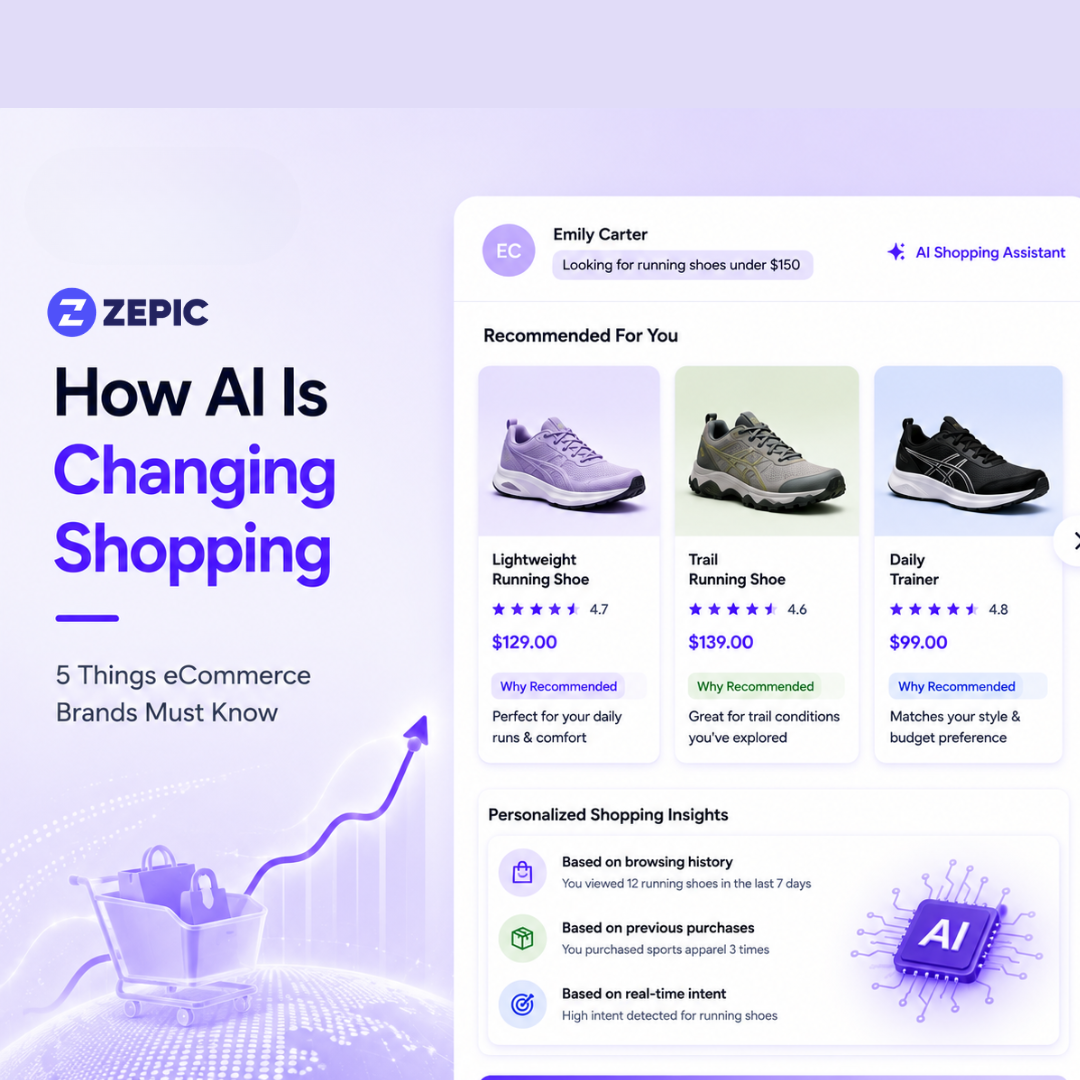
Today’s AI uses predictive modeling to become genuinely helpful, shifting the dynamic from reactive stalking to proactive curation. By analyzing purchase cadence, browsing behavior, and zero-party data (the information a customer willingly shares with you), AI knows exactly when a shopper is about to run out of their favorite espresso beans or when they might need to size up their toddler’s winter boots.
If your AI can predict a need before the customer even realizes they have it, you lock in long-term loyalty. Stop blasting generic Friday discount codes to your entire list, and start triggering highly contextual messages based on individual buying cycles.
Typing is slowly becoming a secondary input method. The modern shopper sees a stylish navy blue jacket at the airport, snaps a photo on their phone, and lets an AI visual search engine find something near identical in minutes.
Visual search bridges the physical and digital worlds, essentially turning everyday life into a shoppable catalog. Computer vision, image tagging, and AI-powered visual matching analyze the photo and return results that would be practically impossible to surface through a keyword search alone. According to a report by Gartner, brands that redesigned their product pages to support visual and voice search saw up to 30% higher engagement rates. The implication for e-commerce brands is straightforward: your product images aren't just visual assets but searchable data points.
Then there's voice. Virtual assistants like Amazon Alexa, Google Assistant, and Apple's Siri use Natural Language Processing (NLP) to understand customer commands, recommend products, and in many cases, complete purchases entirely hands-free. Voice queries are longer, more conversational, and usually loaded with intent. Nobody talks to their smart speaker the way they type into a search bar. "Hey Alexa, find me a waterproof running jacket under $80 with good reviews" is a fundamentally different query than "waterproof jacket."
The brands optimizing only for traditional keyword search are quietly bleeding discovery traffic to competitors who've thought further ahead. Audit your product content for conversational relevance. Make sure your descriptions actually answer real questions shoppers ask out loud.
AI-powered support tools now resolve the vast majority of common inquiries autonomously without a ticket queue in sight.
Statistics show that nearly 80% of customers won’t buy from a brand if their post-purchase experience is bad. For too long, customer support in e-commerce has been treated as damage control, but AI has flipped this entirely. When customer support is fast, proactive, and genuinely helpful, it starts driving repeat purchases, higher lifetime value, and word-of-mouth that no ad budget can buy.
Today's AI customer service agents don't just hand out links to static FAQ pages and bid you farewell. They are deeply integrated with your inventory and order management systems. If a customer sends a message at 2 AM asking where their order is, the AI pulls live tracking data, provides a real-time update, and might even offer a discount. This shift from reactive to proactive support is where the real money is.
Treat your post-purchase experience as seriously as your acquisition funnel. Map out every touchpoint after the order confirmation email and ask yourself, honestly, whether a customer who hits a snag at any of those points would come back. If the answer is uncertain, that's where AI-powered support belongs.
Shoppers want the path of least resistance. Redirecting a customer from an Instagram ad, to a mobile browser, product page, cart, or a payment gateway is a notoriously leaky funnel. Every extra click, every slow page load, is an open invitation for cart abandonment.
In 2026, AI is bringing the checkout counter directly into the chat window.
Whether it's WhatsApp, Apple Messages, or Instagram DMs, AI-driven conversational commerce allows shoppers to browse catalogs, ask hyper-specific questions about sizing, and finalize their payments without ever leaving their messaging app. It's the digital equivalent of a knowledgeable shop assistant handing you the item and swiping your card right there in the aisle.
If your brand is still forcing mobile shoppers through a clunky, multi-page checkout maze, you are losing out to competitors who have collapsed the entire buying journey into a single text thread. The modern consumer expects to buy a pair of sneakers as easily as they text a friend.
Taken together, these five shifts point to the same conclusion. AI in e-commerce is no longer a competitive differentiator you can quietly defer to next quarter's roadmap. It's the operating layer that separates brands that are growing from brands that are slowly becoming irrelevant.
The good news is that you don't need to overhaul everything at once. Start where your data is cleanest. Build unified customer profiles. Automate what's repetitive and time-consuming. Layer intelligence onto the channels where your customers already spend their time. Better data leads to smarter personalization, which drives higher retention, which funds better inventory planning, and so on.
Every click, cart, conversation, and complaint is a data point. The brands treating them that way, and building the infrastructure to act on them intelligently, are the ones defining what e-commerce looks like next.
At ZEPIC, we help e-commerce brands unify their customer data and activate it across every channel, so AI-powered experiences move from aspiration to execution. If you're ready to stop patching gaps and start building something that scales, book a demo with our team and let's get to work.

%201.png)


.png)